 FMASWorkshop
#FMAS2026 will take place in Southampton, UK, on 17–18 November 2026, co-located with ICFEM 2026.
Join us for two days on formal methods for autonomous systems.

#FMAS2026 will take place in Southampton, UK, on 17–18 November 2026, co-located with ICFEM 2026.
Join us for two days on formal methods for autonomous systems.
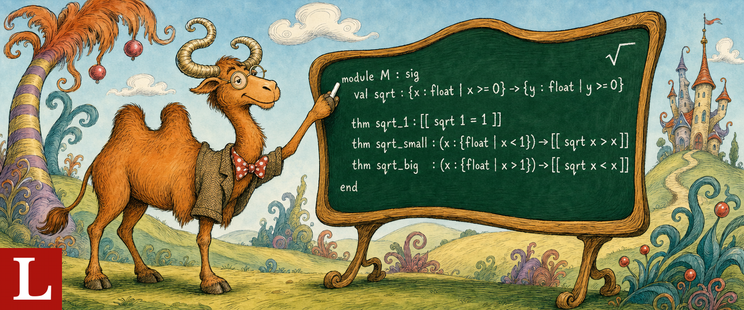
Jane Street gets into formal methods: https://blog.janestreet.com/formal-methods-at-jane-street-index/
Do you have colleagues working on formal methods, autonomous systems, robotics, cyber-physical systems, verification, safety assurance, or runtime verification?
Please let them know about #FMAS2026!
Do you want to use functional programming to find new ways to develop, test and formally verify software or hardware? Come and work with us! [Patrik Jansson, Koen Claessen, Mary Sheeran]
We are announcing two ProgLang PostDoc positions in the FP group at Chalmers. The underlying projects funding them are flexible, meaning we can tailor the exact research to your unique strengths.
We are looking for people who want to bridge mathematical foundations and practical software development using tools like #Haskell and #Agda. Whether your expertise lies in building #DSLs, property-based testing, or interactive theorem proving, Chalmers provides the ideal environment for research on programming with formal guarantees — a topic of increasing practical importance.
Some of my recent work, which could be nice to connect to, is posted here: https://patrikja.owlstown.net/posts
Deadline: 2026-08-15. Please apply, or boost to spread the ad to your networks!
https://www.chalmers.se/en/about-chalmers/work-with-us/vacancies/?rmpage=job&rmjob=14954&rmlang=UK
#FunctionalProgramming #FormalMethods #PostDoc #AcademicJobs #TypeTheory #ComputerScience
Happy to announce another confirmed talk for the #FPIndia #Bangalore June #meetup!
Srijan will talk about Formalising #MachineLearning for Functional Languages!
https://hasgeek.com/fpindia/bangalore-fp-june-2026-meetup/
#Haskell #PureScript #Typescript #Rust #Erlang #Scala #OCaml #FormalMethods #AI
Formal Methods and the Future of Programming
https://blog.janestreet.com/formal-methods-at-jane-street-index/?from_theconsensus=1
#HackerNews #FormalMethods #FutureOfProgramming #ProgrammingTechniques #SoftwareDevelopment #JaneStreet
*sigh* sitting on a nice short conference paper that would either fit at RV (Ontario) or SEFM (Malta). Trying to find a justification for RV which is maybe slightly more relevant, but further away…Originally I wanted to submit two short papers, but the full data for the second didn’t materialise in time, *double sigh*.
Formal methods and the future of programming
https://blog.janestreet.com/formal-methods-at-jane-street-index
 Colin Rowat

 Patrik Jansson
 Anupam 🇮🇳《ミ》λ≡
 Functional Programming India
 Hacker News
 Volker Stolz🏳️🌈
 Lobsters
 Lobsters