@dpat @effigies I'm traveling so just looking on the phone, and can't cross-check our #fMRIPrep versions yet. But a few thoughts anyway:
- are these CMRR multiband sequences? If so, have you checked the SBRef images as well as the fmaps?
- We're collecting an #fMRI dataset with 3mm iso voxels, CMRR MB4, and haven't had trouble
- are all the person's runs in a session distorted, or just some? If some, compare the fmaps, etc between good and bad runs.

Good luck!

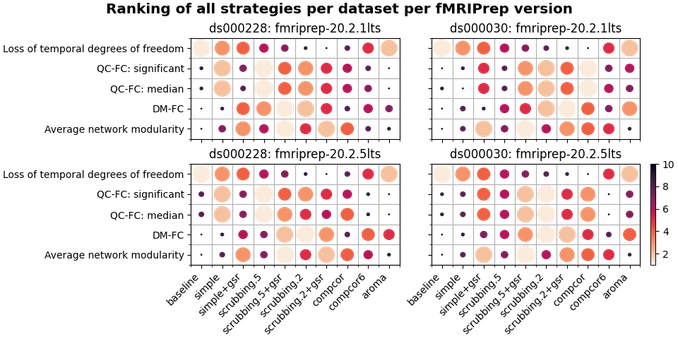
We apply this reproducible benchmark to investigate the robustness of the conclusions across two #OpenNeuro datasets and two LTS versions of #fMRIPrep.
We created a fully reproducible denoising benchmark featuring a range of denoising strategies and evaluation metrics for connectivity analyses based on the classic paper Ciric 2017, built on the #fMRIPrep and @nilearn software packages.
We love #fmriprep, but the confound documentation is a bit long and difficult to navigate. It’s not a trivial job to get the right regressors implemented in the benchmarks done on non-fMRIPrep workflow.
Our work β€œA reproducible benchmark of resting-state #fMRI denoising strategies using #fMRIPrep and @nilearn is now officially on the reproducible preprint service #NeuroLibre and @biorxivpreprint πŸŽ‰
https://neurolibre.org/papers/10.55458/neurolibre.00012
A reproducible benchmark of resting-state fMRI denoising strategies using fMRIPrep and Nilearn

Wang et al., (2023). A reproducible benchmark of resting-state fMRI denoising strategies using fMRIPrep and Nilearn. NeuroLibre Reproducible Preprints, 12, https://doi.org/10.55458/neurolibre.00012

NeuroLibre

@afni_pt @dixy0 @oesteban @DanHandwerker And many of us will be at an #OHBM course devoted to the fMRI Open QC project; please join in the discussion!

#fMRI #fMRIPrep #QC #neuroimaging

@JosetAEtzel #fMRIPrep #mriqc Cool, hadn’t seen this yet! Saren got her PhD here at the U of A. I look forward to reading this.

New #fMRIPrep release up on PyPI and DockerHub: 23.0.0

This is an incremental release, with new morphometric derivatives, T2w derivatives aligned to the subject space, and fixes for a couple classes of SDC bugs.

https://github.com/nipreps/fmriprep/releases/tag/23.0.0

#fmri #neuroimaging #openscience

Release 23.0.0 Β· nipreps/fmriprep

Release Notes New feature release in the 23.0.x series. This release adds improvements for workflows targeting the fsLR grayordinate space. Namely, morphometric (curvature, sulcal depth and cortica...

GitHub
Thanks so much, @RemiGau, for putting this together, and in general for contributing to #DeepMReye in the past months! It is such a useful extension and will make it easier to run it on #fMRIprep outputs etc. for many people.

#DeepMReye now has a wrapper for #BIDS data! https://pypi.org/project/bidsmreye/

This is great for example to decode gaze position in #fMRI datasets processed with #fMRIprep

Thank you @RemiGau for this amazing contribution to our package! w/@CYHSM
---
RT @NauMatt
#DeepMReye is out!
Use #deeplearning to perform #eyetracking in #fMRI without camera! https://www.nature.com/articles/s41593-021-00947-w

@cyhsm & I are thrilled to finally sha…
https://twitter.com/NauMatt/status/1457742155859038217

bidsmreye

bids app using deepMReye to decode eye motion for fMRI time series data

PyPI