 Kara Finance
 GeekProjects News
Squid-Con Brings Joy To All https://hackaday.com/2023/08/24/squid-con-brings-joy-to-all/ #handheldshacks #NintendoSwitch #accessibility #flexures #joy-cons #flexure #joy-con #Games

 hackaday unofficial
Fabulous Flexure Mechanism Makes for Resetting Cat Calendar
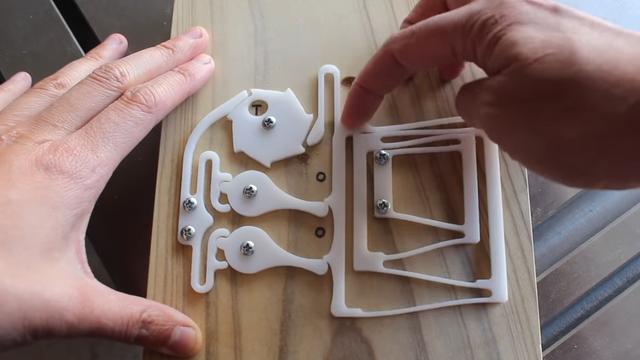
When we met [Amy Makes Stuff] at the 2019 Hackaday Superconference, we were immediately impressed with the array of flexure mechanisms displayed on a board hanging around her neck. That must be where we saw [Amy]'s original version of the cat calendar -- a simple way to know for sure whether the shared house's cat has been fed once, twice, or not at all on a given day.
Left: a simple flexure that gets heavily stressed when actuated. Right: a slightly more complicated flexure that uses less force.
Awesome as it is, the flexure mechanism doesn't reset the yes/no indicators when the day clicks over -- that has to be done manually. So when [Amy] was offered to try a small desktop CNC, she decided it was time to make a new version that resets automatically. Check it out in the video after the break, which also includes an exploration of [Amy]'s choice of flexure design as well as a bonus review of the CNC.
This is just an all-around great video, especially after [Amy] neglected to mill out the check marks and circles, sending her down a rabbit hole of attempting to make branding bits for these that could be chucked into a soldering iron. Unfortunately, the mill stops short of having the necessary mettle for milling metal.
Although [Amy] is likely known for her flexures, she has a ton of skills. Remember when she resurrected that burned and bubbled laser cutter? Or the time she machined a honing jig for hand-sharpening chisels and planes?

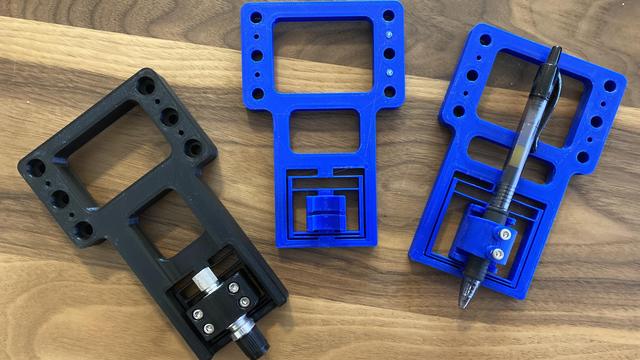
Game developer and eternal learner [David Tucker] just posted a project where he's making linear flexures on a 3D printer. Tinkerer [Tucker] wanted something that would be rigid in five of the six degrees of freedom, but would provide linear motion along one axis. In this case, it is for a pen or knife on a CNC flatbed device. [David]'s design combines the properties of a 1-dimensional flexure and a spring to give a constant downward force. Not only is this an interesting build in and of itself, but he gives a good explanation and examples of more traditional flexible constructs. He also points out this site by MIT Precision Compliant Systems Lab engineer [Marcel Thomas] which provides a wealth of information on flexures.
[David]'s experiments showed that leaf-spring-like segments with a thickness of 0.4 mm provided the desired amount of force. We're not sure how many iterations were required to arrive at this number -- perhaps those mechanically inclined readers can offer up equations to predict the spring force ahead of time for a particular geometry. Even though printing springs of a precise force may be trial and error, at least 3D printers are good at making precise and repeatable thin-walled structures. Also note that since the spring force only needs to act in one direction, pushing into the paper or other working material, the spring design is asymmetric.
This approach is basically a living hinge of sorts, so there could be some longevity issues. On the other hand, yours truly has a small Tupperware pocket stamp container that's well over 20 years old whose living hinge has yet to fail, so maybe they aren't such a bad thing if done right. We wrote about 3D printing of living springs before. Our writeup last year on the Martian helicopter Ingenuity has a good picture of flexures, metal not plastic, which are integrated into its landing gear / legs. Do you have any project which have used flexures like this?