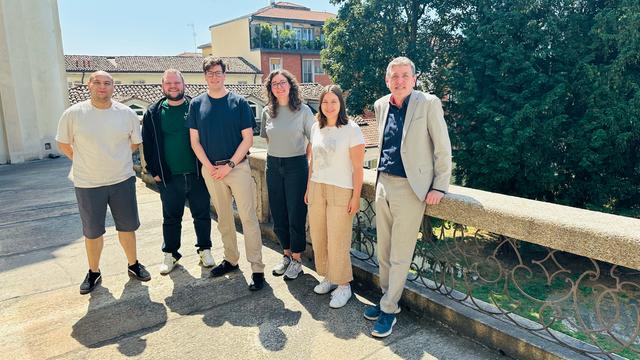
๐Ÿ‘‹๐Ÿ‡ฎ๐Ÿ‡น Weโ€™re back from the ECCOMAS Advanced Course NL26 on Nonlinear Computational Solid & Structural Mechanics in Pavia.

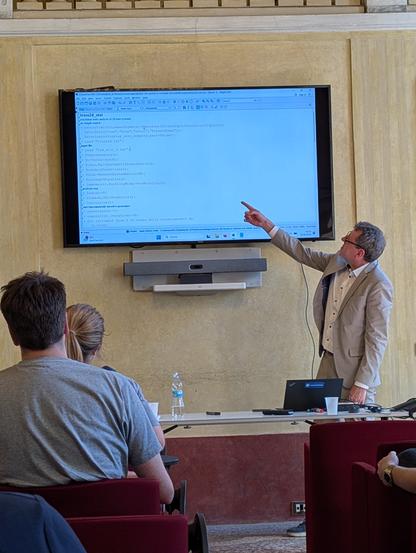
๐Ÿ“š๐Ÿ‘จโ€๐Ÿซ๐Ÿ’ปThe week offered an intensive and well-structured deep dive into numerical techniques, solution algorithms, and finite element approaches for nonlinear solid and structural mechanics. Across lectures and tutorial sessions, the course created a strong setting for discussing both fundamental concepts and current research directions in nonlinear computational mechanics.
๐Ÿ‘จโ€๐Ÿ‘ฉโ€๐Ÿ‘ฆโ€๐Ÿ‘ฆ Our institute was represented by Manfred Bischoff as one of the lecturers, and by several of our doctoral researchers who attended the course as participants.

๐Ÿ™ Many thanks to Ferdinando Auricchio, Manfred Bischoff, Carlo Lovadina, Guillermo Lorenzo Gรณmez, Robert L. Taylor, and Peter Wriggers for the excellent programme and for sharing their expertise.
It was a valuable week of learning, discussion, and scientific exchange in Pavia.
#ECCOMAS #ComputationalMechanics #FiniteElements

In #FElupe, a #python package of mine, I changed the API of a function: the output included two return variables (boundaries, loadcase), where the second one is nowadays mostly unused. So I added a new argument return_loadcase=None, which does not change the return behavior, but marked as deprecated. In a future major version, return_loadcase will be False by default. Now all users have at least one major version time to update existing scripts. Is this good practise or could this be improved?

#opensource #computationalmechanics #scientificcomputing #coding #finiteelements

Our most recent paper on #SPH / #FEM coupling for offshore structures modeling with #GPUSPH has been published:

https://authors.elsevier.com/c/1m3VB_hNWk2tT

These kinds of works, with validation against experimental results, is always a challenging task, even for the simpler problems. Lab experiments and numerical simulations have each their own set of problems that need to be addressed, and the people working on the two sides of the fence often have a very different perspective on what should be considered trivial and not worth measuring, and what is instead crucial to the success of the experiment.

Getting these two sides to talk to each other successfully is no walk in the park, and I wish to extend my deepest gratitude to Vito Zago, who has gone to incredible lengths both during the โ€œscience makingโ€ to make things work out, and during the manuscript submission and review process, a nearly Sisyphean task in itself.

#SmoothedParticleHydrodynamics #FiniteElements #FiniteElementMethods

What do you think, which #logo is better? It's for an open source FEA #python package.

Logo A (round) or B (square with rounded corners)? Here's the poll: https://mathstodon.xyz/@adtzlr/115153260402286236

#scientificcomputing #computationalmechanics #finiteelements #design

After a summerbreak, #FElupe development continues! Stay tuned for lots of handy new features: checkpoint/restore, revolve a.k.a. axi-to-3d, simplified handling of multiple solid bodies, etc. These new features are already available in the main git branch and will be released soon.

https://felupe.readthedocs.io/en/latest/

P.S. I'm always open for new ideas, just let me know!

#computationalmechanics #scientificcomputing #python #opensource #fem #fea #finiteelements

FElupe documentation โ€” FElupe

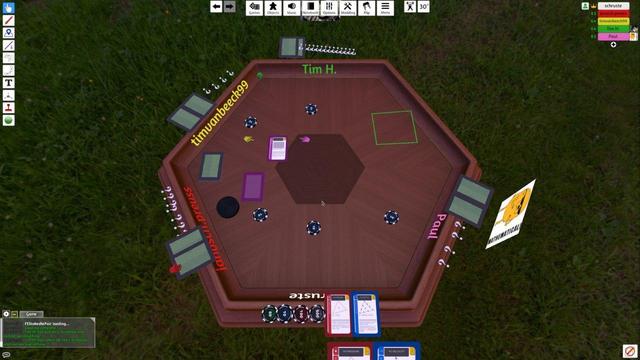
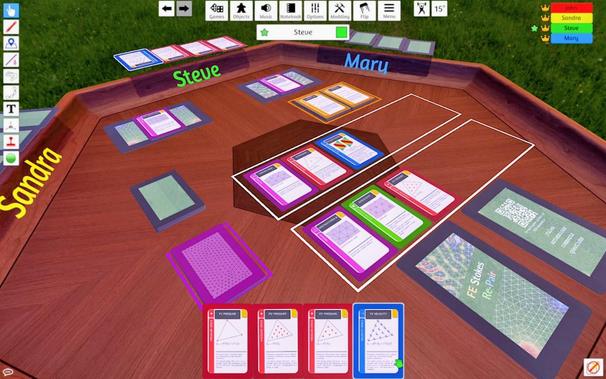
Yesterday, we had our FEStokes-RePair game night.
It was fun. We experimented with the FEStokes-Repair Validator app and we even developed a Poker version of the game. #gameon #festokesrepair #FiniteElements

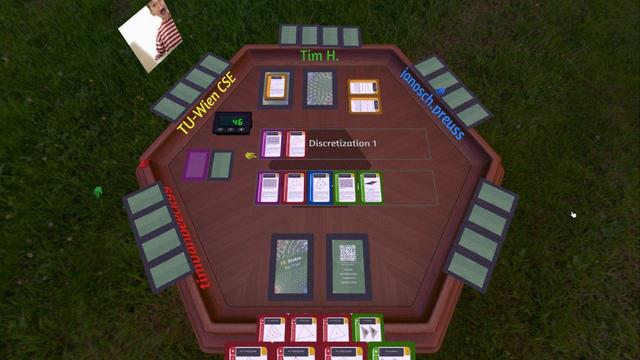
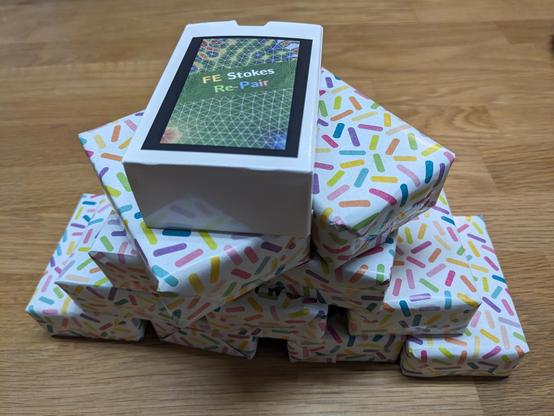
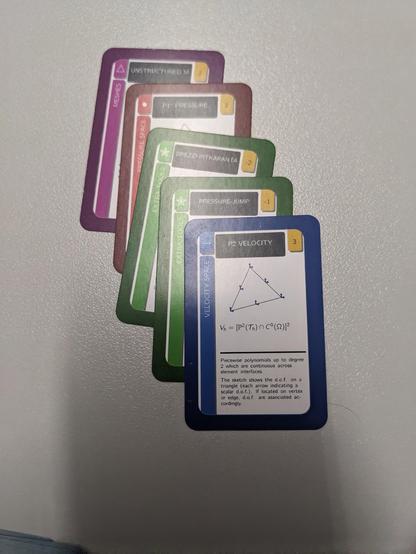
โœจ A small dream came true last year: In the past year, we developed our very own (nerd) card game: FEStokes-RePair! ๐ŸŽ‰๐Ÿƒ

The game uses the finite element discretization of the Stokes equations as a metaphor.

For details see here: https://fe-nerd-games.github.io/FEStokesRePair/ (and the following thread)

#NumericalAnalysis
#MathGames
#EducationalGames
#FiniteElements
#FEStokes-RePair

FE Stokes Re-Pair

In my Python FEA package FElupe I've noticed that the time spent on assembling (especially large) finite element matrices takes longer than in recent releases. The slowdown is about 15% to 100%, depending on the number of degrees of freedom. From a computational-cost point of view, there are some cheap arrays stored inside a numeric region. A somewhat massive einsum-call further evaluates the values for the sparse finite element matrix. Due to some recent code changes, these cheap region arrays aren't contiguous anymore. That slows down the finite element matrix assembly up to 100%! By ensuring C-contiguous arrays, performance is back to normal (NumPy array flags are available as attribute ndarray.flags).

https://github.com/adtzlr/felupe

#python #numpy #FiniteElementMethod #finiteelements #fem #fea #scientificcomputing #computationalmechanics

GitHub - adtzlr/felupe: :mag: finite element analysis for continuum mechanics of solid bodies

:mag: finite element analysis for continuum mechanics of solid bodies - adtzlr/felupe

GitHub

FElupe ๐Ÿ” now has visual previews for the schemes of most numeric regions (finite element formulation + quadrature rule) in its HTML API docs - thanks to PyVista. There are also a lot of helpful static and interactive plots in other sections of the docs too. Go check it out!

Simulating the nonlinear deformation of hyperelastic structures has never been easier in a few lines of Python code.

https://felupe.readthedocs.io/

#fea #fem #scientificcomputing #computationalmechanics #FiniteElementMethod #finiteelements #python #plot

FElupe documentation โ€” FElupe

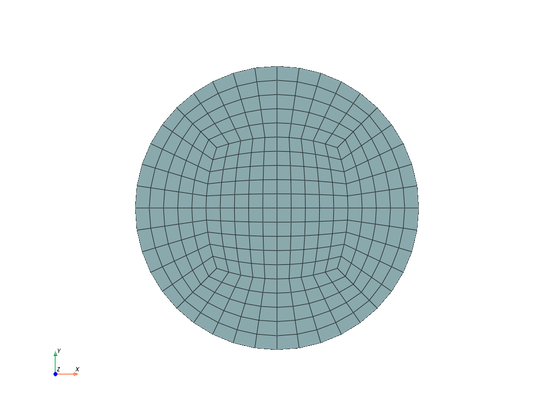
FElupe - A Python package for Finite Element Analysis, Version 7.8.0 is available on PyPI. Now with mesh-generators for the elementary shapes line, rectangle, cube, triangle and circle.

https://github.com/adtzlr/felupe

#computationalmechanics #scientificcomputing #python #opensource #finiteelements #fea #pde

GitHub - adtzlr/felupe: :mag: finite element analysis for continuum mechanics of solid bodies

:mag: finite element analysis for continuum mechanics of solid bodies - adtzlr/felupe

GitHub