It´s the last day of the WCRP Open Science Conference in Kigali.

🎥 Our director Bjorn Stevens held a talk on "How climate change is transforming climate modeling". Missed it? Here is a link to watch a recording of it: https://owncloud.gwdg.de/index.php/s/h0VEGSzc8XgRuFG

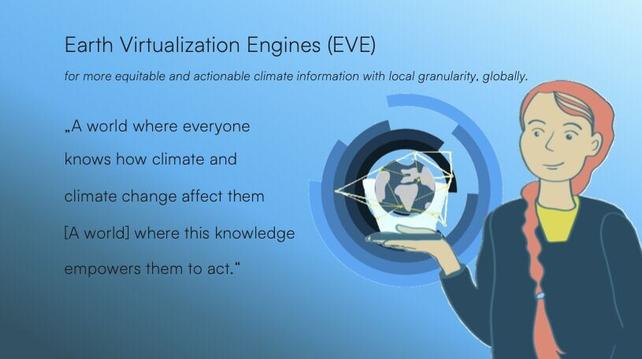
🌍 Learn more about the vision for EVE (Earth Virtualization Engines), an international collaboration to tap our technical capacity so that everyone knows how #climate and #ClimateChange affects them.

#wcrposc23 #Eve4Climate

ownCloud - Your Cloud, Your Data, Your Way!

2023-10-25-wcrp-kigali-final.m4v is publicly shared

ownCloud

Summit Statement from the “Berlin Summit for EVE”: an impassioned call for international cooperation to advance science and technology so that “Everyone knows how #climate and #ClimateChange affect them, and where this knowledge empowers them to act”.

It succinctly outlines how inadequacies and injustices in how climate information is developed and shared is leaving lives and livelihoods unnecessarily vulnerable to climate change: https://mpimet.mpg.de/en/communication/news/berlin-summit-for-eve-summit-statement #Eve4Climate #WarmWorld

Berlin Summit for EVE — Summit Statement

The summary statement of the Berlin Summit for Earth Virtualization Engines (EVE) issues an impassioned call for international cooperation to advance science and technology so that “Everyone knows how climate and climate change affect them, and where this knowledge empowers them to act”. The Summit Statement, developed and signed by the summit’s participants, succinctly outlines how inadequacies and injustices in how climate information is developed and shared is leaving lives and livelihoods unnecessarily vulnerable to climate change.

Day 3 of #eve4climate: we tried to refine the vision and mission statements for EVE. We addressed scope, core values, key beneficaries, and delivery partners.

There will be a synthesis of the discussion, so I wont pre-empt that, but I there was more consensus than I expected around the vision, and I am hopeful that the core offering will be complementary to, and not in competition with, the rest of climate science. That wasn’t a given at the beginning of the week.

The final day2 #eve4climate talk was from CERN about how CERN was established & their governance.

I was inspired enough to go look at the actual CERN convention (https://council.web.cern.ch/en/content/convention-establishment-european-organization-nuclear-research), which very tightly defines what CERN is for (check out article 2, “purpose").

The challenge for tomorrow will be to see if we can define the purpose of an “EVE” in such a way that it is a) deliverable, and b) distinct and complementary to (as opposed to "in competition with") the rest of climate science!

6/6

Convention for the Establishment of a European Organization for Nuclear Research | CERN Council

There was a change of pace in the afternoon of day 2 of #eve4climate.

There were two talks on observations (from space and on european research infrastructures), followed by some observations and lessons for EVE from DestinE, which were basically that we have underestimated the power of

1. Machine Learning: ML may well be the saviour of Digital Twins &
2. Industry: Big Tech companies may well be the saviours of the big tech tasks neeed for future climate.

(Are those controversial?)

5/n

The final talk in the morning #eve4climate was from Adam Sobel. His summary was succinct:

1) We need global, public tools, data & understanding to assess climate risks.
2) Climate adaptation finance is inhibited by the absence of such data, tools and understanding.
3) EVE has the potential to change this, by setting new standards.

His bottom line: if we make data widely available, there is a lot of scrutiny, and that leads to trust (even with known issues, they are at least known!)

4/n

The elsberg paradox is that people's decisions are inconsistent with expected utility theory. "It is generally taken to be evidence of ambiguity aversion, in which a person tends to prefer choices with quantifiable risks over those with unknown, incalculable risks.” (Wikipedia)

Of course that’s the situation we’re in with climate, people like to calculate risks with known imperfect models … and ignore the tail risks because we can’t get at them with our current models.

#eve4climate 3/n

That was from a talk by Peteri Taalas, the secretary general of the WMO, which was from the same #eve4climate session - where we also had a talk on the influence of climate (and human) change on the Amazon.

The next session jumped a bit towards commercial activities, where we learnt a lot about what Tencent (https://www.tencent.com) are up to, as well as how the reinsurance industry works. I copied lots of slides, but the one that resonated was the one on the Elsberg Paradox …

2/n

Tencent 腾讯

腾讯于1998年11月成立,是一家互联网公司,通过技术丰富互联网用户的生活,助力企业数字化升级。我们的使命是“用户为本 科技向善”。Founded in 1998, Tencent is an Internet-based platform company using technology to enrich the lives of Internet users and assist the digital upgrade of enterprises. Our mission is "Value for Users, Tech for Good".

Day 2 at #eve4climate was a bit more of a smorgasbord

Yi Wang gave an interesting talk on the storyline and driving force for climate negotiations from the Chinese perspective. Lots of facts and figures on various aspects of the green transition.

I was struck by this slide which shows the position of climate related risk to the global economy (#2, 4 and 7 on the 2-year timeframe and #1,2 and 3 on the 10-year timeframe). 1/n

One more bonus from yesterday’s #eve4climate and Deborah Coen’s talk:

I’d never heard of Karl Kreil - an Austrian meteorologist (1789-1862) but apparently he said this:

"Everywhere there is a macrocosm and a microcosm, a world on the large scale and on the small - the latter just as important, often more important than the former”

Right up there with Lewis Fry Richardson and his “Big whirls … little whirls … and so to viscosity!"