 WPS News
When the Economy Stops
Why General Strikes Work and What Minnesota Is Showing the Country
By Cliff Potts, CSO, and Editor-in-Chief of WPS News
Baybay City, Leyte, Philippines — April 2026
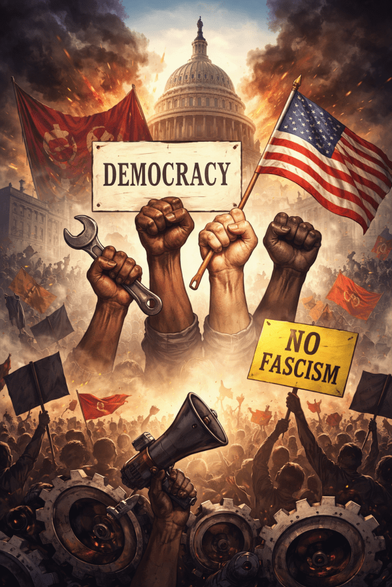
April is when things begin to move again. The weather shifts. The ground softens. People pay attention. That seasonal change is a useful metaphor for political reality in the United States right now, because what is beginning to reemerge—quietly, unevenly, but unmistakably—is the most effective democratic pressure tool working people possess: the general strike.
A general strike is not chaos. It is not violence. It is not revolution by force. It is the organized, collective withdrawal of labor and consumption to demonstrate a simple truth that propaganda works very hard to hide: power does not originate in ideology. It originates in participation.
What recent labor action in Minnesota is demonstrating is not radical theory. It is basic economics. When people stop working, stop buying, and stop complying, systems that depend on continuous extraction begin to fail—quickly.
Economic Power Is the Only Language Authoritarianism Understands
Authoritarian movements are remarkably tolerant of dissent they can ignore. They are far less tolerant of disruption they cannot absorb.
Protests can be contained. Rhetoric can be dismissed. Elections can be undermined. But sustained economic disruption strikes at the one thing that authoritarian-aligned systems depend on: predictable profit and uninterrupted cash flow.
A general strike does not ask permission. It does not require sympathetic media coverage. It does not rely on winning arguments. It changes the cost-benefit calculation by making continued abuse of power economically unsustainable.
This is why general strikes have historically produced results across political systems, including those drifting toward authoritarian control.
Minnesota Matters Because It Breaks the Myth
One of the most persistent myths in American political culture is that large-scale labor action cannot work in the modern United States. Another is that such action is impossible outside a handful of progressive enclaves.
Minnesota punctures both myths.
What matters is not ideological purity. What matters is coordination, discipline, and clarity of purpose. Workers do not need to agree on everything. They need to agree on one thing: that participation is voluntary, and exploitation depends on their continued compliance.
This lesson is transferable. It applies in blue states and red states alike. It applies in urban centers and rural communities. And yes, it applies in the South, where generations of propaganda have worked hard to convince people that collective economic action is somehow alien, dangerous, or un-American.
It is not.
Propaganda Is the Primary Obstacle, Not Education
There is a convenient fiction that resistance fails because people do not understand what is happening. That fiction is comforting, but it is false.
It does not require a college degree—or even a high school diploma—to understand that concentrated power corrupts when left unchecked. It does not require advanced theory to recognize that rules applied selectively are not rules at all. It does not take specialized knowledge to see that an economy built on fear, precarity, and obedience benefits a narrow class at everyone else’s expense.
What prevents action is not ignorance. It is saturation.
For decades, Americans—particularly in conservative regions—have been immersed in a propaganda ecosystem designed to equate obedience with patriotism and exploitation with inevitability. The message is simple and relentless: there is no alternative, and resistance will only make things worse.
General strikes disprove that lie by demonstration rather than debate.
Shutting Down Is Not Destruction—It Is Leverage
A general strike does not destroy the economy. It reveals who actually sustains it.
When workers stop, the illusion that markets operate independently of human labor collapses. When consumers stop spending, the fiction that power flows downward evaporates. What remains is a visible dependency chain—and the realization that those at the bottom have always been carrying the weight.
This is why general strikes are treated as existential threats by authoritarian-aligned interests. Not because they are violent, but because they are effective.
Economic pressure works precisely because it is nonviolent, collective, and difficult to delegitimize without exposing the underlying contempt for democratic participation.
This Is a National Question, Not a Regional One
The conditions that make general strikes viable are not unique to Minnesota. They exist everywhere wages have stagnated, costs have risen, rights have eroded, and political systems have become unresponsive.
The belief that certain regions are permanently loyal to authoritarian politics is another propaganda artifact. People comply because they believe they have no choice. When they see others withdraw participation and survive—when they see leverage produce results—that belief weakens.
Change does not begin everywhere at once. It begins somewhere, then spreads.
Discipline Is What Makes It Work
General strikes succeed when they are disciplined, focused, and sustained. They fail when they become symbolic gestures or moral performances.
This is not about venting anger. It is about changing incentives.
That requires planning, mutual support, clear demands, and an understanding that discomfort is not a flaw of the strategy—it is the mechanism. Economic systems respond to pressure, not persuasion.
For readers seeking constructive, nonviolent frameworks for antifascist economic and civic action, additional resources and organizing guidance are available at https://endfascism.xyz.
April Is a Reminder, Not a Promise
“April showers bring May flowers” is usually treated as a cliché, but politically it carries an uncomfortable truth. Disruption precedes growth. Pressure precedes reform. Comfort rarely produces change.
General strikes are not magic. They are tools. But they are among the few tools that remain effective when institutions are captured, norms are ignored, and power is insulated from accountability.
In April 2026, the lesson is no longer theoretical. When people stop participating in their own exploitation, systems built on abuse begin to fail.
That is not radical.
That is how leverage works.
 vaarthahindi
 Daily Times - Latest Pakistan News, World, Business, Sports, Lifestyle
 Kyiv Independent Daily Headlines
 World Tension Watch
 Yonhap Infomax News


