 Internet Archaeology
New article in IA69 by Vince Gaffney and colleagues on the Neolithic pit structure at #Durrington Walls Henge includes new #OSL dates and #sedaDNA environmental studies. Results indicate a cohesive pit structure at a massive scale.

New article in IA69 by Vince Gaffney and colleagues on the Neolithic pit structure at #Durrington Walls Henge includes new #OSL dates and #sedaDNA environmental studies. Results indicate a cohesive pit structure at a massive scale.

In 2020, a series of large features were identified, set within two arc-like structures, to the north and south of Durrington Walls henge (Gaffney et al. 2020). Based on geophysical survey and borehole investigation, combined with the results of previous, commercial fieldwork, 15 features were interpreted as either large pits or probable pits. Five additional features were identified from aerial photography or topographic modelling as being of potential interest. Some of these features, on the 'northern arc', were assessed by their original investigators to be naturally occurring sinkholes (Leivers 2021). Following the interpretation of these features as a single pit alignment, some discussion has taken place relating to the origin and nature of these features and their association with Durrington Walls henge (Ruggles and Chadburn 2024). This debate has taken place without the benefit of the results of more recent research undertaken both in the field and laboratory. In 2021, further investigations were carried out over 'northern arc' features 13D and 16D, as well as over the 'southern arc' features 1A, 2A, 3A, 4A. This work also provided an opportunity to survey anomaly ii at Larkhill, and to revisit 'southern arc' features 5A, 7A and 8A. The latter three had been surveyed and cored in 2019 and identified as pits. New fieldwork also provided the occasion to utilise a wider range of analytical techniques than previously, and the application of novel geochemistry and sedaDNA methods generated sediment stratigraphies and detailed environmental histories for individual pits. The results of geophysical survey and borehole investigations reinforce the overall similarity between those features previously identified as pits or probable pits, as well as those investigated in the recent field campaign. Consequently, with confirmation of pit 16D as a new addition to the 'northern arc', the total of pits/probable pits in the overall series has risen to 16. However, to the west of Durrington Walls, in Larkhill, a magnetometer survey over anomaly ii did not reveal a magnetic response consistent with a large pit-feature, although this area is heavily disturbed by later development and the survey results at this location cannot be regarded as conclusive. Currently, the majority of features identified during the two seasons of work at Durrington continue to be interpreted as corresponding to large pits or modified features which, irrespective of any possible natural origin, emerged during the later Neolithic to form part of a larger, prehistoric pit structure surrounding Durrington Walls.

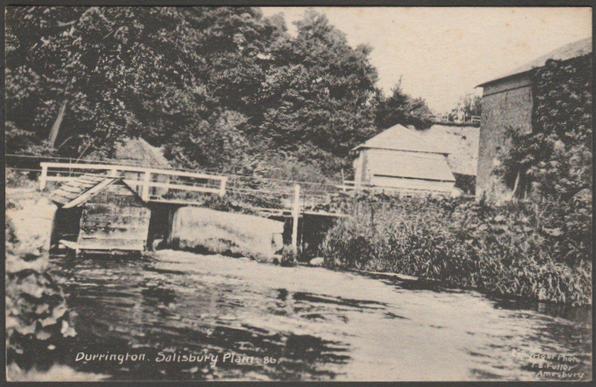
Durrington, Salisbury Plain, Wiltshire, c.1910s - TL Fuller Postcard





 Internet Archaeology
 Derek McMillan
 Cornovia Postcards

 Worthing Community Chest
