 Sarah dreams of beans
Happy #DraculaDay


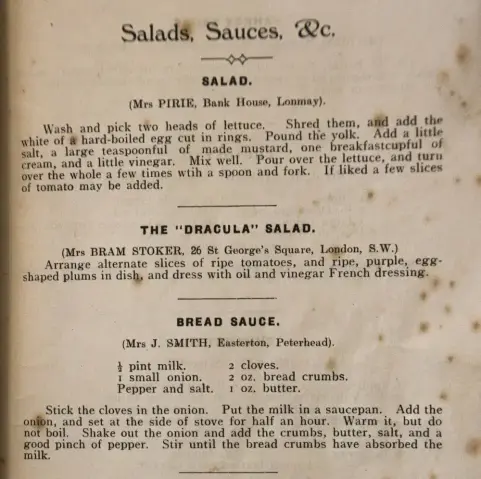
“[Mike] Shepherd… believes the author deliberately pinpointed Cruden Bay, north of Aberdeen—then called Port Erroll, a small fishing village with a sandy beach & a windswept cliff-top fort named Slains Castle—as a retreat where he could concentrate on his writing”
Mrs Bram Stoker’s recipe for “Dracula Salad” – a bit of an oxymoron? – published in CRUDEN RECIPES & WRINKLES (Cruden Parish Church, 1912), & contributed shortly after Bram Stoker’s death. Via Mike Shepherd on Facebook
🧛♂️
https://www.facebook.com/groups/scotlit/posts/10161485849160090/
#Literature #Dracula #recipes #salad #DraculaDay #BramStoker
@jmcrookston The name Dracula means “son of Dracul.” In the Romanian language today, dracul means “the devil”—drac is “devil,” ul is “the”—but it is derived from the Latin dracō, “dragon.” (Dragons have been historically associated with Satan, hence the evolution.)
What comes to your mind when you see or hear the word Dracula? Probably vampires, right? But what about ruthless Romanian royalty … or dragons? It’s time for the story of Dracula—the word. Where does the character Dracula come from? We dress up as vampires on Halloween and watch dramas like True Blood thanks in […]
It's Dracula Day, so I was thinking about vampires and came up with a title for a story, "Requiem for a Vampire". But it turns out, that title has been used already - in one case for the French horror film "Requiem pour un Vampire" (from 1972) and in the other case, for another horror film (from 2006) in English, which has a very low rating on IMDB.
#OTD in 1897. First publication of Bram Stoker’s Dracula. Let's celebrate #DraculaDay!
The novel was mostly written in the 1890s, and Stoker produced over a hundred pages of notes, drawing extensively from folklore and history. He probably found the name "Dracula" in Whitby's public library while on holiday, selecting it because he thought it meant 'devil' in Romanian.
Dracula at PG:
https://www.gutenberg.org/ebooks/345
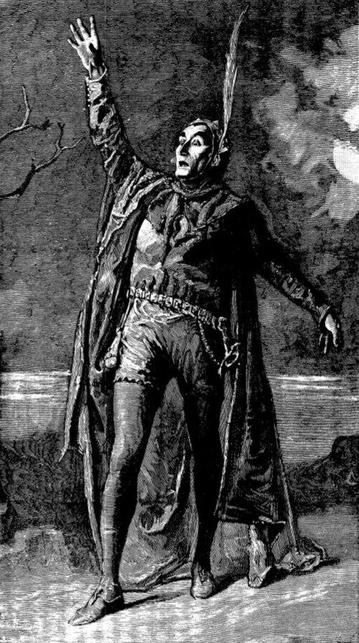
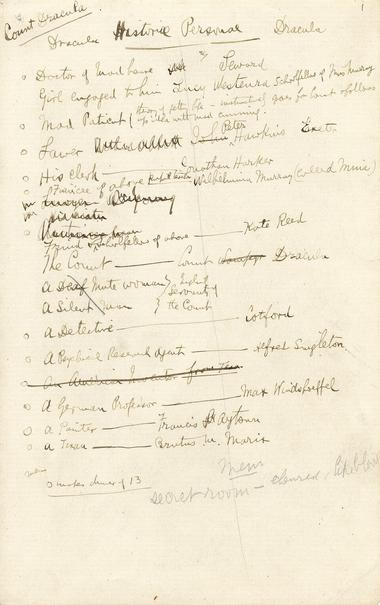
You can download Emily Gerard’s THE LAND BEYOND THE FOREST: Facts, Figures, & Fancies from Transylvania (1888) – the book that helped inspire Bram Stoker to write Dracula – as a free ebook from @gutenberg_org
🧛♂️
3/3
https://www.gutenberg.org/ebooks/57168
#Scottish #literature #Romania #vampire #folklore #anthropology #DraculaDay
“Writing ran in the family. Her younger sister, Dorothea, was also a talented novelist. Her maternal grandfather was the prolific writer & inventor Sir John Robison, & other ancestors were noted philosophical or theological authors”
🧛♂️
2/3
https://blog.historicenvironment.scot/2024/10/emily-gerard/
#Scottish #literature #Romania #vampire #folklore #anthropology #DraculaDay
The Scottish anthropologist who inspired Dracula
“More decidedly evil is the nosferatu, or vampire, in which every Roumanian peasant believes as firmly as he does in heaven or hell…”
—from Emily Gerard’s THE LAND BEYOND THE FOREST: Facts, Figures, & Fancies from Transylvania (1888). Her work was a key part of Bram Stoker’s research materials for Dracula.
Today, 26 May, is Dracula Day 🧛♂️
1/3
https://crimereads.com/the-scottish-anthropologist-who-inspired-dracula/
#Scottish #literature #Romania #vampire #folklore #anthropology #DraculaDay
 Assoc for Scottish Literature
 Project Gutenberg
 Amalia Zeichnerin

