 WPS News
Collapse Is a Team Sport: The “Everyone Turns on Each Other” Lie
Why Survival Depends on Cooperation, Not Individualism
By Cliff Potts, CSO, and Editor-in-Chief of WPS News
Baybay City, Leyte, Philippines — June 1, 2026
The “Everyone Turns on Each Other” Lie
If there is one idea repeated as often as the lone survivor, it is this:
When things fall apart, people become the real danger.
From The Walking Dead to Z Nation, the pattern is familiar. The initial threat—whether zombies, disease, or disaster—quickly fades into the background. The real conflict becomes human. Groups fracture. Trust collapses. Violence becomes the default.
It makes for compelling drama.
It is also one of the most persistent myths about how people actually behave under stress.
The Myth
The myth says that in crisis, social order disappears and human nature reveals itself as selfish, violent, and predatory.
In this view:
- Cooperation is temporary
- Trust is dangerous
- Other people are the primary threat
The logical conclusion is simple: isolate, defend, and assume the worst.
This idea has been repeated so often that many people accept it as fact.
Why People Believe It
Fear drives the belief.
In uncertain situations, people imagine worst-case scenarios. Stories amplify that instinct by showing extreme behavior as normal. Conflict is easier to write than cooperation. Violence is easier to dramatize than coordination.
There is also a deeper cultural narrative at work: the assumption that civilization is a thin layer, easily stripped away.
If that were true, collapse would look like constant conflict.
But that is not what history shows.
Why It Fails in Reality
In real disasters, people do not default to violence.
They default to cooperation.
After major events like Hurricane Katrina and the COVID-19 pandemic, the dominant pattern was not widespread predation. It was people helping each other—sharing resources, organizing assistance, and forming ad hoc support networks.
Yes, there were failures. Yes, there were incidents of crime.
But those were not the defining behavior.
The defining behavior was coordination.
Communities that worked together stabilized faster. Those that fragmented struggled longer.
The idea that everyone immediately turns on each other is not supported by evidence. It is supported by fiction.
What Actually Happens
Under stress, people tend to do three things:
- They seek connection
- They form groups
- They establish informal systems
Neighbors check on neighbors. Strangers organize around shared needs. Information begins to flow. Roles begin to emerge.
This is not idealism. It is adaptive behavior.
Human beings survive by forming networks. In crisis, those networks become more visible, not less.
The Cost of Believing the Myth
Believing that everyone will turn on each other creates its own problem.
It leads to:
- Isolation
- Distrust
- Poor decision-making
- Missed opportunities for cooperation
People who assume hostility often act in ways that produce it. They avoid contact, reject assistance, and treat others as threats.
In doing so, they remove themselves from the very systems that increase their chances of survival.
The myth becomes self-fulfilling.
What Actually Works
Survival depends on selective trust, not universal distrust.
That means:
- Identifying reliable people
- Building small, functional groups
- Sharing information and resources
- Establishing basic norms and expectations
Trust does not have to be absolute. It has to be functional.
Groups do not have to be perfect. They have to work.
The goal is not to eliminate risk. The goal is to reduce it through cooperation.
A Different View of Human Nature
The myth assumes that people are fundamentally destructive under pressure.
Reality shows something more complex.
People are capable of harm.
They are also capable of coordination, empathy, and shared effort.
In crisis, the second set of behaviors is often more useful—and more common—than the first.
Survival favors those who can work with others, not those who assume the worst of everyone.
Practical Takeaway
If you are preparing for disruption, plan for interaction—not isolation.
- Know your neighbors
- Identify skills around you
- Build small, reliable connections before they are needed
- Practice cooperation in normal conditions
Do not wait for a crisis to figure out who you can work with.
By then, it is already harder.
Conclusion
The idea that collapse turns everyone into enemies is powerful because it simplifies a complex reality.
But it is wrong.
People do not survive by turning on each other.
They survive by turning toward each other.
Collapse does not erase cooperation.
It makes it necessary.
Survival begins with cooperation.
For more social commentary, please see Occupy 2.5 at https://Occupy25.com
If you read this and it matters, help me keep it going: https://www.patreon.com/cw/WPSNews
References
Dynes, R. R. (2006). Social Capital: Dealing with Community Emergencies. Homeland Security Affairs.
Federal Emergency Management Agency. (2006). Hurricane Katrina After-Action Report.
World Health Organization. (2020). COVID-19 Situation Reports.
#collapseTheory #cooperationVsIndividualism #disasterResponse #socialResilience #survivalStrategy #WPSNews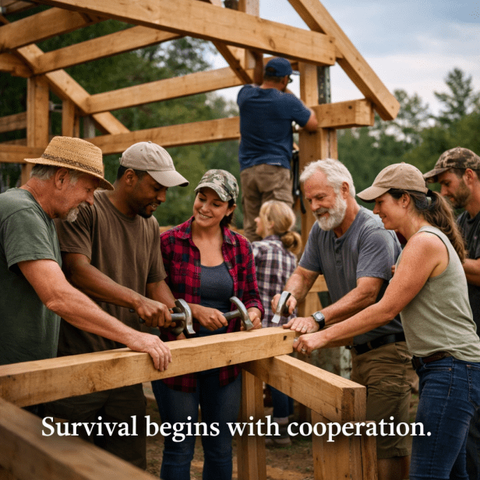
 RAPPLER | Philippine & World News | Investigative Journalism | Data | Civic Engagement | Public Interest [Unofficial]
 Robot Talk
 poVoq
poVoq Maxim Pistos
 RonSupportsYou
 Killer Rabbit 90