When Platforms Adapt to Power

By Cliff Potts, CSO, and Editor-in-Chief of WPS News

Baybay City, Leyte, Philippines — June 18, 2026, 17:35 PHST

Large information platforms frequently describe themselves as neutral intermediaries. They present their systems as technical solutions to problems of scale, relevance, and efficiency. In this framing, political outcomes are treated as externalities rather than design considerations.

That claim collapses when platforms operate across jurisdictions with incompatible legal and ethical standards. When access to markets depends on compliance with state demands, neutrality is no longer a viable position. Adaptation becomes a requirement.

This essay advances a single claim: when information platforms adjust their systems to accommodate state power, they demonstrate that control over information flow is negotiable rather than principled.

Market Access as Leverage

Authoritarian governments do not need to seize platforms to influence them. Market access alone is sufficient leverage. Large populations, expanding consumer bases, and strategic positioning provide incentives that outweigh abstract commitments to openness or free expression.

When access is conditioned on compliance, platforms face a choice: withdraw or adapt. Adaptation may be framed as localization, regulatory alignment, or cultural sensitivity. Functionally, it involves reshaping information systems to conform to external constraints.

This is not a hypothetical dynamic. It is an established pattern.

Engineering for Compliance

Adapting to state requirements often requires technical modification rather than overt censorship. Search results can be filtered. Topics can be suppressed. Terms can be excluded from indexing. Visibility can be selectively reduced without removing content entirely.

These measures are difficult for users to detect. There are no error messages and no explicit prohibitions. Information simply becomes harder to find, then effectively invisible.

The distinction between absence and suppression becomes operationally meaningless.

Internal Systems, External Effects

Once a platform demonstrates the ability to engineer its systems to satisfy political demands, the implications extend beyond any single country. The capability exists regardless of where it is deployed.

Technical architectures do not recognize borders. Tools built to filter or suppress information in one jurisdiction can be repurposed elsewhere with minimal modification. The limiting factor is no longer feasibility, but willingness.

This is a structural risk, not a localized compromise.

Conditional Commitments

Public statements about openness, access, and free expression often coexist with private negotiations over compliance. These positions are not necessarily contradictory from a corporate perspective. Commitments are framed as aspirational, while operations are governed by incentives.

The result is conditional principle. Values apply where they are profitable and recede where they are costly.

For systems that mediate global information flow, conditional principle is indistinguishable from its absence.

The Precedent Problem

Once a platform has demonstrated that it will modify information access to meet state demands, the precedent is established. Other governments observe the outcome. Expectations adjust. Pressure normalizes.

The question shifts from whether accommodation is possible to how far it will extend.

At that point, trust in neutrality becomes unsustainable.

Structural, Not Moral

This analysis does not depend on moral judgment. It does not require attributing intent or malice. It follows directly from incentive alignment and technical capacity.

Platforms that operate at global scale will encounter incompatible demands. Those that choose adaptation over withdrawal reveal the true priority embedded in their systems.

Control over information flow is not absolute, but it is demonstrably negotiable.

This essay will be added to the WPS News monthly briefing or monthly brief available at Amazon.

References

Cook, S. (2020). Censored contagion: How information control is spreading globally. Freedom House.

Deibert, R. (2015). Black code: Surveillance, privacy, and the dark side of the Internet. Signal.

King, G., Pan, J., & Roberts, M. E. (2013). How censorship in China allows government criticism but silences collective expression. American Political Science Review, 107(2), 326–343.

MacKinnon, R. (2012). Consent of the networked: The worldwide struggle for Internet freedom. Basic Books.

#censorshipSystems #digitalInfrastructure #globalPlatforms #informationControl #internetFreedom #platformGovernance #statePower


WHERE OTHERS LOSE CONTROL – WE STAY IN THE LOOP.

At Infinito.Nexus, we believe that AI should never replace human judgment. We are the captains. AI is our navigator. While others hand over responsibility to black-box systems, we stay in control. We design the architecture, review the code, verify every deployment, and make the decisions that shape the future of the systems we build. AI is one of the most powerful tools ever created. But it remains a tool. We are the engineers, architects, and craftsmen who use it to build sovereign digital infrastructure faster, more reliably, and at a scale that was impossible only a few years ago. […]

https://blog.infinito.nexus/blog/2026/06/16/where-others-lose-control-we-stay-in-the-loop/

India-Slovakia Partnership Expands with Focus on AI, Defense and Space Cooperation

India-Slovakia Partnership Expands with Focus on AI, Defense and Space CooperationIntroductionIndia and Slovakia have discussed several areas of cooperation aimed at strengthening bilateral relations. According to available information, both countries emphasized collaboration in technology, defense, space, energy, and workforce development.Strengthening Digital and AI CooperationDigital technology and digital public infrastructure were highlighted as important pillars of future cooperation. […]

https://notetubeorg.wordpress.com/2026/06/15/india-slovakia-partnership-expands-with-focus-on-ai-defense-and-space-cooperation/

India-Slovakia Partnership Expands with Focus on AI, Defense and Space Cooperation

India-Slovakia Partnership Expands with Focus on AI, Defense and Space CooperationIntroductionIndia and Slovakia have discussed several areas of cooperation aimed at strengthening bilateral relatio…

NoteTube

AI Bans Just Got Way More Terrifying: What Happens When They Come For The Platforms You Actually Depend On

So I have been thinking. And the more I think about it, the more I realize that what I wrote about before, as serious as I believe it was and as seriously as I stand behind every word of it, did not go far enough. Because I have had a realization since then that has genuinely unsettled me in a way that I want to share with you. The AI bans are worse than I thought. Not just a little worse. Significantly, fundamentally, potentially catastrophically worse. And the reason comes down to something […]

https://theinterfaithintrepidart.com/2026/06/14/ai-bans-just-got-way-more-terrifying-what-happens-when-they-come-for-the-platforms-you-actually-depend-on/

Web Application Development Services for Modern Business Infrastructure

Create robust digital infrastructures through custom web applications designed to improve operational efficiency and technology scalability.

https://nevinainfotech.com/web-application-development-service

#WebApplicationDevelopmentServices #DigitalInfrastructure #BusinessTechnology #CustomApplications

Africa: African Govts Urged to Dedicate 2 Percent of Annual GDP for Digital Infrastructure Devt: [Ghanaian Times] The Deputy Minister of Education, Dr Clement Abas Apaak, has called on African governments to dedicate up to two percent of their annual GDP to digital infrastructure development. http://newsfeed.facilit8.network/TSz7nh #DigitalInfrastructure #AfricanGovernments #GDP #Education #Development

Ich habe festgestellt, dass moderne Diagnostik, KI und Lieferketten viel enger miteinander verbunden sind, als ich dachte.

Wenn über KI gesprochen wird, reden viele über Modelle. Aber irgendwo dazwischen stehen Fabriken, Stromnetze, Logistik und Menschen. Und erstaunlich oft führt diese Spur irgendwann nach Taiwan.

#AI #Taiwan #SupplyChain #Tech #DigitalInfrastructure #Mastodon

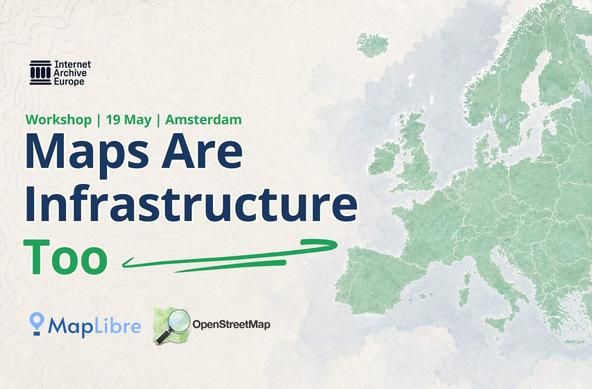
Maps are infrastructure too.

At a recent Internet Archive Europe workshop, we explored how OpenStreetMap and MapLibre are building open, community-governed alternatives to proprietary mapping platforms.

Who decides what stays visible, preserved, and accessible?

https://www.internetarchive.eu/2026/06/08/maps-are-infrastructure-too/

#OpenStreetMap #MapLibre #OpenSource #DigitalInfrastructure

Maps Are Infrastructure Too - Internet Archive Europe

Not all infrastructure looks like a server room. Some of it looks like a map. On 19 May, Internet Archive Europe hosted a workshop at our Amsterdam space with Bart Louwers, one of the core maintainers of MapLibre, and Tommi Marmo, OpenStreetMap contributor. The conversation moved between the technical and the political in a way

Internet Archive Europe - Bringing Collections to Life
Canada's AI Strategy Signals a Shift from Research Leadership to Adoption Leadership

Canada's AI strategy signals a shift from research excellence to adoption leadership. Success will depend not on new discoveries alone, but on whether Canada can turn AI innovation into productivity, commercialization, and economic growth.

Brandon Himpfen
There's still no point in gigabit broadband

Six years ago, I nearly got my ISP to upgrade our fibre connection to 1Gbps. As I said at the time: This is a curmudgeonly post which is going to look ridiculously outdated in a few years. What's the point of Gigabit broadband? Well, it's a few years later and Virgin Media have just given me their Gig1 package for £30 per month. Nice! With all the inflation related price rises, it's great to …

Terence Eden’s Blog