Submission open until 15.10 for
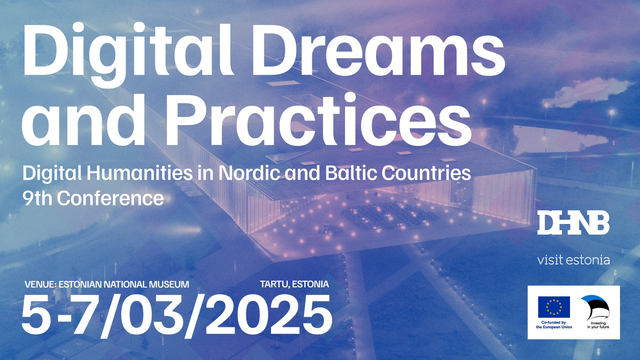
#DHNB2025 Conference "Digital Dreams and Practices", this time held in Tartu, Estonia on 5-7 March 2025
#DH #CUDAN #culturalanalytics #digitalhumanities
Invited topics include but are not limited to:
(1) integration of trad humanities w computational techniques
(2) transition of #DH from the academic "ivory tower" to societal practice;
(3) practical applications of #AI
Submission types: long&short papers, abstracts/posters.
More info here: https://dhnb.eu/conferences/dhnb2025
DHNB 2025 – DHNB

#CulturalAnalytics at its best:

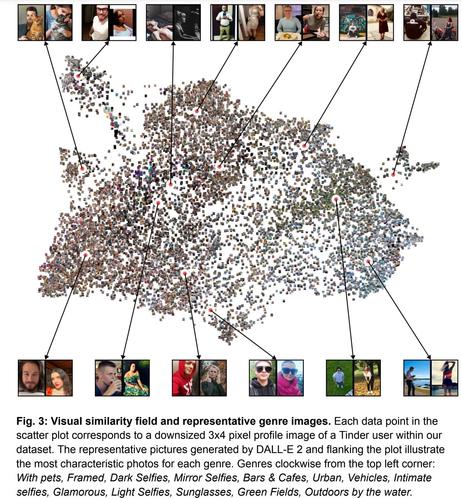
Researchers from Tallinn University have published a groundbreaking study on Tinder's gendered self-representation, employing machine learning to analyze 10,680 profiles. This comprehensive analysis not only identifies key visual self-representation trends but also opens new avenues for cross-platform and cultural research in digital visual culture.
https://osf.io/preprints/socarxiv/m54zy
#MachineLearning #GenderStudies #cudan

OSF

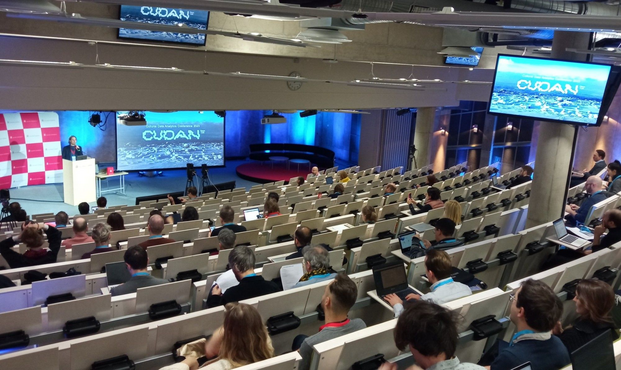
Our #CUDAN2023 Cultural Data Analytics Conference 2023 starting now, with @schichmax opening with a little overview of the field's history. We are streaming the whole thing too! Daily links here: cudan.tlu.ee/conference/
First keynote: Petter Holme on structures and networks in time.
#CUDAN #DH #digitalhumanities #computationalhumanities #CHR #culturalanalytics

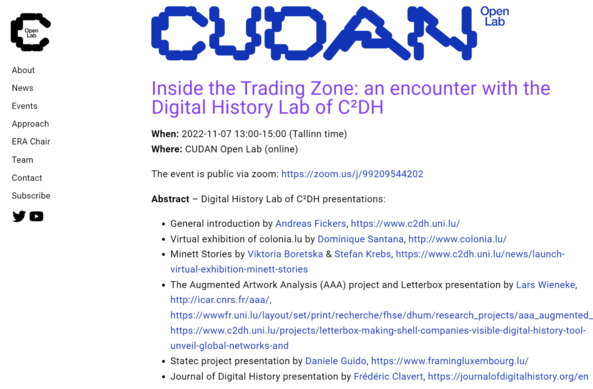
Today at #CUDAN open lab lecture series, we have the Digital History Lab of C²DH over (virtually). It starts today at 11 am UTC. Join us on ZOOM. #digitalhistory #digitalhumanities #datascience #culturaldata

https://cudan.tlu.ee/events/2022-11-07-andreas-fickers-lecture/

At the #CUDAN Lab we hold weekly open seminars on topics in #cultural #data analytics, #digitalhumanities #DH, #computational #humanities etc. Today 2022-11-07 it takes the form of a lab encounter, with Andreas Fickers et al of the Digital History Lab of C²DH. These seminars are always broadcast on zoom and open to everybody! Usually 2PM Tallinn time (1PM CET), but today it's 1PM Tallinn/12 CET.
Details here: https://cudan.tlu.ee/events
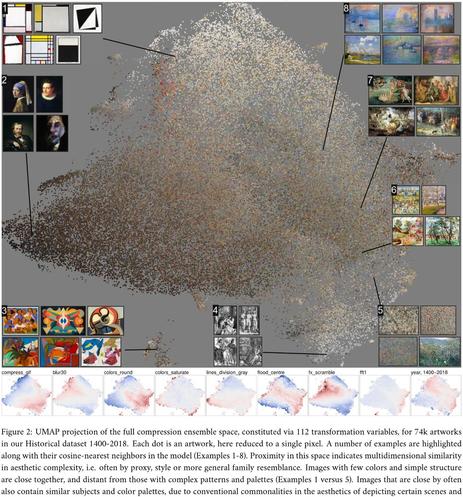
Preprint is out 🎉 Explainable and interpretable embeddings (without Deep Learning!) that encode the aesthetic complexity of visual artworks. Another step towards curatorial possibility spaces of digital collections. @andreskarjus #datascience #culturaldata #CUDAN #arthistory #digitalhumanities
🖼 📈 https://arxiv.org/abs/2205.10271
Compression ensembles quantify aesthetic complexity and the evolution of visual art

The quantification of visual aesthetics and complexity have a long history, the latter previously operationalized via the application of compression algorithms. Here we generalize and extend the compression approach beyond simple complexity measures to quantify algorithmic distance in historical and contemporary visual media. The proposed "ensemble" approach works by compressing a large number of transformed versions of a given input image, resulting in a vector of associated compression ratios. This approach is more efficient than other compression-based algorithmic distances, and is particularly suited for the quantitative analysis of visual artifacts, because human creative processes can be understood as algorithms in the broadest sense. Unlike comparable image embedding methods using machine learning, our approach is fully explainable through the transformations. We demonstrate that the method is cognitively plausible and fit for purpose by evaluating it against human complexity judgments, and on automated detection tasks of authorship and style. We show how the approach can be used to reveal and quantify trends in art historical data, both on the scale of centuries and in rapidly evolving contemporary NFT art markets. We further quantify temporal resemblance to disambiguate artists outside the documented mainstream from those who are deeply embedded in Zeitgeist. Finally, we note that compression ensembles constitute a quantitative representation of the concept of visual family resemblance, as distinct sets of dimensions correspond to shared visual characteristics otherwise hard to pin down. Our approach provides a new perspective for the study of visual art, algorithmic image analysis, and quantitative aesthetics more generally.

arXiv.org