Cortical cooling reveals a role for visual cortex in generating visual responses in auditory cortex (in ferret)
https://www.biorxiv.org/content/10.64898/2026.06.10.731095v1 "Units responsive to sound, light, or combined audiovisual stimuli were found across all sampled auditory fields and cortical depths";
#crossmodal #multisensory #neuroscienceCortical cooling reveals a role for visual cortex in generating visual responses in auditory cortex
Multisensory integration is a fundamental feature of cortical processing, yet the functional pathways that deliver visual signals to the auditory cortex remain poorly understood. While anatomical studies reveal multiple candidate projection routes, demonstrating their causal contribution requires targeted manipulation of neural activity. Here, we used cortical cooling to reversibly inactivate the posteromedial lateral suprasylvian cortex (PMLS) and the adjacent area 21 to determine the functional role of higher-order visual areas in generating visual responses within the auditory cortex of the ferret. Units responsive to sound, light, or combined audiovisual stimuli were found across all sampled auditory fields and cortical depths, with visual responses most prominent within the infragranular layers and the non-tonotopic secondary auditory cortex of the Anterior Ectosylvian Gyrus (AEG). Cortical cooling induced robust, bi-directional, and stimulus-specific modulations of firing rates in AC. Approximately 50% of visually responsive units exhibited a significant decrease or complete elimination of visual activity during cooling, confirming a functional role for visual input from PLMS/area 21 to AC. Surprisingly, cooling also revealed circuit-level complexities: a subset (~5%) of units showed enhanced or newly emergent visual responses during inactivation, suggesting that PMLS/area 21 normally exerts a gating influence over alternative visual pathways. Furthermore, contrary to feedforward anatomical predictions, neurons in the AEG - the region most heavily innervated by the cooled visual areas - were less frequently impacted by cooling than those in PEG. Together, these findings demonstrate that higher visual areas causally shape cross-modal processing in the auditory cortex through a complex mixture of direct excitation and network-level modulation.
### Competing Interest Statement
The authors have declared no competing interest.
Wellcome Trust, https://ror.org/029chgv08, 098418/Z/12/A, BB/H016813/1
European Research Council, https://ror.org/0472cxd90, 771550
Biotechnology and Biological Sciences Research Council, https://ror.org/00cwqg982, BB/H016813/1
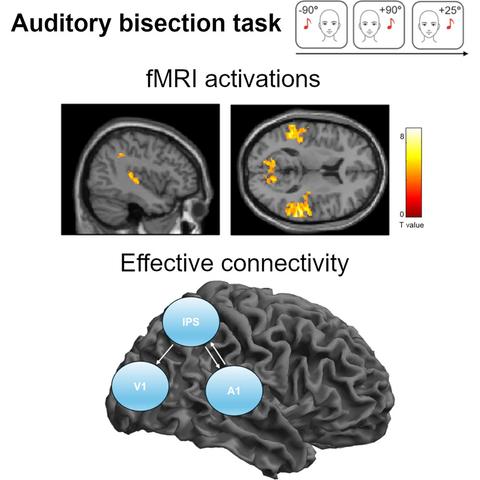
Primary visual cortex BOLD responses to relative localization of sounds at 7T
https://www.cell.com/iscience/fulltext/S2589-0042(26)01450-1 "V1 is activated during a purely acoustic spatial localization task";
#crossmodal #neurosciencePrimary visual cortex BOLD responses to relative localization of sounds at 7T
www.cell.com/iscience/ful... "V1 is activated during a purely acoustic spatial localization task";
#crossmodal #neuroscienceBy linking up visual and auditory processing in the human brain, The vOICe vision BCI can act as both a fully noninvasive visual prosthesis for the totally blind and as a research vehicle for macroscopic neuroscience
https://www.artificialvision.com/neuralink.htm #crossmodal #plasticity #BrainStates
The vOICe vision BCI, or a brain implant?
White paper comparing Neuralink Blindsight and other brain implants with The vOICe vision BCI for the totally blind.
By linking up visual and auditory processing in the human brain, The vOICe vision BCI can act as both a fully noninvasive visual prosthesis for the totally blind and as a research vehicle for macroscopic neuroscience
www.artificialvision.com/neuralink.htm #crossmodal #plasticity #BrainStatesThe vOICe vision BCI, or a bra...The vOICe vision BCI, or a brain implant?
White paper comparing Neuralink Blindsight and other brain implants with The vOICe vision BCI for the totally blind.
Selective attention to auditory and visual modalities converges onto noncholinergic basal forebrain neurons (in rats)
https://www.science.org/doi/10.1126/sciadv.adz7778 The basal forebrain "may serve as a subcortical hub integrating attention signals across modalities to guide adaptive behavior."
#crossmodal #neuroscienceSelective attention to auditory and visual modalities converges onto noncholinergic basal forebrain neurons (in rats)
www.science.org/doi/10.1126/... Basal forebrain "may serve as a subcortical hub integrating attention signals across modalities to guide adaptive behavior"
#crossmodal #neuroscienceSelective attention to auditor...Disentangling the functional roles of pre-stimulus oscillations in crossmodal associative memory formation via sensory entrainment
https://www.nature.com/articles/s41598-025-33761-6#Sec7 "externally induced pre-stimulus alpha entrainment boosts audiovisual associative encoding";
#crossmodal #multisensory #neuroscience
Disentangling the functional roles of pre-stimulus oscillations in crossmodal associative memory formation via sensory entrainment - Scientific Reports
The state of neural dynamics prior to the presentation of an external stimulus significantly influences its subsequent processing. This neural preparatory mechanism might be of particular importance for crossmodal memory formation. The integration of stimuli across different sensory modalities is a fundamental mechanism underlying the formation of episodic memories. However, the causal role of pre-stimulus neural activity in this process remains largely unclear. In this preregistered study, we investigate the direct relationship between transient brain states induced by sensory entrainment and crossmodal memory encoding. Participants (n = 105) received rhythmic visual stimuli at theta (5 Hz) or alpha (9 Hz) frequencies to evoke specific brain states. EEG recordings confirmed successful entrainment, with sustained increases in neural activity within the stimulated frequency bands persisting until stimulus onset. Notably, induced alpha oscillatory activity enhanced recognition memory performance reflected by increased sensitivity, and suggesting that alpha oscillations prepare the brain for optimal multisensory integration. These findings highlight the functional significance of distinct oscillatory brain states in facilitating memory encoding by increasing cortical excitability before stimulus presentation. Overall, our results emphasize the importance of pre-stimulus brain states in shaping the efficiency of memory formation across sensory modalities and shed light on how dynamic neural preparations support learning.
Disentangling the functional roles of pre-stimulus oscillations in crossmodal associative memory formation via sensory entrainment
www.nature.com/articles/s41... "externally induced pre-stimulus alpha entrainment boosts audiovisual associative encoding";
#crossmodal #multisensory #neuroscienceDisentangling the functional r...Disentangling the functional roles of pre-stimulus oscillations in crossmodal associative memory formation via sensory entrainment - Scientific Reports
The state of neural dynamics prior to the presentation of an external stimulus significantly influences its subsequent processing. This neural preparatory mechanism might be of particular importance for crossmodal memory formation. The integration of stimuli across different sensory modalities is a fundamental mechanism underlying the formation of episodic memories. However, the causal role of pre-stimulus neural activity in this process remains largely unclear. In this preregistered study, we investigate the direct relationship between transient brain states induced by sensory entrainment and crossmodal memory encoding. Participants (n = 105) received rhythmic visual stimuli at theta (5 Hz) or alpha (9 Hz) frequencies to evoke specific brain states. EEG recordings confirmed successful entrainment, with sustained increases in neural activity within the stimulated frequency bands persisting until stimulus onset. Notably, induced alpha oscillatory activity enhanced recognition memory performance reflected by increased sensitivity, and suggesting that alpha oscillations prepare the brain for optimal multisensory integration. These findings highlight the functional significance of distinct oscillatory brain states in facilitating memory encoding by increasing cortical excitability before stimulus presentation. Overall, our results emphasize the importance of pre-stimulus brain states in shaping the efficiency of memory formation across sensory modalities and shed light on how dynamic neural preparations support learning.
Saccades adapt to visual and auditory stepping targets and display an asymmetrical pattern of cross-modal transfer
https://journals.physiology.org/doi/abs/10.1152/jn.00182.2025 #crossmodalSaccades adapt to visual and auditory stepping targets and display an asymmetrical pattern of cross-modal transfer | Journal of Neurophysiology | American Physiological Society
Reactive saccades are rapid eye movements performed toward salient stimuli. Saccadic adaptation maintains the accuracy of visual reactive saccades throughout life and is thought to occur at the motor level of the saccade circuitry. Recently, we revealed that saccadic adaptation also emerges with non visual, namely tactile targets (Batikh et al. 2024). In addition, such adaptation of tactile saccades transferred partially to non-adapted visual reactive saccades of similar amplitude, compared to a complete visual-to-tactile transfer, suggesting the adaptation occurred upstream the motor level common to all saccade modalities. Here, we test whether and how saccadic adaptation and transfer occur for auditory saccades. Experiment 1 tested the visual-to-auditory transfer of both backward and forward adaptation while Experiment 2 investigated the possibility of adapting auditory saccades and the extent to which such adaptation transfers to visual saccades. Experiment 1 revealed a strong visual to-auditory transfer of both forward and backward adaptations. In Experiment 2, stepping the auditory target to another location while the saccade was in flight induced backward adaptation, but could not elicit any significant forward adaptation. Furthermore, we found a partial auditory-to-visual transfer of backward adaptation, in agreement with our previous findings regarding tactile saccades adaptation. This work brings additional insights into our understanding of saccadic adaptation, highlighting the adaptive functional levels of the different saccade modalities.
 The vOICe vision BCI 🧠🇪🇺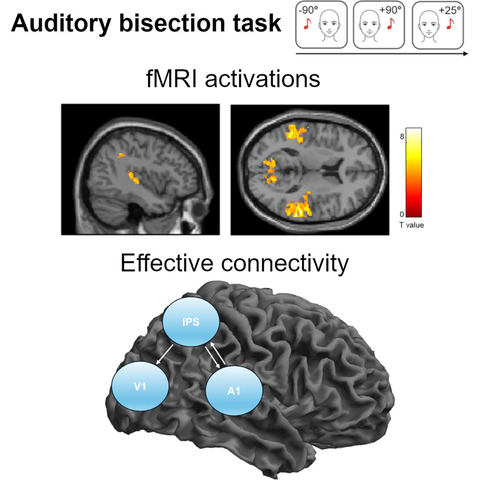
 The vOICe vision BCI 🧠🇪🇺