When we stepped out of Omega Mart's supermarket, we stepped into other worlds and galaxies.

It was a truly multi-sensory experience that we will never forget.

Here's a brief glimpse at some of what you'll see in Omega Mart, which is a Meow Wolf interactive art exhibit in Las Vegas.

#omegamart #lasvegas #multisensory #familytravel #meowwolflasvegas
https://www.instagram.com/reel/DVjxHIXjhkR/?igsh=MTk2ZDRpdzljNHU4aQ==

Family Well Traveled on Instagram: "When we stepped out of Omega Mart's supermarket, we stepped into other worlds and galaxies. It was a truly multi-sensory experience that we will never forget. Here's a brief glimpse at some of what you'll see in Omega Mart, which is a Meow Wolf interactive art exhibit in Las Vegas. #omegamart #lasvegas #multisensory #familytravel #meowwolflasvegas"

1 likes, 0 comments - familywelltraveled on March 6, 2026: "When we stepped out of Omega Mart's supermarket, we stepped into other worlds and galaxies. It was a truly multi-sensory experience that we will never forget. Here's a brief glimpse at some of what you'll see in Omega Mart, which is a Meow Wolf interactive art exhibit in Las Vegas. #omegamart #lasvegas #multisensory #familytravel #meowwolflasvegas".

Instagram
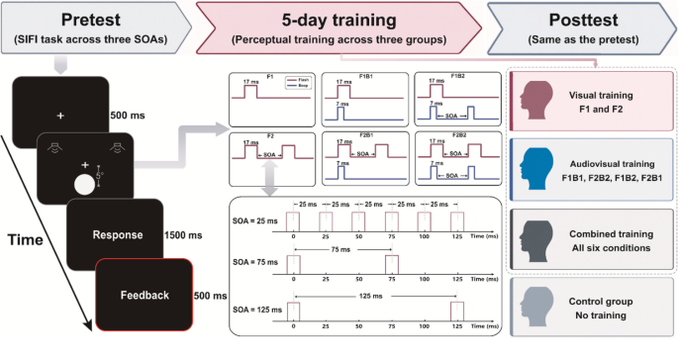
Crossmodal interaction of flashes and beeps across time and number follows Bayesian causal inference https://link.springer.com/article/10.3758/s13423-026-02857-z #SiFI #multisensory
Crossmodal interaction of flashes and beeps across time and number follows Bayesian causal inference - Psychonomic Bulletin & Review

Multisensory perception requires the brain to dynamically infer causal relationships between sensory inputs across various dimensions, such as temporal and spatial attributes. Traditionally, Bayesian Causal Inference (BCI) models have generally provided a robust framework for understanding sensory processing in unidimensional settings where stimuli across sensory modalities vary along one dimension such as spatial location, or numerosity (Samad et al., PloS one, 10 (2), e0117178, 2015). However, real-world sensory processing involves multidimensional cues, where the alignment of information across multiple dimensions influences whether the brain perceives a unified or segregated source. In an effort to investigate sensory processing in more realistic conditions, this study introduces an expanded BCI model that incorporates multidimensional information, specifically numerosity and temporal discrepancies. Using a modified sound-induced flash illusion (SiFI) paradigm with manipulated audiovisual disparities, we tested the performance of the enhanced BCI model. Results showed that integration probability decreased with increasing temporal discrepancies, and our proposed multidimensional BCI model accurately predicts multisensory perception outcomes under the entire range of stimulus conditions. This multidimensional framework extends the BCI model’s applicability, providing deeper insights into the computational mechanisms underlying multisensory processing and offering a foundation for future quantitative studies on naturalistic sensory processing.

SpringerLink
Crossmodal interaction of flashes and beeps across time and number follows Bayesian causal inference link.springer.com/article/10.3... #SiFI #multisensory

Crossmodal interaction of flas...
Crossmodal interaction of flashes and beeps across time and number follows Bayesian causal inference - Psychonomic Bulletin & Review

Multisensory perception requires the brain to dynamically infer causal relationships between sensory inputs across various dimensions, such as temporal and spatial attributes. Traditionally, Bayesian Causal Inference (BCI) models have generally provided a robust framework for understanding sensory processing in unidimensional settings where stimuli across sensory modalities vary along one dimension such as spatial location, or numerosity (Samad et al., PloS one, 10 (2), e0117178, 2015). However, real-world sensory processing involves multidimensional cues, where the alignment of information across multiple dimensions influences whether the brain perceives a unified or segregated source. In an effort to investigate sensory processing in more realistic conditions, this study introduces an expanded BCI model that incorporates multidimensional information, specifically numerosity and temporal discrepancies. Using a modified sound-induced flash illusion (SiFI) paradigm with manipulated audiovisual disparities, we tested the performance of the enhanced BCI model. Results showed that integration probability decreased with increasing temporal discrepancies, and our proposed multidimensional BCI model accurately predicts multisensory perception outcomes under the entire range of stimulus conditions. This multidimensional framework extends the BCI model’s applicability, providing deeper insights into the computational mechanisms underlying multisensory processing and offering a foundation for future quantitative studies on naturalistic sensory processing.

SpringerLink
Age-related neural dynamics revealed by time-domain #fNIRS decoding of audiovisual dual-task processing https://www.sciencedirect.com/science/article/abs/pii/S0166432826000938 "Age-related neural dynamics are best captured under high cognitive load"; #multisensory #integration
Age-related neural dynamics revealed by time-domain #fNIRS decoding of audiovisual dual-task processing www.sciencedirect.com/science/arti... "Age-related neural dynamics are best captured under high cognitive load"; #multisensory #integration

Age-related neural dynamics re...
Visual and tactile motion cues enhance the categorisation of novel object shapes link.springer.com/article/10.1... #multisensory

Visual and tactile motion cues...
Visual and tactile motion cues enhance the categorisation of novel object shapes - Experimental Brain Research

Object categorisation is a fundamental cognitive process, involving the integration of information across the senses. We investigated, using smartphones, whether visual and tactile motion cues could enhance object category learning and generalisation to novel object shapes. Two categories of similar shapes were associated with specific correlated visual and tactile vibration motion cues. After learning object categories, participants were assessed on categorisation of learned and novel objects across four cue conditions: shape-only, shape-visual motion, shape-tactile motion, and shape-visual and tactile motion. We also assessed if accuracy was influenced by blocked versus interleaved cue-conditions at test. In Experiment 1, we found more accurate categorisation and generalisation when all cues were available at test. In Experiment 2 we replicated this effect even when the reliability of the shape-only cue for predicting category membership was reduced. In Experiment 3, we found that the absence of motion cues during learning removed the benefit of motion cues at test. Overall, our findings suggest that multisensory motion cues benefit the formation of novel object categories and allow for better generalisation. The results have implications for our understanding of the underlying dynamic and multisensory nature of object categories and the predictive role of multisensory features on category formation.

SpringerLink
Visual and tactile motion cues enhance the categorisation of novel object shapes https://link.springer.com/article/10.1007/s00221-026-07238-5 #multisensory
Visual and tactile motion cues enhance the categorisation of novel object shapes - Experimental Brain Research

Object categorisation is a fundamental cognitive process, involving the integration of information across the senses. We investigated, using smartphones, whether visual and tactile motion cues could enhance object category learning and generalisation to novel object shapes. Two categories of similar shapes were associated with specific correlated visual and tactile vibration motion cues. After learning object categories, participants were assessed on categorisation of learned and novel objects across four cue conditions: shape-only, shape-visual motion, shape-tactile motion, and shape-visual and tactile motion. We also assessed if accuracy was influenced by blocked versus interleaved cue-conditions at test. In Experiment 1, we found more accurate categorisation and generalisation when all cues were available at test. In Experiment 2 we replicated this effect even when the reliability of the shape-only cue for predicting category membership was reduced. In Experiment 3, we found that the absence of motion cues during learning removed the benefit of motion cues at test. Overall, our findings suggest that multisensory motion cues benefit the formation of novel object categories and allow for better generalisation. The results have implications for our understanding of the underlying dynamic and multisensory nature of object categories and the predictive role of multisensory features on category formation.

SpringerLink
Using varied strategies ensures you not only remember the material better but also internalize it in different ways. This versatility helps you apply knowledge across multiple situations, making your learning richer and more versatile. #Multisensory #Emberhart #Engage https://podcasts.apple.com/fi/podcast/emberhart-podcast/id1784530203?i=1000694639425
Exploring New Ways to Learn and Think: A Spring Adventure in Knowledge

Podcast Episode · Emberhart Podcast · 21/02/2025 · 7m

Apple Podcasts

Specific relevance for psychotherapists, social workers, mental health professionals, and therapists. By detailing multisensory integration—how smell, touch, sound, sight, and balance influence perceptions of taste, objects, and even body weight—this content offers a useful lens for understanding clients' sensory experiences. The note that more than twenty distinct senses may operate simultaneously highlights the perceptual complexity that can shape daily life and clinical description.

Article Title: New research reveals humans could have as many as 33 senses

Link to Science Daily Mind-Brain News: https://ift dot tt/6bNmqnu

#Multisensory #Perception #SensoryIntegration #Neuroscience #MindBrainNews

Copy and paste broken link above into your browser and replace "dot" with "." for link to work.

We have to do it this way to avoid display of copyrighted images.

Disentangling the functional roles of pre-stimulus oscillations in crossmodal associative memory formation via sensory entrainment https://www.nature.com/articles/s41598-025-33761-6#Sec7 "externally induced pre-stimulus alpha entrainment boosts audiovisual associative encoding"; #crossmodal #multisensory #neuroscience
Disentangling the functional roles of pre-stimulus oscillations in crossmodal associative memory formation via sensory entrainment - Scientific Reports

The state of neural dynamics prior to the presentation of an external stimulus significantly influences its subsequent processing. This neural preparatory mechanism might be of particular importance for crossmodal memory formation. The integration of stimuli across different sensory modalities is a fundamental mechanism underlying the formation of episodic memories. However, the causal role of pre-stimulus neural activity in this process remains largely unclear. In this preregistered study, we investigate the direct relationship between transient brain states induced by sensory entrainment and crossmodal memory encoding. Participants (n = 105) received rhythmic visual stimuli at theta (5 Hz) or alpha (9 Hz) frequencies to evoke specific brain states. EEG recordings confirmed successful entrainment, with sustained increases in neural activity within the stimulated frequency bands persisting until stimulus onset. Notably, induced alpha oscillatory activity enhanced recognition memory performance reflected by increased sensitivity, and suggesting that alpha oscillations prepare the brain for optimal multisensory integration. These findings highlight the functional significance of distinct oscillatory brain states in facilitating memory encoding by increasing cortical excitability before stimulus presentation. Overall, our results emphasize the importance of pre-stimulus brain states in shaping the efficiency of memory formation across sensory modalities and shed light on how dynamic neural preparations support learning.

Nature