Hackathon: “Data-Driven Methods in Philosophy”

Gregor Bös and Max Noichl organize a hackathon on “Data-Driven Methods in Philosophy,” which will take place in Utrech from October 16 to 18. Before and after, hybrid meetings will also take place.

Their announcement reads:

Computational methods have transformed academic research, including in the humanities. Philosophers have been comparatively slow to adopt them, but as contemporary language modelling techniques now enable much more sophisticated analyses, they are seeing increasing interest. We want to explore techniques from the digital humanities, linguistics and AI research (Betz 2022) that can support the study of philosophical and scientific corpora, with applications for philosophy of science (Lean, Rivelli & Pence 2021; Noichl 2023. See also the contributions to Pence & Rivelli 2022), the history of philosophy (Petrovich, Verhaegh, Bös et al. 2024; Verhaegh, Petrovich & Bös forthcoming), and metaphilosophy (Petrovich, 2022).

This activity is built around a “hackathon” – an extended period of collaborative programming and discussion. During the three-day in-person event, the participants develop their own projects, either individually or in small groups. The first two days start with keynote lectures that present state-of-the-art research. In the lead-up to the event, we organize two hybrid seminars, in which participants present recent research to each other, to get an idea of what’s possible in this space. During the seminars, participants brainstorm research ideas and discuss with seminar leaders how to apply digital methods, identify appropriate data sources, and determine which digital skills to develop. During the event, our keynote speakers Charles Pence and Gregor Betz contribute their expertise in argument representation, LLMs, digital methods for history and philosophy of science. They will also be available during the event to discuss research ideas, share practical knowledge, and support the seminar participants.

As an additional help for participants without programming experience or who have not yet used data-driven methods in their research, the organizers prepare coding templates and assist in using LLMs for writing code. More experienced participants can focus on exchanging ideas and developing their own projects. A few weeks after the hackathon, we reconvene in a hybrid event to discuss the results of the projects and avenues for further work.

The aim of the course is to offer an introduction to data-driven methods for philosophy and focuses on participant-designed research projects. At the end of the course, participants:

a) Know examples of state-of-the-art data-driven research methods in philosophy and are in a
good position to apply them.
b) Have gained experience in starting their own computational philosophy project
In the best case, the hackathon can be the starting point for a research project in the participants’
domain of expertise.
#ArtificialIntelligence #CorpusAnalysis

Data-driven Methods in Philosophy – ozsw

::Roundtable:: From Manuscripts to Digital Corpus: Structuring Islamic Data Sources for the Future of AI Jurisprudence

By Ezieddin Elmahjub Introduction Artificial Intelligence (AI), particularly large language models (LLMs) and generative AI, is poised to revolutionize how we approach and interact with Islamic jur…

Islamic Law Blog

Which subreddits score higher on deliberation metrics?

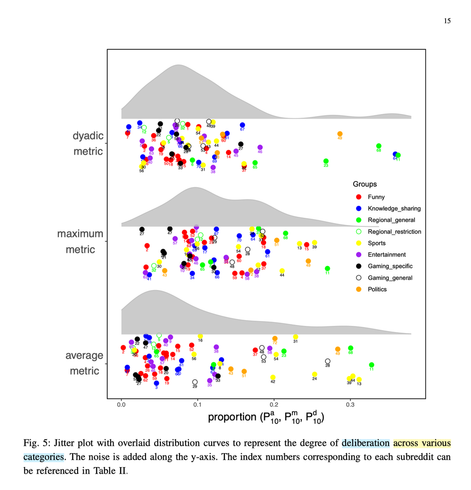
A new metric of deliberation (designed to overcome prior issues) found that the following subreddits had the highest deliberation scores (across 72 subreddits)
- Subreddits that are based on geographical regions
- Political subreddits
- Sports subreddits

https://arxiv.org/abs/2410.21996

#socialMedia #Reddit #publicDiscourse #decisionScience #corpusAnalysis #NLP #statistics

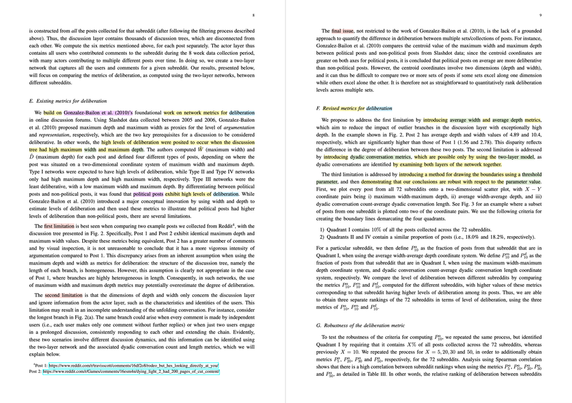
Multi-layer network analysis of deliberation in an online discussion platform: the case of Reddit

This paper uses a multi-layer network model to study deliberation in online discussion platforms, focusing on the Reddit platform. The model comprises two layers: a discussion layer, which represents the comment-to-comment replies as a hierarchical tree, and an actor layer, which represent the actor-to-actor reply interactions. The interlayer links represent user-comment ownership. We further propose several different network metrics to characterise the level of deliberation in discussion threads, and apply the model and metrics to a large Reddit dataset containing posts from 72 subreddits focused on different topics. We compare the level of deliberation that occurs on different subreddits, finding that subreddits that are based on geographical regions or focus on sports have the highest levels of deliberation. Analysis of the actor layer reveals several features consistent across all subreddits, such as small-world characteristics and similar numbers of highly active users.

arXiv.org

A corpus analysis of rock harmony

The researchers in this study conducted a corpus analysis of rock harmony by using Rolling Stone magazine's list of the '500 Greatest Songs of All Time'. The corpus consisted of 100 songs, which were chosen by taking the top 20 ranked songs from each decade from the 1950s to the 1990s. The authors personally analyzed all 100 songs using conventional Roman numeral symbols, and their agreement between the two sets of analyzes was over 90%. The analyses were then encoded using a recursive notation similar to a context-free grammar, allowing for concise encoding of repeating sections. Statistical analyses were then conducted on the aggregate data, examining the frequency of different chords and chord transitions, root motions, patterns of co-occurrence between chords, and changes in harmonic practices over time. The results indicated that the IV chord is the most common chord after the I chord, and is particularly common preceding the tonic.

https://www.jstor.org/stable/23325809

#corpusanalysis #rock #harmony #RollingStone #500GreatestSongs #RomanNumeral #contextfreegrammar #statisticalanalyses #chords #transitions #rootmotions #harmonicpractices #time #music #analysis #musicology

A corpus analysis of rock harmony on JSTOR

TREVOR DE CLERCQ, DAVID TEMPERLEY, A corpus analysis of rock harmony, Popular Music, Vol. 30, No. 1 (January 2011), pp. 47-70

#introduction2

Hi, I'm a linguist, affiliated with #TheUniversityOfSydney and #MacquarieUniversity (Australia)

My main research interests include #CDS, #SFL, #semantics #AppraisalTheory #corpuslinguistics

I recently published a paper on the #grammar of #toxicpositivity on Facebook and am currently working on an #appraisalanalysis of negation in #Reddit discourse surrounding the Australian #climate election

My research assistant is called Mr Magz #cats
#linguistics #CorpusAnalysis