1970s Lee 200Z and Copper King 99Z comparison (final)
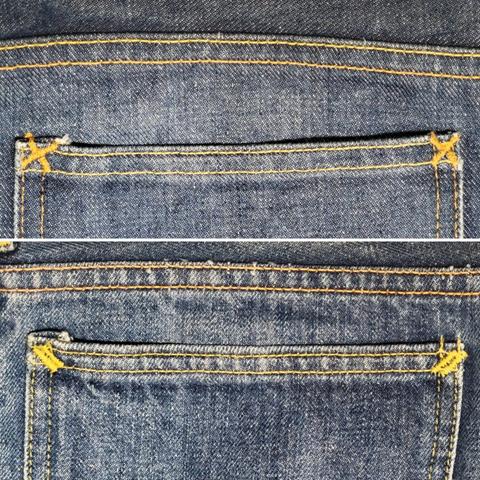
Over the last several posts I've shown how these two pairs of jeans are nearly identical in the way they are constructed. Yet, they look distinctively different. The main factor that makes them look so different is the shape of the back pockets and their decorative stitching design, which is of course why brands are so protective of their back pocket design.
After Lee acquired Can't Bust 'Em in 1946, and with that the Copper King brand, they gradually adjusted the Copper King construction to match that of Lee, in order to make them more efficient to produce, while cleverly maintaining those aspects that define the Copper King identity.

#vintagejeans #vintagedenim #realvintage #1970s #backpocket #lazys #lee #copperking
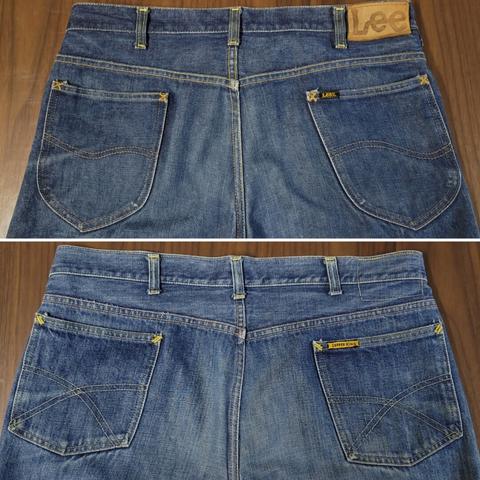
1970s Lee 200Z and Copper King 99Z comparison
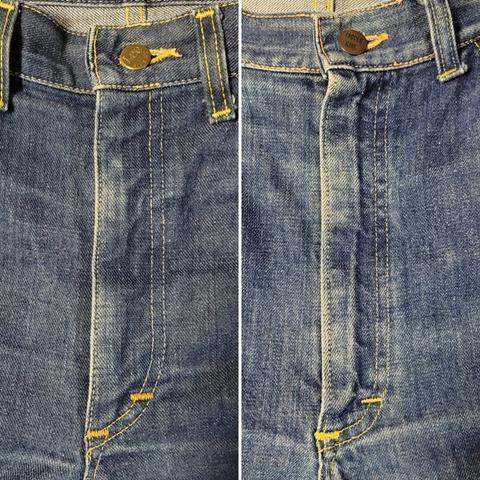
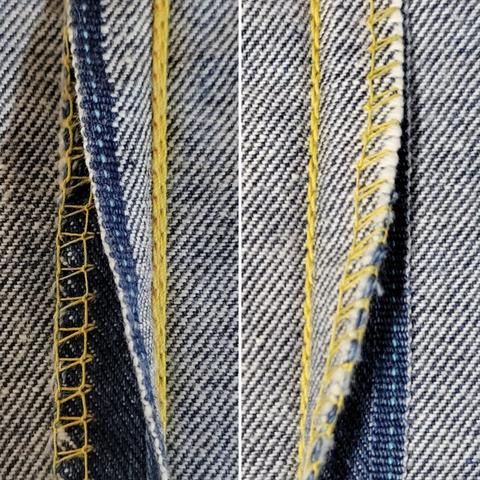
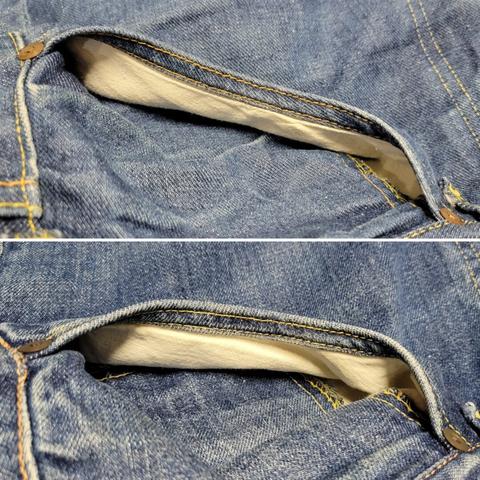
The fly on both pairs is also constructed in the exact same way.
Pic 1 left: Lee 200Z
Pic 1 right: Copper King 99Z
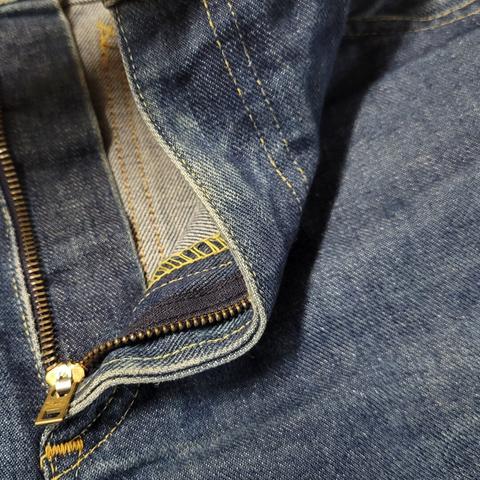
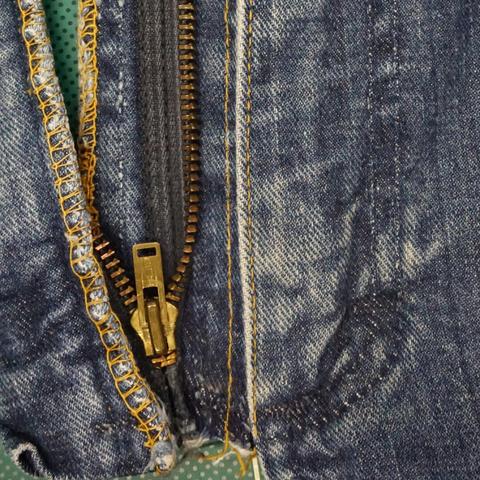
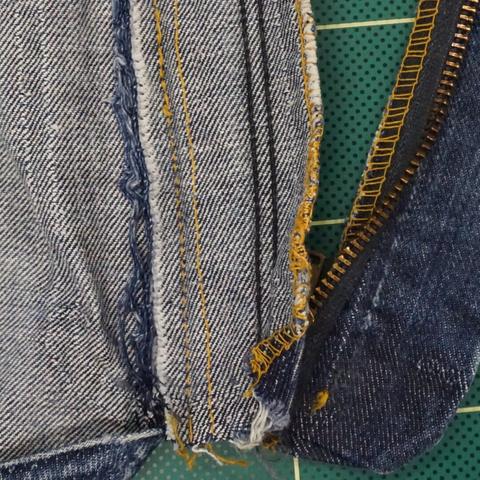
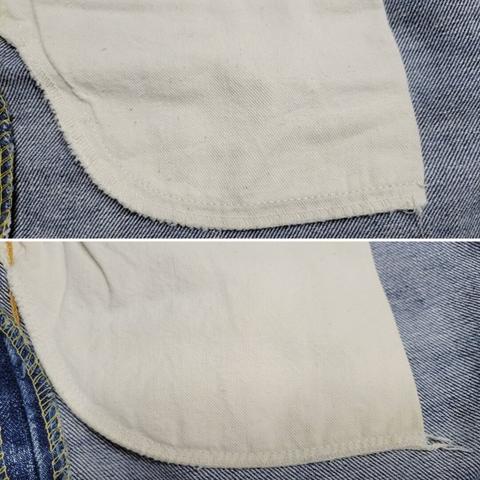
The topstitching on the edge of the fly looks from the outside as if it goes through all layers, just like on Levi's zipper flies, but actually it doesn't. As you can see in pic 2 (Lee), it goes only through 3 layers. There's another row of stitches a bit further inward on the inside of the fly, and it's not clear how many layers this goes through. So ... some time ago I took another pair of 1970s Lee jeans apart to find out (pics 3 & 4).
It turns out, to my surprise, that this row of stitches just goes through one single layer, and therefore doesn't seem to have any functional purpose! However, it's there on every zipper fly Lee jeans I've ever seen, and on the Copper King pair as well.
If anyone can enlighten me as to its purpose, I'd be very interested to find out!

#vintagejeans #vintagedenim #realvintage #1970s #lee #copperking #fly #zipperfly
1970s Lee 200Z and Copper King 99Z comparison
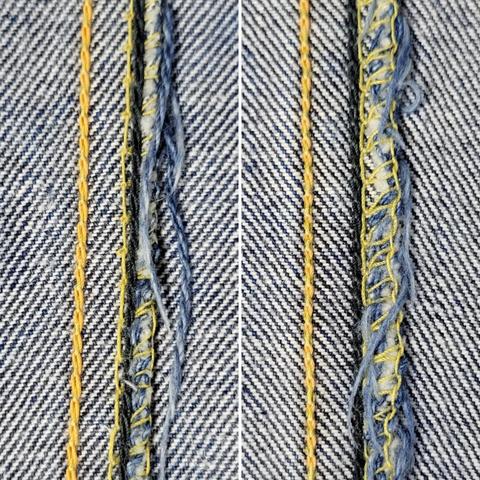
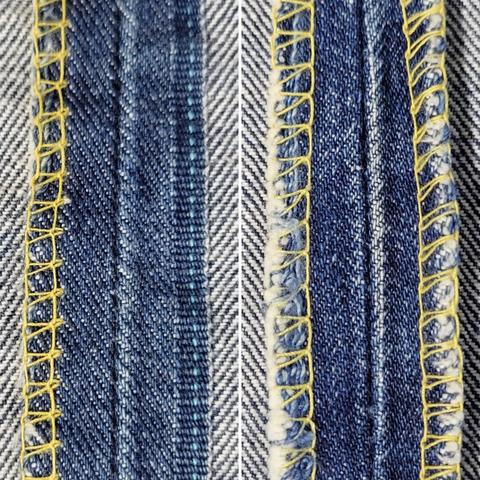
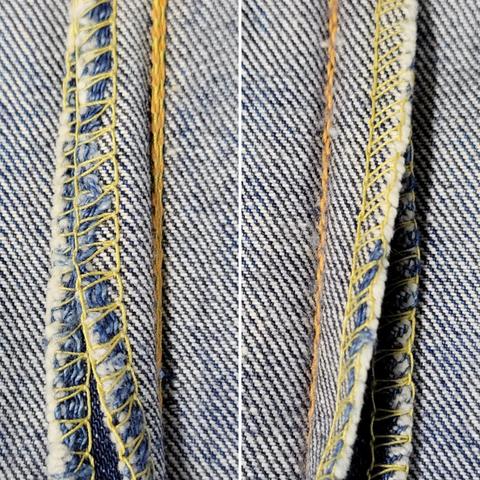
The inseams would be indistinguishable if it weren't for the twill of the denim.
Pics 1 & 2 Left: Lee 200Z
Pics 1 & 2 right: Copper King 99Z
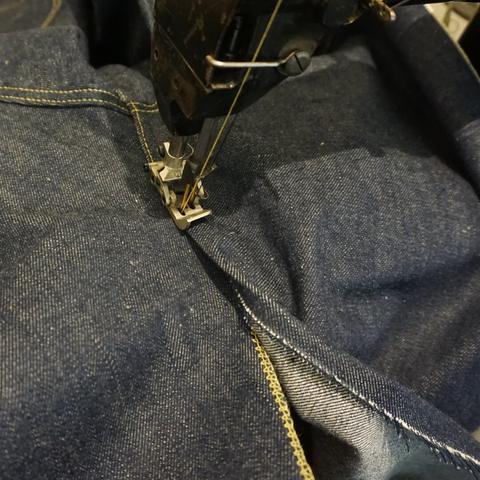
They are sewn using a method that was used mostly by Lee, but also by a few store brands. The point is that only the back panel is serged , and the front panel is folded and sewn onto the back panel with a double row of chainstitches.
I'm pretty sure that for mass production a special folder was used, but I do this free-hand without folder, which is quite easy to do as shown in pic 3.

#vintagejeans #vintagedenim #realvintage #1970s #lee #copperking #inseam
1970s Lee 200Z and Copper King 99Z comparison
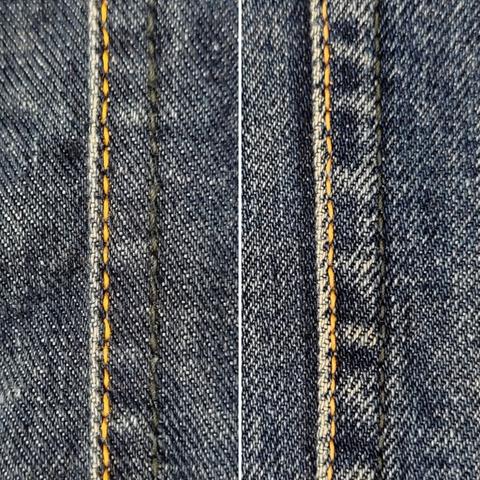
Apart from the "half selvedge" on the Lee, the construction of the outseams is identical, sewn with a double row of chainstitches right next to each other.
Pic 1 left and pic 2: Lee 200Z
Pic 1 right and pic 3: Copper King 99Z

#vintagejeans #vintagedenim #realvintage #lee #copperking #chainstitch #outseam
1970s Lee 200Z and Copper King 99Z comparison
One feature that is unmistakably characteristic of Lee jeans (left pic) is the position of the belt loops sewn right on top of the side seams. This detail is identical on the Copper King pair (right pic), illustrating again that these were made by Lee on the same production line.
On a side note, the belt loops on the Lee pair are made of a different denim from the rest of the jeans (pic 2), which is not at all uncommon with Lee. It doesn't show well in the photo, but the belt loops are made of vat-dyed denim, while everything else is made of rope-dyed denim. This was unnoticeable when they were raw, but has become increasingly clear with aging.
Another trivial detail is that one of the belt loops was cut right on the selvedge of the denim.

#vintagejeans #vintagedenim #realvintage #1970s #lee #copperking #beltloop
1970s Lee 200Z and Copper King 99Z comparison
Apart from the branding, the rivets are not only identical, but also attached in the exact same locations.
Top: Lee 200Z
Bottom: Copper King 99Z

#vintagejeans #vintagedenim #realvintage #rivet #1970s #lee #copperking
1970s Lee 200Z and Copper King 99Z comparison
Both jeans have a tab attached to the same corner of the right back pocket.
The famous Lee tab has yellow letters on a black background, while the Copper King tab has black letters on a yellow background.
Closer inspection, however, reveals that the ribbon used for the tabs basically consists of the same material used in reverse. As both brands were owned and made by Lee, was this another measure to make production more cost efficient?

#vintagejeans #vintagedenim #realvintage #1970s #lee #copperking #pockettab
1970s Lee 200Z and Copper King 99Z comparison
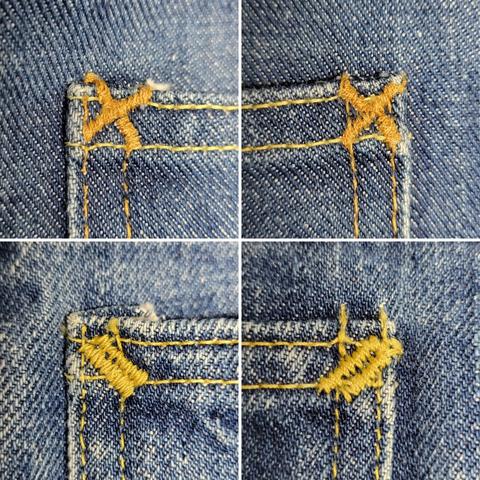
The back pockets are reinforced with double bartacks on both jeans -- the characteristic X bartacks on the Lee, and parallel bartacks on the Copper King.
In terms of construction, these are basically identical, the only difference being the angle of the second bartack.

#vintagejeans #vintagedenim #realvintage #1970s #lee #copperking #bartacks
1970s Lee 200Z and Copper King 99Z comparison
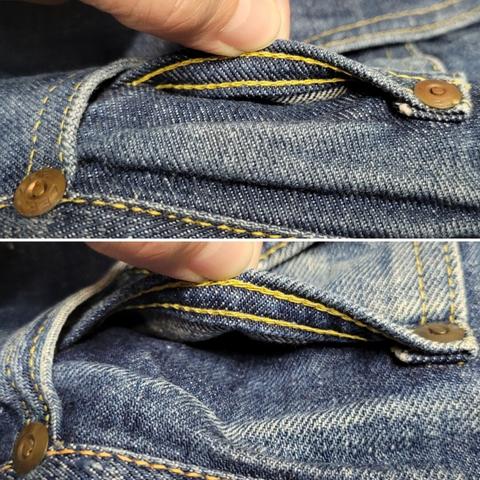
Staying with the front pockets once more.
Identical construction on the entrance of the watch pockets, the front pockets, and the overlocking finish on the pocket bags.
Top: Lee 200Z
Bottom: Copper King 99Z

#vintagejeans #vintagedenim #realvintage #1970s #lee #copperking #cantbustem
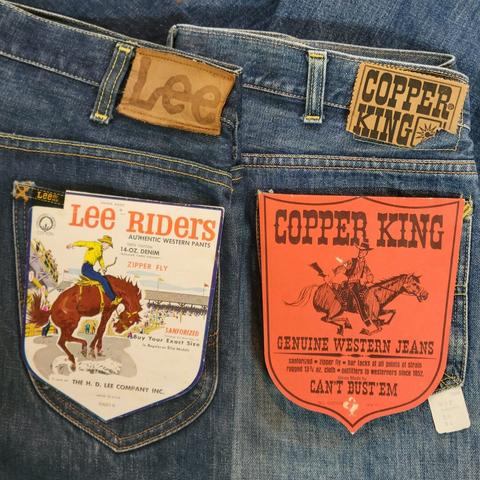
1970s Lee 200Z and Copper King 99Z, with their original flashers and labels.
Both of these were raw deadstock when I bought them nearly 30 years ago, and I've worn both of them quite a bit.
Other than both flashers depicting a cowboy on a horse, not much similarity here.

#vintagejeans #vintagedenim #realvintage #lee #lee200 #lee200z #copperking #copperking99 #copperking99z #cantbustem