Constructor Can Return DIFFERENT Object?!

Constructors can LIE about what they create! If you return an object, it REPLACES the instance. The 'new' keyword becomes USELESS. instanceof returns false! This breaks OOP principles!

#javascript #javascripttricks #constructor #classsyntax #instanceof #javascriptweird #javascriptquiz #codingchallenge #javascriptshorts #javascriptwtf #oopquirks #advancedjavascript

https://www.youtube.com/watch?v=NSHaq1zbSWE

Constructor Can Return DIFFERENT Object?! #javascriptshorts

YouTube

Field vs Constructor Injection в Java: ошибка объектного дизайна или вопрос синтаксиса?

Знаю, знаю... Прочитав заголовок, хочется голосом волка из мультфильма "Жил был пёс" сказать - "Шо, опять?" . Ведь битва этих подходов давно закончилась и разработчики Spring уже поставили точку. Но недавняя публикация в одном довольно крупном Telegram-канале заставила меня вернуться к этому вопросу. В качестве главных аргументов против field injection там приводились лишь сложность изоляции в тестах и неудобство создания экземпляров для unit-тестов. И хотя с этими пунктами не поспоришь, у многих разработчиков и не только начинающих, остаются вопросы: каковы реальные последствия для самого объекта? Можно ли считать его полноценным сразу после создания new ? И почему все современные рекомендации так настаивают на конструкторах? Поиск ответов показал мне, что аргумент о тестах лишь верхушка айсберга. В глубине, куда я Вас сегодня приглашаю заглянуть, скрываются куда более фундаментальные вопросы принципов объектно-ориентированного дизайна, гарантий Java Memory Model и уважения к жизненному циклу объекта.

https://habr.com/ru/articles/983344/

#field #injection #constructor #setter #Dependency_Injection #Spring_Framework #Java #ObjectOriented_Design #Invariants

Field vs Constructor Injection в Java: ошибка объектного дизайна или вопрос синтаксиса?

Знаю, знаю... Прочитав заголовок, хочется голосом волка из мультфильма "Жил был пёс" сказать - "Шо, опять?" . Ведь битва этих подходов давно закончилась и разработчики Spring уже поставили точку. Но...

Хабр

Field vs Constructor Injection в Java: ошибка объектного дизайна или вопрос синтаксиса?

Знаю, знаю... Прочитав заголовок, хочется голосом волка из мультфильма "Жил был пёс" сказать - "Шо, опять?" . Ведь битва этих подходов давно закончилась и разработчики Spring уже поставили точку. Но недавняя публикация в одном довольно крупном Telegram-канале заставила меня вернуться к этому вопросу. В качестве главных аргументов против field injection там приводились лишь сложность изоляции в тестах и неудобство создания экземпляров для unit-тестов. И хотя с этими пунктами не поспоришь, у многих разработчиков и не только начинающих, остаются вопросы: каковы реальные последствия для самого объекта? Можно ли считать его полноценным сразу после создания new ? И почему все современные рекомендации так настаивают на конструкторах? Поиск ответов показал мне, что аргумент о тестах лишь верхушка айсберга. В глубине, куда я Вас сегодня приглашаю заглянуть, скрываются куда более фундаментальные вопросы принципов объектно-ориентированного дизайна, гарантий Java Memory Model и уважения к жизненному циклу объекта.

https://habr.com/ru/articles/983340/

#field #injection #constructor #setter #Dependency_Injection #Spring_Framework #Java #ObjectOriented_Design #Invariants

Field vs Constructor Injection в Java: ошибка объектного дизайна или вопрос синтаксиса?

Знаю, знаю... Прочитав заголовок, хочется голосом волка из мультфильма "Жил был пёс" сказать - "Шо, опять?" . Ведь битва этих подходов давно закончилась и разработчики Spring уже поставили точку. Но...

Хабр

It didn’t take long: CVE-2025-55182 is now under active exploitation

On December 4, 2025, researchers published details on the critical vulnerability CVE-2025-55182, which received a CVSS score of 10.0. It has been unofficially dubbed React4Shell, as it affects React Server Components (RSC) functionality used in web applications built with the React library. RSC speeds up UI rendering by distributing tasks between the client and the server. The flaw is categorized as CWE-502 (Deserialization of Untrusted Data). It allows an attacker to execute commands, as well as read and write files in directories accessible to the web application, with the server process privileges.

Almost immediately after the exploit was published, our honeypots began registering attempts to leverage CVE-2025-55182. This post analyzes the attack patterns, the malware that threat actors are attempting to deliver to vulnerable devices, and shares recommendations for risk mitigation.

A brief technical analysis of the vulnerability


React applications are built on a component-based model. This means each part of the application or framework should operate independently and offer other components clear, simple methods for interaction. While this approach allows for flexible development and feature addition, it can require users to download large amounts of data, leading to inconsistent performance across devices. This is the challenge React Server Components were designed to address.

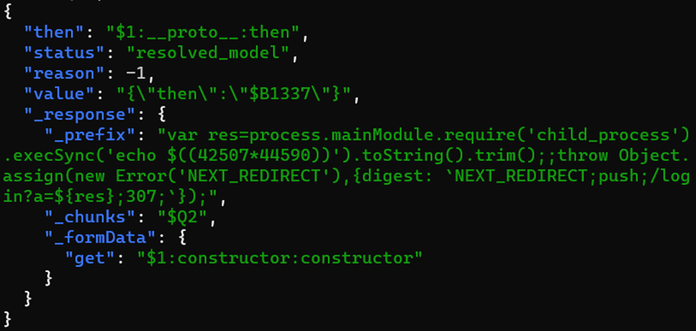
The vulnerability was found within the Server Actions component of RSC. To reach the vulnerable function, the attacker just needs to send a POST request to the server containing a serialized data payload for execution. Part of the functionality of the handler that allows for unsafe deserialization is illustrated below:


A comparison of the vulnerable (left) and patched (right) functions

CVE-2025-55182 on Kaspersky honeypots


As the vulnerability is rather simple to exploit, the attackers quickly added it to their arsenal. The initial exploitation attempts were registered by Kaspersky honeypots on December 5. By Monday, December 8, the number of attempts had increased significantly and continues to rise.

The number of CVE-2025-55182 attacks targeting Kaspersky honeypots, by day (download)

Attackers first probe their target to ensure it is not a honeypot: they run whoami, perform multiplication in bash, or compute MD5 or Base64 hashes of random strings to verify their code can execute on the targeted machine.

In most cases, they then attempt to download malicious files using command-line web clients like wget or curl. Additionally, some attackers deliver a PowerShell-based Windows payload that installs XMRig, a popular Monero crypto miner.

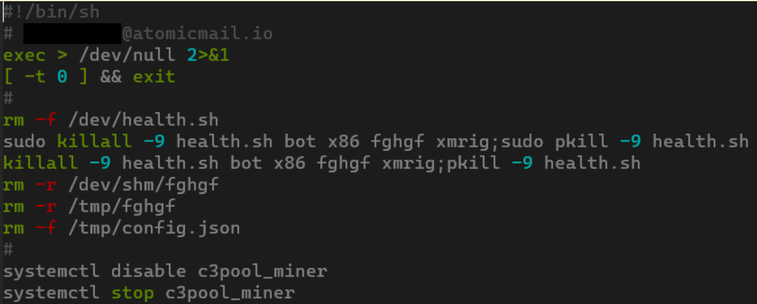
CVE-2025-55182 was quickly weaponized by numerous malware campaigns, ranging from classic Mirai/Gafgyt variants to crypto miners and the RondoDox botnet. Upon infecting a system, RondoDox wastes no time, its loader script immediately moving to eliminate competitors:

Beyond checking hardcoded paths, RondoDox also neutralizes AppArmor and SELinux security modules and employs more sophisticated methods to find and terminate processes with ELF files removed for disguise.

Only after completing these steps does the script download and execute the main payload by sequentially trying three different loaders: wget, curl, and wget from BusyBox. It also iterates through 18 different malware builds for various CPU architectures, enabling it to infect both IoT devices and standard x86_64 Linux servers.

In some attacks, instead of deploying malware, the adversary attempted to steal credentials for Git and cloud environments. A successful breach could lead to cloud infrastructure compromise, software supply chain attacks, and other severe consequences.


Risk mitigation measures


We strongly recommend updating the relevant packages by applying patches released by the developers of the corresponding modules and bundles.
Vulnerable versions of React Server Components:

  • react-server-dom-webpack (19.0.0, 19.1.0, 19.1.1, 19.2.0)
  • react-server-dom-parcel (19.0.0, 19.1.0, 19.1.1, 19.2.0)
  • react-server-dom-turbopack (19.0.0, 19.1.0, 19.1.1, 19.2.0)

Bundles and modules confirmed as using React Server Components:

  • next
  • react-router
  • waku
  • @parcel/rsc
  • @vitejs/plugin-rsc
  • rwsdk

To prevent exploitation while patches are being deployed, consider blocking all POST requests containing the following keywords in parameters or the request body:

  • #constructor
  • # proto
  • #prototype
  • vm#runInThisContext
  • vm#runInNewContext
  • child_process#execSync
  • child_process#execFileSync
  • child_process#spawnSync
  • module#_load
  • module#createRequire
  • fs#readFileSync
  • fs#writeFileSync
  • s#appendFileSync


Conclusion


Due to the ease of exploitation and the public availability of a working PoC, threat actors have rapidly adopted CVE-2025-55182. It is highly likely that attacks will continue to grow in the near term.

We recommend immediately updating React to the latest patched version, scanning vulnerable hosts for signs of malware, and changing any credentials stored on them.

Indicators of compromise


Malware URLs
hxxp://172.237.55.180/b
hxxp://172.237.55.180/c
hxxp://176.117.107.154/bot
hxxp://193.34.213.150/nuts/bolts
hxxp://193.34.213.150/nuts/x86
hxxp://23.132.164.54/bot
hxxp://31.56.27.76/n2/x86
hxxp://31.56.27.97/scripts/4thepool_miner[.]sh
hxxp://41.231.37.153/rondo[.]aqu[.]sh
hxxp://41.231.37.153/rondo[.]arc700
hxxp://41.231.37.153/rondo[.]armeb
hxxp://41.231.37.153/rondo[.]armebhf
hxxp://41.231.37.153/rondo[.]armv4l
hxxp://41.231.37.153/rondo[.]armv5l
hxxp://41.231.37.153/rondo[.]armv6l
hxxp://41.231.37.153/rondo[.]armv7l
hxxp://41.231.37.153/rondo[.]i486
hxxp://41.231.37.153/rondo[.]i586
hxxp://41.231.37.153/rondo[.]i686
hxxp://41.231.37.153/rondo[.]m68k
hxxp://41.231.37.153/rondo[.]mips
hxxp://41.231.37.153/rondo[.]mipsel
hxxp://41.231.37.153/rondo[.]powerpc
hxxp://41.231.37.153/rondo[.]powerpc-440fp
hxxp://41.231.37.153/rondo[.]sh4
hxxp://41.231.37.153/rondo[.]sparc
hxxp://41.231.37.153/rondo[.]x86_64
hxxp://51.81.104.115/nuts/bolts
hxxp://51.81.104.115/nuts/x86
hxxp://51.91.77.94:13339/termite/51.91.77.94:13337
hxxp://59.7.217.245:7070/app2
hxxp://59.7.217.245:7070/c[.]sh
hxxp://68.142.129.4:8277/download/c[.]sh
hxxp://89.144.31.18/nuts/bolts
hxxp://89.144.31.18/nuts/x86
hxxp://gfxnick.emerald.usbx[.]me/bot
hxxp://meomeoli.mooo[.]com:8820/CLoadPXP/lix.exe?pass=PXPa9682775lckbitXPRopGIXPIL
hxxps://api.hellknight[.]xyz/js
hxxps://gist.githubusercontent[.]com/demonic-agents/39e943f4de855e2aef12f34324cbf150/raw/e767e1cef1c35738689ba4df9c6f7f29a6afba1a/setup_c3pool_miner[.]sh

MD5 hashes
0450fe19cfb91660e9874c0ce7a121e0
3ba4d5e0cf0557f03ee5a97a2de56511
622f904bb82c8118da2966a957526a2b
791f123b3aaff1b92873bd4b7a969387
c6381ebf8f0349b8d47c5e623bbcef6b
e82057e481a2d07b177d9d94463a7441

securelist.com/cve-2025-55182-…

Started playing #Constructor Plus on the Switch today. Have had it for 5 years now… I remember a friend playing this game backbone #PlayStation. But at the age we were I doubt he actually knew how to play it. I certainly didn’t.

The game has a certain charm to it and a unique look. But wow is this game a lot to absorb! So many mechanics and layers. It can get a bit overwhelming and more often than not I’m confused on how to get something done. But it’s fun though! Just a lot to keep track of.

JavaScript: зачем конструктору return …

Этот вопрос интересовал меня настолько давно, что за прошедшие годы даже стал как-то про него забывать. И не то, чтобы меня это прям как-то сильно интересовало, но всё же лучше понимать назначение было бы приятно. И, ведь, ну в самом деле, подумаешь, ну может разработчику хочеться вернуть не эземпляр, не instance, а какой-нибудь другой объект, и зачем-то при этом ему нужен именно вызов конструктора. Ну, допустим, он хочет чтобы new.target был заполнен и т.п., ну, мало ли какие варианты зачем-то иметь возможность в противном случае вернуть объект. Или может он хочет асинхронных конструкторов и вернуть new Promise, где уже в resolve передать this как вариант для создания await new MyConstructor . Или может быть хочет вернуть Proxy над this для отслеживания операций с этим экземпляром. В общем есть всякие разные причины когда гуманно было бы иметь этот "сахар", но всё же, может быть есть что-то, что иначе никак не сделать? И, самое важное, что эта функциональность былв всегда, с самой первой версии же. Понятно, что может быть про это вообще не думали, просто делали "как привычно". И, да, функции-конструкторы, в отличие от class-ов можно вызвать без new и в те времена никаких классов в JavaScript не было конечно, и return объективно был нужен, но может быть есть какие-нибудь варианты когда и с new имеется глубокий практический смысл уже и тогда существовали, то есть может быть назначение операции возврата иного значения конкретно у конструкторов вполне себе приемлемое. И, да, конечно, конструкторы не возвращают примитивы, но может быть и для объектов есть какое-то применение тоже находилось бы, ну, вдруг, внезапно, может быть ...

https://habr.com/ru/articles/939050/

#JavaScript #constructor #item

JavaScript: зачем конструктору return …

Этот вопрос интересовал меня настолько давно, что за прошедшие годы даже стал как-то про него забывать. И не то, чтобы меня это прям как-то сильно интересовало, но всё же лучше понимать назначение...

Хабр

😭 TIL: can't have a private class field named "#constructor"
https://tc39.es/ecma262/#sec-class-definitions-static-semantics-early-errors

#javascript #webdev

ECMAScript® 2025 Language Specification

Introduction This Ecma Standard defines the ECMAScript 2025 Language. It is the sixteenth edition of the ECMAScript Language Specification. Since publication of the first edition in 1997, ECMAScript has grown to be one of the world's most widely used general-purpose programming languages. It is

Camel POOP - Perl Object Oriented Programming

I wrote this article for the CodeProject back in 2002 during my first consulting career as a web developer as a way to boost my visibility. I am capturing it here for my archives. The article is based on Perl 5.

https://islandinthenet.com/camel-poop-perl-object-oriented-programming/

😭 TIL: can't have a private class field named "#constructor"

https://tc39.es/ecma262/#sec-class-definitions-static-semantics-early-errors

#javascript #webdev

ECMAScript® 2025 Language Specification

Introduction This Ecma Standard defines the ECMAScript 2025 Language. It is the sixteenth edition of the ECMAScript Language Specification. Since publication of the first edition in 1997, ECMAScript has grown to be one of the world's most widely used general-purpose programming languages. It is

@IGVazquez I love #ranger and #neovim

but at the same time I started to use #Emacs

For me, they are specific tools, that made for different things.

#Emacs is the best #Constructor ever, when #vim is the fastest thing ever.

I love them both 🙂