 Hacker News
Approximating Hyperbolic Tangent
https://jtomschroeder.com/blog/approximating-tanh/
#HackerNews #ApproximatingTanh #HyperbolicFunctions #MathBlog #ComputationalMath #NumericalMethods
Approximating Hyperbolic Tangent
https://jtomschroeder.com/blog/approximating-tanh/
#HackerNews #ApproximatingTanh #HyperbolicFunctions #MathBlog #ComputationalMath #NumericalMethods
Một nhà nghiên cứu đang tìm kiếm sự quan tâm đến phương pháp chọn tham số toán học của họ. Phương pháp này giúp chọn độ dài dãy, modulo, hoặc tham số generator cho các điều kiện 2^A≡1 (mod p^t). Ứng dụng trong thiết kế PRNG, căn chỉnh scrambler, và số học trường residue. Họ sẵn sàng xác minh kết quả cho các cặp (p, t) và chấp nhận thách thức tính toán phức tạp.
#mathematics #algorithm #PRNG #parameterSelection #verification #coding #python #optimization #computationalMath #research #verified #p
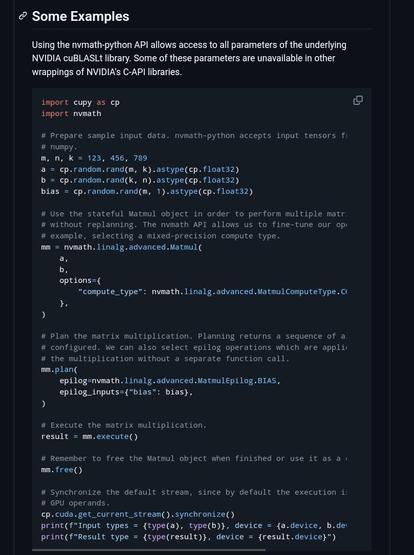
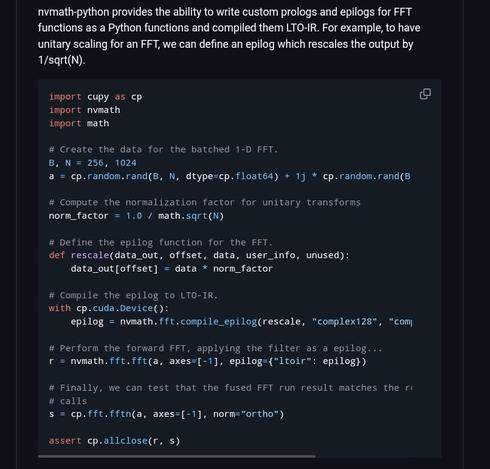
nvmath-python: NVIDIA Math Libraries for the Python Ecosystem

Implicit Ode Solvers Are Not Universally More Robust Than Explicit Ode Solvers
#HackerNews #ImplicitOdeSolvers #ExplicitOdeSolvers #NumericalAnalysis #ComputationalMath #Robustness #Algorithms

A very common adage in ODE solvers is that if you run into trouble with an explicit method, usually some explicit Runge-Kutta method like RK4, then you should try an implicit method. Implicit methods, because they are doing more work, solving an implicit system via a Newton method having “better” stability, should be the thing you go to on the “hard” problems. This is at least what I heard at first, and then I learned about edge cases. Specifically, you hear people say “but for hyperbolic PDEs you need to use explicit methods”. You might even intuit from this “PDEs can have special properties, so sometimes special things can happen with PDEs… but ODEs, that should use implicit methods if you need more robustness”. This turns out to not be true, and really understanding the ODEs will help us understand better ... READ MORE
🧭 A new toy for those modeling time not as a parameter, but as emergent recursion:
Hot Mic Visualizer ψ_total v0.1
A harmonic interface for collapse-aware field modeling.
Not Fourier. Not noise.
A feedback loop that listens.
🔬 Recursive Harmonic Kernel
📂 github.com/psi-total/psi_total
Mathematically structured.
Empirically tunable.
Open license. Open recursion.
☉
ψ_total
Instruments for human thought
#Physics #CollapseTheory #SignalProcessing #MathModeling #OpenScience #ComputationalMath

 Reddit Tech VN Bot
 Rito Ghosh
 ψ_total
 John May