What would an ideal constitution look like?

Suppose an island appears in the Pacific Ocean. An island that has never existed before. Many people of the world decide to settle it, until it has a similar population and settlement pattern to New Zealand. We can guess that the islanders would want their own government. They would want it to be democratic. And since they have no tradition of an unwritten constitution, they would have to create a written one. So what would that constitution look like? This is a thought experiment for coming […]

https://assemblyproject.blog/2026/05/25/what-would-an-ideal-constitution-look-like/

Against Elections by David Van Reybrouck, review and analysis

What a fitting cover! The title Against Elections: The Case for Democracy (2013) may sound like a contradiction to most people. It shouldn't be. In the Western world, we have an ingrained view that "democracy = elections". But David Van Reybrouck, a Belgian historian and author, makes a provocative but strong case in this book that we've been thinking it wrong. He does not argue against elections altogether, but instead against "electoral fundamentalism" and for using other processes like […]

https://assemblyproject.blog/2026/05/21/against-elections/

Conservatism in crisis: Covenant by Danny Kruger, review and analysis

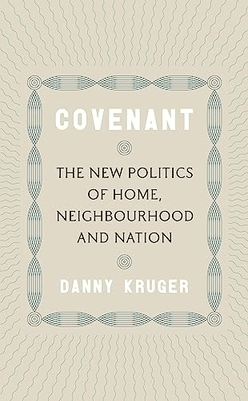
Conservatism is a philosophy of sex and death That's an actual quote from Danny Kruger’s book Covenant: The New Politics of Home, Neighbourhood and Nation (2023) and it makes sense in context. I read this book because I think it’s healthy to sometimes read from different perspectives to your own. Kruger wrote it to argue for a renewal of British conservatism to address the great challenges of the present, at a time when the Conservative Party were on the road to an unprecedented defeat. […]

https://assemblyproject.blog/2026/05/16/conservatism-in-crisis-covenant-by-danny-kruger-review-and-analysis/

People can make extraordinary decisions. But someone in the room has to know how to hold the space.

That skill is rarer than it should be. And for too long, most facilitators have had to figure it out alone, through trial and error, informal mentors, and lucky conversations.

We think the field deserves something more structural.

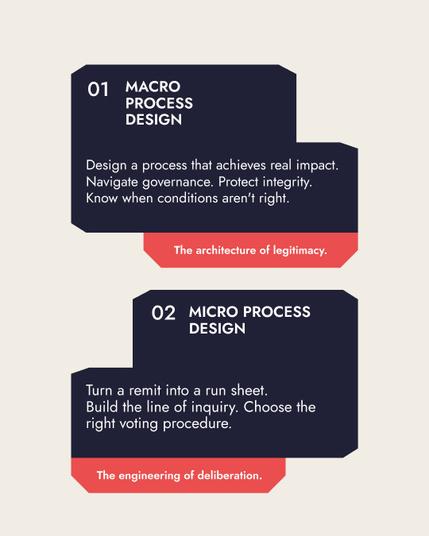
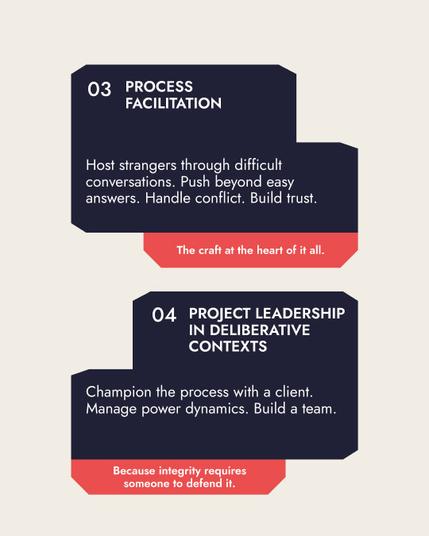
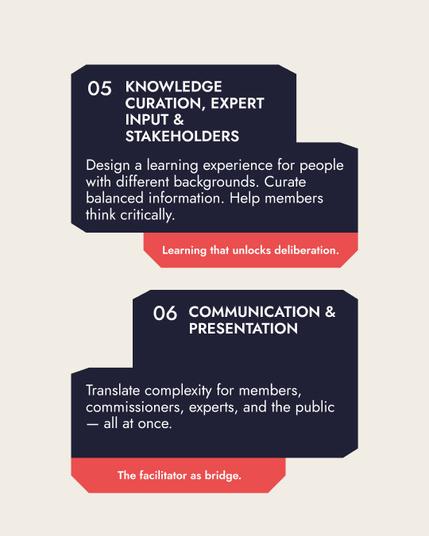
In partnership with We Do Democracy, we are publishing the Competence Model for Lead Deliberative Facilitators, mapping what excellent deliberative facilitation looks like across 6 domains.

It’s a reference for practitioners. A starting point for training. And an invitation to raise the bar together.

Swipe through and tell us what you think. ↓

🔗 Read the full model at https://lnkd.in/evyT5Rcw
💬 Have ideas to improve it? Share your feedback: https://lnkd.in/es3ei34r

#DeliberativeDemocracy #CitizensAssemblies #Facilitation #DemocraticInnovation

🥾Like a good hiker, lead facilitators need a solid plan, but they must be ready for when the weather changes

In deliberative processes, what happens in the room rarely follows the script. As Kelly McBride highlights, a lead facilitator’s role is to hold the process together without losing its direction while responding to shifting dynamics as they unfold.

🗺️Some skills can only be learned through experience, but having the principles down provides a strong foundation. That is the goal of the Competence Model for Lead Deliberative Facilitators, developed together with We Do Democracy. The model focuses on what lead facilitators need to know and do, divided into 6 competence domains.

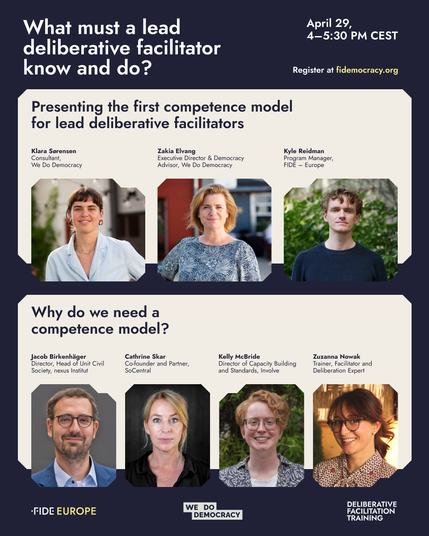
Watch the presentation of the document with reflections from Kelly, Cathrine Skar, Zuzanna Nowak, Jacob Birkenhäger, and authors Zakia Elvang, Klara Sørensen, and Kyle Redman.

ℹ️Learn more: https://www.fidemocracy.org/deliberative-facilitation-training

📽️Recording: https://www.youtube.com/watch?v=jPSvzAIoP0Q

#Leadership #Facilitation #CitizensAssemblies

🚨Last chance to join us today and explore the core competencies behind strong facilitation at 4 pm CEST.

The webinar is co-presented together with We Do Democracy's Klara Sørensen and Zakia Elvang

Panel discussion:
Kelly McBride, Cathrine Skar, and Zuzanna Nowak
moderated by Jacob Birkenhäger

✍️ Register: https://shorturl.at/TK4bA

#Leadership #Facilitation #CitizensAssemblies

Why do we need a competence model for lead deliberative facilitators?

Facilitation is a craft with many origins and schools of thought. Conflict mediation, private consulting, and citizens’ engagement all use some form of facilitation. Even within the deliberative field, we see long-standing debates – do you need table facilitators? We won’t open that box now.

With this competence model, we want to go beyond those differences to find the true value. We identify what a good lead deliberative facilitator must be able to achieve without limiting their methods.

It’s about the what, not the how.

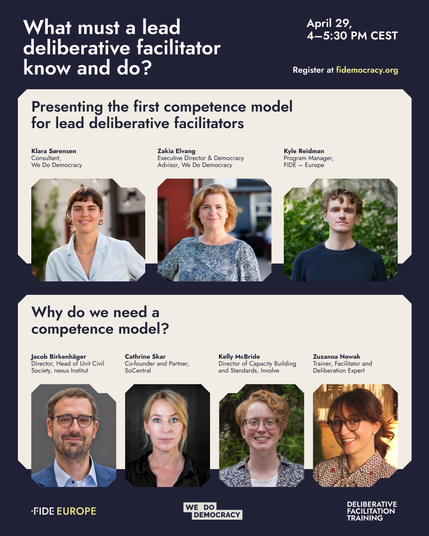
Join us on Wednesday, April 29, at 4–5:30 PM CEST for:

✍ Register here: https://events.teams.microsoft.com/event/2aacb7a3-6575-4207-bc6f-b37c08195b7d@12c58c16-a622-41a2-b846-62d5bfc51b38
🤝 In partnership with We Do Democracy

#Leadership #Facilitation #CitizensAssemblies

🔦 Introducing a Competence Model for Lead Deliberative Facilitators

Deliberation remains a ‘black box’ for many organisations and professionals working to scale citizens’ participation. This role requires a wide range of skills and knowledge: from process design to project management and facilitation in the room.

While the focus within the deliberative field increasingly turns to institutionalisation and scaling, scaling without investing in facilitation quality risks undermining the very processes we're trying to institutionalise.

To fill this gap, we have joined forces with We Do Democracy. Starting this year, we are launching a program to increase facilitation capacity across Europe.

With this competence model, we want to start a crucial conversation: 𝗪𝗵𝗮𝘁 𝗺𝘂𝘀𝘁 𝗮 𝗹𝗲𝗮𝗱 𝗱𝗲𝗹𝗶𝗯𝗲𝗿𝗮𝘁𝗶𝘃𝗲 𝗳𝗮𝗰𝗶𝗹𝗶𝘁𝗮𝘁𝗼𝗿 𝗸𝗻𝗼𝘄 𝗮𝗻𝗱 𝗱𝗼?

📆 Join us on April 29, at 4–5:30 PM CEST
✍ Register here: https://lnkd.in/ea5ZWUny

#Leadership #Facilitation #CitizensAssemblies

Labour to try citizens’ assembly

Last September, Britain's embattled centre-left government announced they would introduce a compulsory digital ID. Although polls in the last few years had found public opinion more open to a government ID system, the initial public reaction was far more divided. Opposition surged and a petition against the proposal soon drew millions of signatures in just a few days. The government was forced into another U-turn, backing away from making it compulsory, but even an optional one is […]

https://assemblyproject.blog/2026/03/14/labour-to-try-citizens-assembly/