 StudentsCircles
🔍 Buro Happold Careers 2025 🔍
💼 Job Role: Electrical Engineer
🔗 https://studentscircles.com/buro-happold-careers/
💬 Join Our WhatsApp Group: https://bit.ly/waalerts
✅ Comment #INTERESTED below, to get shortlisted in 6 hours.
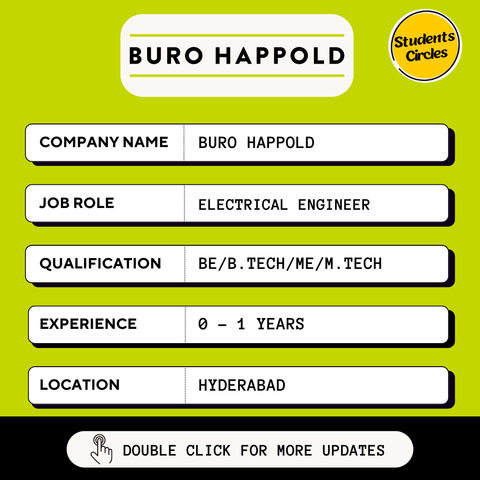
🔍 Buro Happold Careers 2025 🔍
💼 Job Role: Electrical Engineer
🔗 https://studentscircles.com/buro-happold-careers/
💬 Join Our WhatsApp Group: https://bit.ly/waalerts
✅ Comment #INTERESTED below, to get shortlisted in 6 hours.
Buro Happold works with indigenous builders to develop climate resilience strategies for cities
Roofs made from living trees and floating houses on reed islands are among the urban planning concepts developed by engineering studio Buro Happold in collaboration with indigenous communities as part of an installation called Symbiocene.
The project, commissioned for the exhibition Our Time on Earth at London's Barbican Centre, presents three proposals for how indigenous building technologies could be applied to cities by 2040 to make them more resilient to climate breakdown without contributing to it.
Visualised through architectural models overlaid with video projections, each concept is based on a nature-based design strategy developed by different aboriginal communities from around the world – the War Khasi of north-eastern India, the Ma'dan of southern Iraq and Bali's Subak farming cooperatives.
Symbiocene features models with overlaid animations (top image) by Buro Happold visualisation lead Paul Eastell (above)
Through a series of workshops between the first nation builders and engineers from British firm Buro Happold, these technologies were applied to the most pressing environmental issues facing our cities – water scarcity, rising temperatures and sea levels.
"Cities all over the world are completely aware that conventional construction is very problematic in terms of the climate emergency and ongoing resilience," said Buro Happold's sustainability director Smith Mordak.
"We have solutions but we're usually looking in the wrong places. If we collaborate with indigenous communities, who have been developing technologies that are respectful of the way that ecosystems work for centuries, then we can have a vision for 2040."
One concept is based on the Ma'dan's floating reed islands. Image courtesy of Julia Watson
The first Symbiocene concept uses the floating islands made from layers of reed, on which the Ma'dan build their homes in the marshes of southern Iraq, to help retrofit coastal communities so they can survive higher sea levels.
This would involve jacking up lighter at-risk structures like single-family houses and building a structure underneath so they can be lifted onto reed islands and turned into off-grid homes with their own energy supply and composting toilets.
"When the reeds decompose, they trap air so they create these buoyant bubbles, which means that the islands are floating," Mordak told Dezeen.
"And then you can create homes on them, you can farm on them because the layers upon layers of the reeds create an island and an earth. And underneath the islands, there are these amazing bio-havens that provide habitat for water life."
Homes could be lifted onto these floating islands to protect them from rising seas
Using pontoon bridges, these floating islands could then be connected to existing infrastructure that has survived on higher ground as well as larger buildings raised up on stilts.
In this way, the project hopes to offer an alternative to common flood resilience proposals like barge communities, which would require considerable resources to build from scratch.
"We talk a lot about retrofitting rather than building new and we wanted to apply some of that thinking to existing waterfront communities," Mordak said.
"A lot of the ideas that have been put forward are kind of like concrete pontoons but we were trying to look at a bio-based approach."
The second concept creates covered walkways from interwoven trees
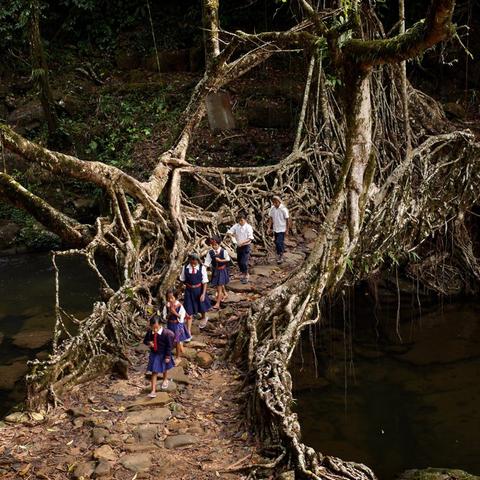
The second concept uses a trellising technique, which the War Khasi people use to construct bridges from living trees, to form a network of covered walkways connecting city dwellers to public transport stations.
Ficus trees with aerial roots would be planted at different levels over bamboo scaffolds and their roots and branches trained to form dense roof structures that can shield pedestrians from rising temperatures.
"This is particularly relevant in climates where it's getting hotter and actually cycling or walking for any distance is getting increasingly uncomfortable and difficult," Mordak said.
"The trees provide shade, improve air quality and lower surface temperatures through the process of evapotranspiration. That's going to make a big difference to how far people are willing and able to use those sustainable forms of transport."
[
Read:
Indigenous technologies "could change the way we design cities" says environmentalist Julia Watson
The final Symbiocene concept hopes to tackle the problem of water scarcity by moving away from a centralised "out of sight out of mind" water management system.
Instead, it proposes establishing small cooperatives at neighbourhood level, based on the Subak system used in Bali to irrigate rice terraces, which would see locals work together to distribute water according to need and encourage them to use this finite resource more responsibly
"Because water is managed at a local level with a small group of people, it's not abstract," Mordak said. "So you're going to think much more carefully about what you use, and you will be able to see the results."
This concept is based on the living root bridges of the War Khasi. Image by Timothy Allen courtesy of Julia Watson
Instead of purifying all water used across a city to drinking-water quality, the concept proposes a two-step nature-based system, in which neighbourhood reed beds are used to clean water for flushing, showering and other daily activities.
From here, local cooperatives would decide how much water needs chemical purification in order to make it drinkable for the community, with any wastewater used to irrigate nearby reed beds used for growing food.
"One of the questions that came up in the conversation was, why do we in western cities shit in drinking water," Mordak said.
"Why are we using a huge amount of energy and chemicals to create very clean, drinkable water and then we're using it for things that don't need that level of purification."
The third concept looks at cooperative local water management
To select the building techniques presented in the installations and establish relationships with the different communities, Mordak worked with Julia Watson, author of the much-publicised book LO–TEK Design by Radical Indigenism.
The installation forms an attempt at finding practical applications for some of the indigenous technologies outlined in the book within a dense urban environment.
"If we did a bit more work, you could build the concepts," Mordak said. "They're all intended to be completely realisable."
The idea is based on the Subak system for irrigating rice terraces. Image courtesy of Julia Watson
Alongside the concepts, Mordak and Watson also formulated a "smart oath", recorded on a public blockchain to set out how any kind of profits made from these ideas will be shared with the relevant communities.
"The project has been about how can we facilitate a fair and just knowledge exchange between ourselves, the engineers and landscape architects and architects, and the indigenous communities and the builders of these indigenous technologies," Mordak explained.
"If you're getting a bunch of design fees and you're using these ideas, these indigenous communities should be remunerated for their contribution. If we're not very clear about the way in which that should happen, then they could be exploited very easily."
All images are courtesy of Buro Happold unless otherwise stated.
Our Time on Earth takes place at London's Barbican until 29 August 2022. SeeDezeen Events Guide for an up-to-date list of architecture and design events taking place around the world.
The post Buro Happold works with indigenous builders to develop climate resilience strategies for cities appeared first on Dezeen.
#all #architecture #installations #landscapeandurbanism #conceptualarchitecture #burohappold #urbandesign #cities #climatechange


Buro Happold pledges to eliminate embodied carbon in projects as part of SE 2050 commitment
Engineering firm Buro Happold has become the latest signatory to the SE 2050 Commitment Program, which unites structural engineering firms behind the common goal to slash embodied carbon emissions from their projects by 2050.
Spearheaded by the Structural Engineering Institute (SEI) of the American Society of Civil Engineers, the pledge focuses specifically on tackling the emissions associated with structural systems, their construction and material use.
This accounts for the largest portion of a building's embodied carbon footprint, typically around 50 per cent, while the two most-used structural materials – steel and concrete – are together responsible for almost 12 per cent of all global greenhouse gas emissions.
It is here that structural engineers can make the biggest impact in the race to create a net-zero built environment by 2050 and help limit global warming to around 1.5 degrees Celsius in line with the Paris Agreement, according to Buro Happold principal Stephen Curtis.
"There has been, to date, a focus on operational carbon," he told Dezeen. "As structural engineers, we are more able to influence embodied carbon, so that is the focus for us."
"This is more than just a concrete and steel issue"
Buro Happold has already set a goal to halve the embodied carbon footprint of its projects by 2030.
By joining the Structural Engineers 2050 Commitment Program, the firm has extended this commitment to measuring, reducing and ultimately eliminating all embodied carbon emissions in its projects from structural systems by 2050.
The programme, which already counts Arup and SOM among its 69 signatories, provides engineering practices with the resources and guidance to achieve this goal, as well as for offsetting any hard-to-remove emissions that cannot be eliminated.
Buro Happold says this process will involve not just replacing and reducing polluting materials in its projects but, crucially, also educating the many other stakeholders that are involved in the process of getting a project built, from clients to planners and architects.
Stephen Curtis (above), who is leading Buro Happold's SE 2050 commitment, has also spearheaded the structural design of projects including the Science and Engineering Complex at Harvard University (top image)
"This is more than just a concrete and steel issue," Curtis said. "Structural engineers have been requiring cement replacement in concrete and recycled content in steel for a long time."
"We know we will need to educate and explain to the other stakeholders on our projects why this issue is important and what may be viable alternate options, whether that means timber construction or other alternate technologies," he added.
"To support this, we plan to undertake comparative embodied carbon assessments of our structural design options during the initial project phases, making carbon part of the decision-making process."
Architecture lagging behind other industries
The SE 2050 Commitment Program was formulated in response to a challenge originally put forward in 2019 by the Carbon Leadership Forum, a non-profit based at the University of Washington that is dedicated to radically reducing embodied carbon in the built environment through collective action.
On the other side of the Atlantic, more than 234 British structural engineers and their firms – including Buro Happold – have so far set their own net-zero carbon targets as signatories of Structural Engineers Declare.
[
Read:
Architecture "one of the least well-represented businesses" in UN's net-zero push, says UN climate champion
](https://www.dezeen.com/2021/06/28/carbon-emissions-architecture-race-to-zero-cop26-nigel-topping/)
Similar efforts are happening across the built environment sector, with the cement and concrete industry committed to reaching net-zero emissions by 2050.
Dezeen has set a more ambitious target of becoming a net-zero business by 2025.
But according to COP26 climate action champion Nigel Topping, architecture is still "one of the least well-represented businesses" in UN's Race to Zero campaign, with none of the 50 largest practices signed up so far.
Similarly, only 300 out of the Royal Institute of British Architects' 4,000 chartered practices are have currently committed to its net-zero carbon challenge.
The top photograph is byBrad Feinknopf.
The post Buro Happold pledges to eliminate embodied carbon in projects as part of SE 2050 commitment appeared first on Dezeen.
Architects and engineers have "significant potential to impact climate change" says Buro Happold
Dezeen promotion: the intelligence and technologies that architects need to decarbonise the built environment are accessible now and must be utilised, according to engineering consultancy Buro Happold.
Buro Happold said that designers of the built environment must urgently "decarbonise our buildings, infrastructure and energy supply" in order to help alleviate climate change.
The built environment is currently one of the biggest contributors to the changing climate, responsible for approximately 40 per cent of all greenhouse gas emissions.
"This past year has made apparent how communities globally are being deeply harmed by climate change, at a rapidly increasing rate," Buro Happold said.
"We have the intelligence and the technologies necessary to correct this now," the consultancy continued.
"As designers of the built environment, we have significant potential to impact climate change, and it is our responsibility to fully utilise that potential."
22 Gordon Street won the CIBSE Building Performance Award with 60 per cent energy use reduction per square metre. Photo by Jack Hobhouse
Architects must tackle whole-life carbon
Decarbonisation is the process of reducing or removing the carbon dioxide emissions from a particular output, such as a building or country.
According to the consultancy, in the built environment, this requires minimising the "whole-life carbon" of buildings – meaning both their embodied energy and operational energy.
However, Buro Happold said that efforts to minimise embodied energy – the emissions caused by the manufacturing, construction, maintenance and demolition of buildings – are rarely considered in the design process.
Consultants from Buro Happold petitioning for climate action in Los Angeles. Photo by Buro Happold
"It must be continuously recognised that the best method to avoid emitting embodied carbon is to make the best use of our existing building stock and reusing existing materials," Buro Happold explained.
"When new materials cannot be avoided, designers must prioritise specification of products and materials that have third-party verified Environmental Product Declarations, which disclose the amount of embodied carbon emitted in the manufacturing of the product," the consultancy continued.
"Embodied carbon needs to be considered a key criterion in material selection processes. We cannot afford to be complacent with this."
To help architects quantify the embodied carbon of their buildings and in turn minimise their whole-life carbon, Buro Happold has launched the BHoM LCA-Toolkit.
BHoM LCA-Toolkit is a life cycle assessment tool that helps architects calculate the whole-life carbon their building proposal could emit. It can also help architects better understand the amount of embodied carbon associated with both existing buildings and new construction.
"Decarbonisation will not be achieved working in silos"
Collaboration between different countries and policymakers in this way is critical if the built environment is to decarbonise, the consultancy said.
"In many climates, decarbonisation is already possible, and in others, the technologies are still emerging."
"Full decarbonisation will not be achieved working in silos, we must engage research institutions to jointly explore emerging technologies, manufacturers to develop necessary equipment, and policymakers to facilitate the use of such technologies."
The recladding and refurbishment of the University of Edinburgh icon, Appleton Tower led to a 20 per cent reduction in energy. Photo by Buro Happold
Architects must design for "new normal"
However, alongside decarbonising the built environment, Buro Happold added that it is also time to prioritise designing built environments that are resilient to the effects of a changing climate.
Protecting people from extreme weather events such as flooding and storms should be the core driver for design decisions across the world, Buro Happold said.
"The past year has shown us that the standards we must design have changed," the consultancy continued.
"Even if all current Paris agreement climate pledges are met, the world is expected to experience temperatures rising by about 2.4 degrees Celsius by the end of the century."
"We have reached the point where we must not only continue to fight climate change, but we must accept our new normal of natural disasters occurring at a frequency that is continuously increasing."
An example of this is Buro Happold's Los Angeles County Climate Vulnerability Assessment.
The project identifies "the people, systems, infrastructure, and places that are most vulnerable to the increasing impacts of climate change" in the County of Los Angeles and its 88 cities and is intended to help it prepare for the increasing impacts of climate change.
Find out more about Buro Happold's work by visiting its net zero carbon buildings or climate change adaptation and resilience consultancy services pages.
Top photo is the Santa Monica City Hall by Alex Nye.
Partnership content
This article was written by Dezeen for Buro Happold as part of a partnership. Find out more about Dezeen partnership contenthere.
The post Architects and engineers have "significant potential to impact climate change" says Buro Happold appeared first on Dezeen.
Watch our live talk about designing equitable spaces
A panel of experts will discuss designing sustainable and socially responsible cities around the world in this live talk produced by Dezeen for engineering firm Buro Happold. Watch here from 5:00pm London time.
Moderated by Dezeen's editor Tom Ravenscroft, the talk will feature Buro Happold's Heidi Creighton, Bartlett professor Priti Parikh, and Anna Marazuela Kim from The Centre for Conscious Design.
The speakers will explore social value in the built environment and the role of policy and context in the design process, with a specific focus on some of the challenges unique to the UK, USA and Asia.
The conversation, which is called The Case for Equitable Space, will also cover the impact of climate change on marginalised communities, sanitation infrastructure in rural and urban communities in south Asia, and the role of culture and the arts in spatial equity.
Heidi Creighton, associate principal at Buro Happold
Creighton is an architect, AIA fellow and associate principal at Buro Happold. For the past 15 years, her work has focused on creating a restorative built environment that aims to deliver socially, economically and environmentally sustainable developments.
Alongside her work at Buro Happold, Creighton also serves on the AIA California Committee of the Environment, which works to combat advancing climate change and natural resource depletion.
Bartlett professor Priti Parikh
Parikh is an associate professor at the Bartlett School of Construction and Project Management in London, where she heads the university's Engineering for International Development Centre.
Her work focuses on improving water, sanitation and energy infrastructure in slums and remote villages in south Asia, Africa and Latin America.
In addition to teaching at the Bartlett, Parikh is a fellow of the Institute of Civil Engineers and a board member of Engineers Against Poverty.
She is also a trustee of Buro Happold's charity, The Happold Foundation, which works with young people, educators and researchers to shape a community dedicated to improving the built environment.
In 2019, Parikh was recognised as a leading change-maker by Engineers Without Borders.
Anna Marazuela Kim from The Centre for Conscious Design
Kim is a cultural thinker, advisor and activist with a background in philosophy, history of art and architecture.
Her work explores urban theory and practice across academic institutions, research groups and cultural organisations.
Kim currently holds the position of director of cultural innovation and strategic partnerships at The Centre for Conscious Design, an international grassroots think tank that aims to use design to alleviate complex social and urban issues.
She is also a member of London Metropolitan University's interdisciplinary research initiative, The Centre for Creative Arts, Cultures and Engagement.
Alongside her research and practice, Kim is also a consultant for architecture studio Foster + Partners and cultural consultancy firm Futurecity in London.
This live stream was produced by Dezeen forBuro Happold as part of a partnership. Find out more about Dezeen's partnership contenthere.
The post Watch our live talk about designing equitable spaces appeared first on Dezeen.
#architecturetalks #designtalks #all #architecture #infrastructure #talks #videos #sustainabledesign #uk #burohappold #usa #climatechange #livestreams #asia
Calligraphy-covered Museum of the Future nears completion in Dubai
Photos reveal the Museum of the Future in Dubai, which was designed by architecture studio Killa Design and engineered by Buro Happold, with its exterior largely complete.
Created for the Dubai Future Foundation, the Museum of the Future will contain exhibitions on innovative design and was designed to have a dynamic form that represents the Dubai government's view of the future.
Located alongside Dubai's elevated train line a short distance from the Burj Khalifa, the torus-shaped building forms a ring around a void that was designed to represent unknown knowledge.
The Museum of the Future is nearing completion in Dubai
"The Museum of the Future aims to be a catalyst for pioneering concepts and ideas, inspiring those who see and visit the building to innovate, create and discover," said Tobias Bauly, project director at Buro Happold.
"The core concept of the building was to create a form that represents the client's vision of the future – dynamic and innovative," he told Dezeen. "The torus shape of the building captures the perpetual energy of the city."
It has a calligraphy-covered exterior
The exterior of the building is covered with windows that form a poem by Dubai's ruler Sheikh Mohammed about his vision for the city's future, written in Arabic calligraphy.
To create the desired form and unique cladding, while aiming for a sustainability rating of LEED Platinum, Killa Design and Buro Happold developed new parametric modeling tools.
These included a "growth algorithm" that was used to "digitally grow" the building's internal steel structure.
The calligraphy forms a poem written by Dubai's ruler
"Parametric design tools were developed for the project to solve specific design and buildability challenges," said Bauly.
"The resulting digital optimisation fundamentally enabled feasible and efficient design solutions to be realised for primary aspects of the project such as the structural diagrid, the facade and its glazing," he continued.
"The original vision of the shape, along with its inherent complexity, was never comprised to enable something 'similar' or 'easier' to be built in its place," he added. "That would have been the easy way out!"
Windows are calligraphy-shaped
Created with the aim of making one of the "most advanced buildings in the world", the studio says the museum exemplifies a new, digital design approach.
"At the outset, the project aspired to drive our industry towards a new digital approach to design and construction, and the project has delivered on that aspiration," said Bauly.
"Our project architects and engineers have gone through a digital transformation of their own, along with this building. And yet at the heart of it all is a lesson in the continued need for teams of people to work collaboratively to create, innovate and look towards our future. "
The building aims to encourage digital design
This year Dubai will host the Expo 2020 Dubai, which was postponed due to coronavirus. The organisers recently released images of buildings by Adrian Smith + Gordon Gill, Grimshaw and Foster + Partners that will host the event.
Photography is by Phil Handforth.
Project credits:
Client: Dubai Future Foundation
Developer: North25
Architect: Killa Design
Lead consultant (design, site supervision & contract administration): Buro Happold:
Structural engineering, facade engineering, sustainability, building services engineering: Buro Happold
Bridges, transport, infrastructure, geotechnical engineering, access, people flow modelling, fire and life safety, specialist lighting, acoustics, waste & logistics: Buro Happold
AoR/EoR: Rice Perry Ellis Cracknell (Landscape),
AV/ICT: Mediatech
VT: RBA
Civils: CDM Smith
Programming: Matrix
H &S: Atkins
Security: Arkan
Auditorium: Theatre Projects
The post Calligraphy-covered Museum of the Future nears completion in Dubai appeared first on Dezeen.
#all #cultural #architecture #news #dubai #burohappold #museums

 dezeen (unofficial)


