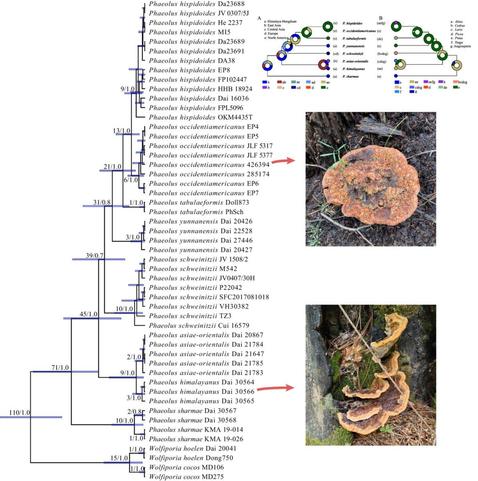
🍄The #fungal genus Phaeolus is a major #conifer #pathogen.
🌲Cui et al. explore its #phylogeny, #divergence times, and #biogeography, laying the foundation for future pathogen control and #ecological #conservation.
🔗https://doi.org/10.1111/jse.13187 @WileyEcolEvol #JSE #forestry #trees #botany
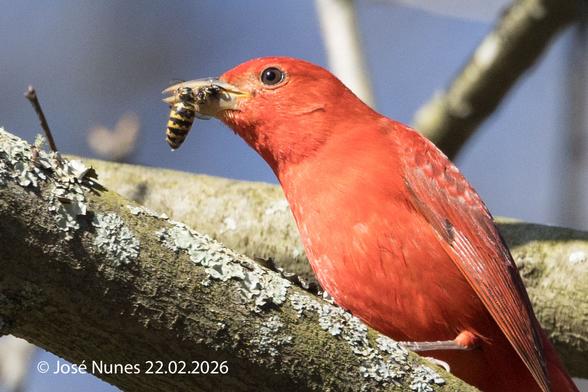
Le Piranga vermillon, un migrateur aux couleurs de feu, à Porto au Portugal

Piranga rubra par © José Nunes 22.02.2026 à Porto (Portugal) Le matin du lundi 23 février 2026, je découvre sur mon mur Facebook une très belle photo d’un Piranga vermillon (Piranga rubra) à Porto,…

paysages

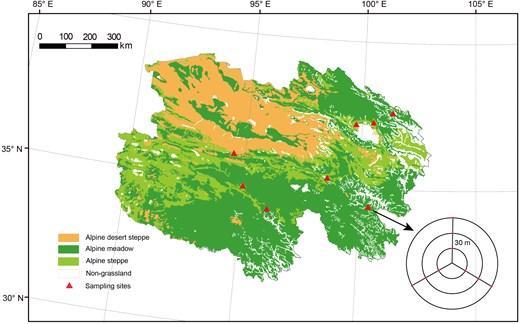
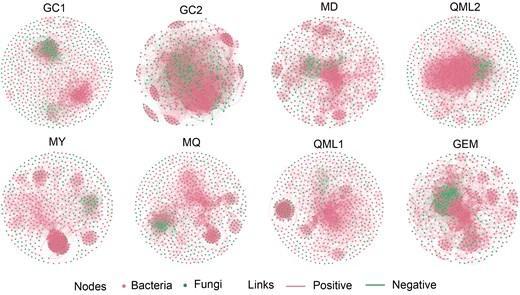
#PhyllosphereMicrobiota showed a significant non-linear environmental gradient effect in #AlpineGrasslands on the Qinghai–Tibetan Plateau, which was mostly explained by climate factors, especially annual precipitation.

#Biogeography | #MicrobialNetwork | #EcosystemMultifunctionality

https://doi.org/10.1093/jpe/rtaf133

New publication: On the role of #mutualisms in #plant #biogeography: consequences for ecology, evolution, and invasion.
https://doi.org/10.1111/nph.70465
Die Zukunft der Natur – Wie sich Tiere und Pflanzen an den Klimawandel anpassen

Die Klimaerwärmung hat Auswirkungen auf die Tier- und Pflanzenwelt, an die viele gar nicht denken. Tiere werden kleiner, manche ändern ihr Verhalten. Ameisen scheinen aggressiver zu werden. Eingespielte Rhythmen geraten aus dem Takt. Ob Fisch oder Vogel – vieles ist im Wandel.

SWR Kultur
Interesting case of recent human-modulated geodispersal which was enabled by the building and functioning of the Suez Canal. Interesting to think about this case as an analogue of ancient tectonic restructuring of seaways 👇
https://t.co/k6Qdu82nti
🧪 ⚒️ #Paleobio #Geology #Macroecology #Biogeography

Neozealandia (Biogeography 🌍)

Neozealandia is a biogeographic province of the Antarctic Realm according to the classification developed by Miklos Udvardy in 1975.

https://en.wikipedia.org/wiki/Neozealandia

#Neozealandia #Biogeography #EnvironmentOfNewZealand

Neozealandia - Wikipedia

Nunatak hypothesis (Phytogeography 🌱)

In biogeography, particularly phytogeography, the nunatak hypothesis about the origin of a biota in formerly glaciated areas is the idea that some or many species have survived the inhospitable period on icefree land such as nunataks. Its antithesis is the tabula rasa hypothesis, which posits that all s...

https://en.wikipedia.org/wiki/Nunatak_hypothesis

#NunatakHypothesis #IceAges #Biogeography #Phytogeography #BiologicalHypotheses #PrehistoryOfTheArctic

Nunatak hypothesis - Wikipedia

Antarctic realm (Biogeography 🌍)

The Antarctic realm is one of eight terrestrial biogeographic realms. The ecosystem includes Antarctica and several island groups in the southern Atlantic and Indian oceans. The continent of Antarctica is so cold that it has supported only 2 vascular plants for millions of years, and its flora presently consists of around 250 lichens, 100 mosses,...

https://en.wikipedia.org/wiki/Antarctic_realm

#AntarcticRealm #Biogeography #Phytogeography #BiogeographicRealms

Antarctic realm - Wikipedia

Blakiston's Line (Biogeography 🌍)

The Blakiston Line or Blakiston's Line is a faunal boundary line drawn between two of the four largest islands of Japan: Hokkaidō in the north and Honshū, south of it. It can be compared with faunal boundary lines like the Wallace Line. Certain animal species can only be found north of Blakiston's Line, while certain other species can only be f...

https://en.wikipedia.org/wiki/Blakiston's_Line

#BlakistonSLine #Biogeography #GeographyOfJapan #1883Introductions

Blakiston's Line - Wikipedia