
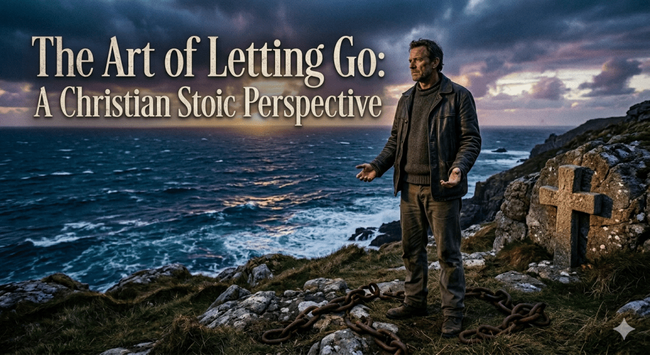
The Art of Letting Go: A Christian Stoic Perspective

2,773 words, 15 minutes read time.

The Myth of Control and the Idolatry of the Grip

You think you are holding your life together, but you are really just strangling it. Your knuckles are white because you believe that if you let go of the wheel for even a second, the whole car goes off the cliff. This is the great lie of the modern age and the primary rot in your soul. You treat your plans, your kids, your money, and your health like they belong to you. They do not. When you try to own what you only have on loan, you turn into a slave to fear. True strength is not found in a tighter grip but in the steel-toothed resolve to open your hand and look at the sky. You are not the boss of the world, and every second you spend acting like the CEO of the universe is a second you spend in a dark room fighting a ghost that will always win.

Why Your Need for Certainty is a Spiritual Failure

The deep urge to know exactly what happens tomorrow is a form of pride that eats men alive. You want a map because you do not trust the One who made the road. In the cold light of reality, your worry does not add a single hour to your life or a single penny to your bank account. It only burns out your heart and makes you a burden to everyone around you. You call it being “prepared” or “responsible,” but it is really just a lack of faith wrapped in a suit and tie. A man who cannot let go is a man who thinks his brain is bigger than God’s will. This is the ultimate failure of the human spirit because it places your tiny, fragile ego at the center of the world. You are trying to play a part that was never written for you, and the weight of that role is crushing your chest every time you try to sleep.

The Violent Collision of Human Will and Divine Sovereignty

The old Stoics had it half right when they said we should only care about what we can control, but they missed the punchline. They thought the mind was the ultimate fortress, but the Christian knows that even the mind belongs to the Maker. When your will slams into what God has planned, you are the one who is going to break. You cannot out-think a storm and you cannot out-muscle a tragedy. The collision is violent because you are stiff and brittle instead of being fluid and submissive. You fight against the “what is” because you are obsessed with the “should be.” But “should be” is a fantasy that kills your ability to live in the truth. Submission is the only way to survive the impact. It is the act of looking at a wreck and realizing that even in the debris, there is a design you are too small to see.

The Problem: The High Cost of Holding On

Your body knows you are lying to yourself long before your mind admits it. When you refuse to let go, your biology pays the bill that your pride ran up. Science shows us that the human frame was never built to carry the weight of the future. Chronic worry keeps your system flooded with chemicals meant for escaping a predator, but you are using them to sit at a desk and fret about things that have not happened yet. This constant state of high alert grinds down your heart, ruins your gut, and clouds your brain. You think you are being a hero by carrying the world on your back, but you are really just a man breaking his own spine for a prize that does not exist. The data is clear: those who cannot release their grip on outcomes experience a massive spike in inflammatory markers and a total collapse of their immune response. You are literally rotting from the inside because you refuse to acknowledge your own limits.

Data on the Physiological Toll of Chronic Worry and Rigidity

The numbers do not care about your feelings, and they tell a brutal story of what happens when you try to play God. Research from major health institutions shows that the physical cost of mental rigidity is a shortened life and a dimmed mind. When you live in a state of constant “what-if,” your blood pressure stays in the red zone and your sleep becomes a shallow, useless rest. This is not just about feeling stressed; it is about the structural failure of your physical vessel. The stress hormone cortisol is supposed to be a tool for survival, but for the man who won’t let go, it becomes a slow-acting poison. It eats away at your bone density and shrinks the parts of your brain responsible for clear thought and memory. You are sacrificing your health for the illusion of safety, trading your actual life for the mere feeling of being in charge. It is a sucker’s bet that leaves you bankrupt in the end.

A Case Study in Paralysis: When Planning Becomes a Prison

Look at the ruins of any great project or personal life that ended in a heap, and you will find the fingerprints of a man who planned too much and trusted too little. Industry data reveals that the most common reason for catastrophic failure is not a lack of effort, but a refusal to pivot when the ground shifts. There is a specific kind of paralysis that happens when you become so attached to a specific outcome that you cannot see the exit ramp God has provided. You build a prison out of your own expectations and then wonder why the air feels thin. When the market turns, or the health report comes back dark, or the person you love walks away, the rigid man snaps like a dry twig. He has no “give” in his soul because he has spent years convincing himself that his plan was the only way forward. This rigidity is a death sentence in a world that is constantly in motion. You cannot navigate a changing sea if you have bolted your rudder in one direction.

The Root Cause: Misunderstanding the Nature of the Gift

The reason you cannot let go is that you have a warped view of what you actually own. You walk around acting like you built the earth you stand on and brewed the air you breathe. This is a fundamental error in your logic. Every single thing in your life—your sharp mind, your strong hands, the people who love you, even your very next breath—is a gift that was handed to you by someone else. You are not a builder; you are a tenant. When you forget this, you start to view the natural end of things as a personal robbery. You get angry at the sky when it rains on your parade because you think you bought the rights to the sunshine. But the Christian Stoic looks at the world and sees a vast collection of borrowed items. You cannot lose what you never truly owned, and once you realize that everything is a loan from the Creator, the fear of losing it loses its teeth. You can enjoy the meal without being terrified of the empty plate that follows.

The Christian Correction to Stoic Self-Sufficiency

The old Stoic masters thought they could reach peace through sheer brainpower and a cold heart. They believed that if they just toughened up their minds, they could stand alone against the world. They were wrong. Self-sufficiency is just another name for a different kind of prideful prison. The Christian knows that we are not enough on our own, and we were never meant to be. Our strength does not come from a hollowed-out heart that feels nothing, but from a filled-up soul that trusts the Father. You don’t let go because you are “tough”; you let go because you are held by something bigger than yourself. Stoicism without Christ is just a lonely man in a cold room trying to stay warm by hugging himself. Christianity takes that discipline and gives it a target. You don’t just “not care” about the outcome; you actively hand the outcome over to the only One who actually knows what to do with it. This isn’t weakness; it is the highest form of tactical intelligence.

Seeing Every Attachment as a Loan, Not a Right

If you want to stop the bleeding in your spirit, you have to change your vocabulary from “mine” to “ours” or “His.” Every morning you wake up, you should do a mental inventory of everything you value and acknowledge that you have zero legal right to keep any of it. Your career is a stewardship, not a throne. Your family members are souls entrusted to your care for a season, not extensions of your own ego. When you treat your life like a series of short-term loans, the sting of “letting go” vanishes because you were always prepared to return the items to the rightful owner. This mindset shifts you from a defensive, panicked posture to one of gratitude and readiness. You stop fighting the repo man and start thanking the Provider. This is the only way to live with an open hand in a world that is designed to take things away. You realize that the hand that takes is the same hand that gave, and that hand has a much better track record than yours does.

Actionable Fixes: How to Open Your Hands Without Losing Your Soul

If you want to stop the internal bleeding, you have to train your soul to stop flinching every time the world moves. This is not about a soft, passive surrender where you lay in the dirt and let life kick you. It is about a calculated, aggressive release of the things you cannot change so you can put all your fire into the things you can. You start by looking at your fears in the face and stripping them of their power. You do not hide from the worst-case scenario; you walk right up to it, look it in the eye, and realize that even if the world ends, your soul is anchored in something that cannot burn. You practice the art of being ready for anything by being attached to nothing but the Truth. This requires a daily, grueling discipline of the mind where you consciously identify your idols—those things you think you “need” to survive—and you hand them over before they are snatched from you.

The Practice of Premeditatio Malorum Through a Cruciform Lens

The Stoics used a trick called the premeditation of evils, where they would imagine everything going wrong to take away the shock of failure. As a Christian, you take this further. You do not just imagine the house burning down or the job disappearing; you see those things through the lens of the Cross. You realize that the worst thing that could ever happen already happened to the only innocent Man who ever lived, and God turned that execution into the greatest victory in history. When you look at your own potential disasters this way, they lose their fangs. You can imagine losing your wealth because you know your treasure is not kept in a bank. You can imagine losing your reputation because you know your name is written in a place where men cannot reach it. This is not being a pessimist; it is being a realist who knows the ending of the story. You walk through the dark valleys of your imagination and realize that even there, you are not alone, which makes you the most dangerous man in the room—a man who cannot be intimidated.

Active Submission as the Ultimate Form of Strength

Most people think submission is for the weak, but they are dead wrong. Letting go is a violent act of the will. It takes more muscle to keep your hands open when the wind is howling than it does to curl them into useless fists. Active submission means you show up, you work like a dog, you do your duty, and then you leave the results at the altar. You stop trying to manipulate people and events to fit your script. You act with total intensity in the present moment and then you step back and let the chips fall where they may. This is the ultimate form of strength because it makes you untouchable. If you do not need a specific result to be at peace, then the world has no hooks in you. You are free to speak the truth and do the right thing because you are not a slave to the consequences. This is the freedom of a soldier who knows the General is competent; you just do your job and trust the strategy even when you are standing in the smoke.

Conclusion: The Freedom Found in the Final Surrender

At the end of the day, you are going to let go of everything anyway. Death is the final “letting go” that no man can avoid. You can either spend your life practicing for that moment, or you can spend your life fighting a losing battle until your fingers are pried back by force. The Art of Letting Go is really just the art of living in reality. It is the realization that you are a small part of a massive, beautiful, and sovereign plan that you do not need to understand to be a part of. When you stop trying to own the world, you finally become free to enjoy it. You can love your wife, your kids, and your work with a fierce intensity because you are no longer trying to suck your identity out of them. You are no longer a starving man trying to eat a stone.

The peace you are looking for is not at the end of a successful plan; it is at the beginning of a total surrender. It is found in the simple, simple realization that you are not God, and that is the best news you will ever hear. You can breathe now. You can put the weight down. The universe will keep spinning without your help, and the One who keeps it moving loves you more than you love your own life. Open your hands. Look at the sky. Your knuckles have been white for far too long, and it is time to let the blood flow back into your fingers. Stand up, do your duty, and leave the rest to the King. That is the only way to live, and it is the only way to die.

Call to Action

The time for white-knuckled living is over. You’ve read the truth, and now you have a choice: you can walk away and keep trying to choke the life out of your circumstances, or you can finally drop the weight.

Take the first step toward a loose grip today.

Pick the one thing that has been keeping you awake at night—that one outcome you are trying to force through sheer willpower. Write it down on a piece of paper, look at it, and realize it was never yours to control. Offer it up, leave it on the table, and walk out of the room.

The world won’t end when you stop trying to hold it up. In fact, that’s exactly when your life truly begins.

Stand up. Open your hands. Do your duty. Leave the rest to the King.

SUPPORTSUBSCRIBECONTACT ME

D. Bryan King

Sources

Disclaimer:

The views and opinions expressed in this post are solely those of the author. The information provided is based on personal research, experience, and understanding of the subject matter at the time of writing. Readers should consult relevant experts or authorities for specific guidance related to their unique situations.

#activeSubmission #biblicalMindset #biblicalStoicism #biblicalSurrender #ChristianEthics #ChristianLiving #ChristianStoicism #ChristianWorldview #chronicWorryFix #cortisolAndStress #cruciformPerspective #dailyDiscipline #divineSovereignty #dutyAndFaith #emotionalGrit #emotionalResilience #endurance #eternalPerspective #faithAndLogic #faithOverFear #findingPeace #gritLitTheology #hardboiledSpirituality #heartOfStone #humilityInAction #idolatryOfControl #lettingGo #lettingGoOfFear #lettingGoOfOutcomes #masculineFaith #mentalRigidity #mentalToughness #overcomingAnxiety #overcomingPride #peaceOfMind #physiologicalTollOfWorry #premeditatioMalorum #providenceOfGod #psychologicalHealth #radicalTrust #releaseControl #resilienceTraining #sovereignGrace #spiritualDiscipline #spiritualFreedom #spiritualMaturity #spiritualWarfare #stoicExercises #StoicPhilosophy #stoicismVsChristianity #strengthInWeakness #stressManagement #sufferingAndFaith #surrenderToGod #theologicalGrit #trustInGod #trustTheProcess #wisdomLiterature
Breaking Down Arrogance, Pride & Fear Before God – How Can We Truly Surrender?

3,572 words, 19 minutes read time.

The God revealed in The Holy Bible is not insecure, not diminished, and not strengthened by human applause. He does not wake up hoping we validate Him. He is eternally self-existent, self-sufficient, and surrounded by glory that never flickers. The real issue is not whether God receives praise. The issue is whether we understand who we are before Him.

Scripture makes it clear that if humanity refused to open its mouth, creation itself would erupt. Jesus declared that stones would cry out if people were silent. Heaven is not short on worship. According to Isaiah’s vision, the seraphim cry “Holy, holy, holy” without rest. Day and night. No fatigue. No boredom. No ego. Just perpetual awe before infinite holiness. God is not pacing heaven hoping we sing louder. He is enthroned in glory whether we participate or not. So the question shifts. If He does not need our praise, why does He command it?

Because we need it. And more specifically, we need His grace.

Why Pride and Fear Make Real Surrender Impossible

Pride is not loud confidence. Pride is self-exaltation in the presence of a holy God. It is the internal posture that says, consciously or not, “I deserve to be here. I deserve grace. I deserve mercy. I deserve blessing.” That posture collapses under biblical scrutiny. Romans makes it clear that all have sinned. Jeremiah declares that the heart is deceitful. James states plainly that God opposes the proud. Not ignores them. Opposes them. The Creator of galaxies sets Himself against arrogance. That should sober anyone breathing.

But pride rarely walks alone. It is usually armored with fear.

Fear of looking foolish. Fear of losing control. Fear of surrendering image. Fear of being exposed. Pride and fear operate like twins protecting the same throne — self. When a person stands rigid before God, unwilling to bow internally or externally, it is rarely about personality. It is about control. It is about maintaining dignity before others. It is about preserving identity that has not yet been crucified. Scripture never treats this lightly. In the Psalms, commands are not suggestions. Clap your hands. Lift your hands. Shout to God. Bless the Lord. These are imperatives rooted in divine authority, not denominational preference.

Here is the uncomfortable truth: folded arms before a holy God often reveal a guarded heart. Not always, but often. And Scripture does not allow us to hide behind temperament when it comes to obedience. If the Word commands visible expressions of worship, then obedience is not optional. The issue is not volume or personality. The issue is submission.

The arrogance of thinking we can stand unmoved before the One who spoke light into existence is breathtaking. He formed humanity from dust. He sustains every breath. Acts declares that in Him we live and move and have our being. If breath is in our lungs, it is borrowed. And borrowed breath was never meant for silent self-preservation. It was meant to glorify the Giver.

God Is Surrounded by Praise — We Are Surrounded by Need

One of the most humbling realities in Scripture is that heaven does not pause when we disengage. Isaiah saw seraphim covering their faces before God’s holiness. John, in Revelation, witnessed living creatures declaring holiness without rest. Hebrews speaks of innumerable angels in festal gathering. The throne room is not short on worship. God is not waiting on human affirmation to feel exalted. He is already exalted above the heavens.

This dismantles religious ego instantly. If a church service lacks passion, heaven does not dim. If a leader feels too dignified to lift their hands, the angels do not skip a beat. Holiness continues. Glory continues. Worship continues. The Lord remains enthroned. His majesty is untouched by human indifference.

So why command praise at all?

Because praise is not for God’s ego. It is for our transformation.

You cannot genuinely magnify God and magnify yourself at the same time. One diminishes as the other increases. You cannot stand in awe of His holiness and remain inflated with self-importance. True praise crushes arrogance because it forces perspective. It reminds the soul who is Creator and who is created. It exposes how small we are and how dependent we remain. And that is where grace becomes visible.

Grace is never owed. That must be said without softening it. God owes humanity nothing. Not mercy. Not breath. Not another sunrise. The cross was not a payment of obligation. It was an act of sovereign mercy. When pride creeps in, we subtly shift from gratitude to entitlement. We begin to act as if forgiveness is expected. As if blessing is guaranteed. As if access to God is casual. Scripture never supports that tone.

When Isaiah encountered God’s holiness, he did not negotiate. He said, “Woe is me.” When Peter recognized the divine power of Christ, he said, “Depart from me, for I am a sinful man.” Real encounters produce collapse, not coolness. They produce humility, not management.

And this is where the heart of the issue lies. Familiarity breeds arrogance. The longer someone handles sacred things without trembling, the easier it becomes to treat holiness as common. Leaders are not immune. Length of service does not reduce the requirement of reverence. If anything, it increases accountability. To grow accustomed to holy ground is spiritually dangerous. Scripture shows repeatedly that God resists those who grow comfortable in pride.

True surrender begins when we understand this: God does not need our praise to be God. We need His grace to survive being sinners before Him.

And surrender is not emotional hype. It is alignment. It is yielding control. It is acknowledging that every breath, every gift, every opportunity flows from mercy we did not earn. It is dropping the illusion of self-sufficiency. It is laying down the image we protect and admitting that without Christ we are lost.

Praise, when commanded in Scripture, becomes the training ground for humility. It forces the body to align with the soul. It forces the will to bow. It declares through action that God is worthy whether we feel dignified or not. That is not emotionalism. That is obedience.

And obedience dismantles pride.

How Scripture Shows That God Does Not Need Our Praise — But Commands It for Our Good

When considering God’s worthiness, we must start with a clear biblical foundation: the Almighty never needed anything from His creation in order to be God. His glory, power, and holiness are intrinsic and eternal. From eternity past to eternity future, God is self-existent, self-sufficient, and unchanging. Scripture explicitly declares that He does not require affirmation to be glorified. The psalmist says, “But You are holy, enthroned in the praises of Israel” (Psalm 22:3). This verse does not suggest that human praise sustains God. Rather, it depicts how God chooses to dwell — in the worship of His people, not because He is insecure but because He sovereignly delights in drawing humanity toward Himself.

Theologians and Bible teachers have long acknowledged this truth clearly. As one Christian commentary explains, phrases like “God is enthroned in the praises of His people” do not mean God lacks praise without us, but that praise reveals the posture of the human heart before God and draws believers into fellowship with Him.

This aligns perfectly with what the Apostle James wrote: “God opposes the proud but gives grace to the humble” (James 4:6). If God truly depended on human worship, Scripture would not describe Him as opposing the proud. But Jesus Himself taught that what matters to God is not showy worship or spiritual confidence without humility — it is a heart that recognizes its own need.

Here is where the modern message must pierce through religious comfort and confront spiritual arrogance. The God of Scripture is not diminished when humans refuse to praise Him. He is surrounded by worship that never ceases. Isaiah’s vision of seraphim crying out “Holy, holy, holy” without rest (Isaiah 6:1-3) prefigures Revelation’s throne room where countless beings continually declare God’s holiness (Revelation 4:8). Angels are not insecure. They do not hesitate. They know God in His fullness and respond with unending awe.

Scholars note that this heavenly praise, depicted in Scripture, emphasizes God’s transcendence. Human praise does not add anything to God. Rather, God commands praise because He created humanity with a soul that exists in relationship to Him — not as a cosmic cheer squad, but as beings formed to know Him, to depend on Him, and to be transformed by Him. This is why Scripture includes concrete commands to praise Him — not optional suggestions rooted in cultural preference — but spiritual directives that reflect how God designed us.

The Real Reason God Commands Praise: It Breaks Arrogance and Draws Us to Humility

The command to praise God seems counterintuitive in a world that values autonomy, pride, and self-direction. But God’s commands are not arbitrary. They are not about performance. They are about heart transformation. When Scripture tells us to “shout for joy to God” and “lift up your hands” (Psalm 47; Psalm 134), it is not advocating emotionalism for its own sake. It is confronting spiritual pride.

When Charles Spurgeon expounded on Psalm 51, he said that true worship begins with a heart that has been broken by awareness of its own sin. Worship that refuses humility is not worship at all; it is a display of self-assertion disguised as devotion. Spurgeon’s point echoes the ancient biblical pattern: every true encounter with God in Scripture evokes awe, confession, and surrender. Isaiah says, “Woe is me! For I am undone!” (Isaiah 6:5). Peter falls at Christ’s feet, saying, “Depart from me; for I am a sinful man” (Luke 5:8). These narratives exhibit an internal collapse before the divine — not a polished performance.

Modern Christian writers have reinforced this biblical truth: arrogance in worship is not spiritual strength. It is self-deception. One pastoral reflection challenges believers to examine why they withhold praise from God: it is often out of fear of vulnerability, fear of losing control, or fear of exposing the self they have worked hard to protect.

This fear masquerades as dignity. The thought goes something like this: “If I show too much emotion, or raise my hands, or shout, I’ll look foolish.” Yet Scripture shatters this illusion. It is not behavior God demands for His benefit — He commands praise because it reveals the posture of the heart. Praise bends the soul from self-reliance toward dependence on God. It dismantles arrogance and replaces it with awe.

Furthermore, Christian teaching sites remind believers that praise is not about mood but alignment. When you praise God according to His Word, you are not trying to manipulate emotion or perform for audience approval. You are acknowledging truth. The world tells us to prioritize dignity, self-control, and autonomy. Yet the God of Scripture tells us — in the commands of praise — that human dignity before Him is rooted in surrender, not self-protection.

The Dangerous Illusion of “I Deserve God’s Grace”

One of the most subtle forms of spiritual arrogance is the assumption that we somehow deserve God’s grace. Let’s be blunt: we never have. Grace, by definition, is unearned favor. Scripture declares that we have broken God’s law. That every human heart is deceitful above all else. That no one is righteous on their own. We approach God not by right, but by mercy.

Christian commentary explains this plainly: when believers speak as if grace is owed, they are stepping into territory Scripture reserves only for God. Grace is not a human right. It is a divine gift extended through Christ’s atoning work on the cross, not through religious activity, not through moral achievement, and not through spiritual performance.

This is why the Bible continually juxtaposes grace with humility. Paul exhorts believers to adopt Christ’s mindset — one of self-emptying humility that counts others as more important than self. He who humbled Himself unto death on a cross is the Savior who extends grace to those who recognize their need. To approach God with anything less than spiritual poverty is to misunderstand grace entirely.

Your own writings have touched this theme powerfully: grace shows up when we fail because grace does not belong to the proud.

The Crushing Weight of God’s Holiness and the Collapse of Human Ego

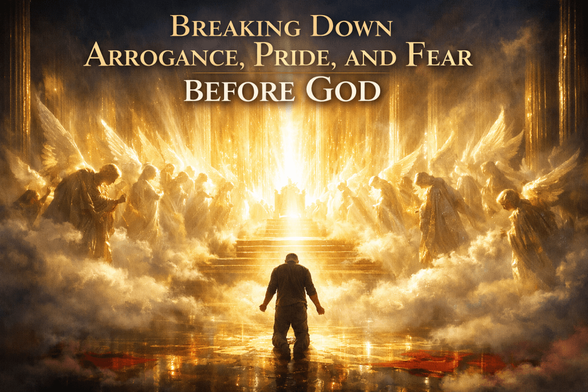
If arrogance survives in the human heart, it is because holiness has been domesticated. The God revealed in The Holy Bible is not a motivational accessory. He is not a background presence validating our personal brand of spirituality. He is a consuming fire. Hebrews declares it plainly. Isaiah did not stroll into the throne room with folded arms and casual familiarity. He saw the Lord high and lifted up, the train of His robe filling the temple, seraphim covering their faces, and the foundations shaking at the sound of “Holy.” That encounter did not inflate him. It dismantled him. “Woe is me,” he said. Not, “I feel affirmed.” Not, “This is powerful leadership energy.” He pronounced judgment on himself because holiness exposes everything.

This is where pride dies if we allow Scripture to speak honestly. Pride cannot survive a clear vision of God. It thrives only in comparison to other people. It feeds off status, recognition, platform, influence, theological precision, and years of ministry. But when confronted with divine holiness, those metrics evaporate. The angels are not impressed with resumes. They cry holy because they see reality clearly. The more clearly God is seen, the smaller self becomes. That is not humiliation for humiliation’s sake. That is alignment with truth.

Fear enters the picture here as well. When holiness is encountered, one of two things happens. Either the heart bows in reverence, or it retreats behind defensiveness. Pride often masks fear of exposure. If I remain controlled, if I remain composed, if I remain dignified, then I do not have to confront how unworthy I truly am apart from grace. But Scripture does not allow that defense to stand. Peter’s reaction to Jesus’ divine power was not posturing. It was collapse. “Depart from me, for I am a sinful man.” That is what happens when holiness pierces ego.

The throne room of Revelation reinforces this truth with overwhelming imagery. Living creatures do not moderate their response. They do not ration worship. They respond proportionally to what they see. Day and night they declare holiness because the object of their vision is inexhaustibly glorious. God is not enhanced by their praise. He is revealed by it. And that revelation crushes self-exaltation. If the church grows comfortable in the presence of holy truth without trembling, it has drifted from biblical posture.

Surrender Begins Where Entitlement Ends

True surrender does not start with emotional intensity. It starts with the death of entitlement. As long as a person believes they deserve access, deserve grace, deserve blessing, or deserve recognition before God, surrender remains partial. The gospel dismantles that illusion at the cross. Christ did not die because humanity earned rescue. He died because mercy triumphed over judgment. The cross is not dignified. It is brutal. It is humiliating. It is sacrificial. It exposes the severity of sin and the magnitude of grace in one act.

When someone approaches worship with an entitled mindset, praise becomes transactional. It becomes performance. It becomes a subtle exchange: I give You this, You give me that. But biblical praise is not negotiation. It is surrender. It is the acknowledgment that without Christ, there is no standing. When David danced before the Lord, he did not calculate optics. He responded to the presence of God with abandon because he understood covenant mercy. When confronted for his undignified expression, he doubled down. He would become even more undignified. Why? Because preserving image was irrelevant compared to honoring God.

This is the dividing line between pride and humility. Pride protects reputation. Humility protects reverence. Pride worries about perception. Humility worries about obedience. Scripture commands clapping, lifting hands, shouting, blessing the Lord. Those commands are not cultural artifacts frozen in ancient poetry. They are divine imperatives aimed at the human will. They force the question: will I obey even when obedience costs me comfort?

Surrender becomes visible when the soul stops managing how it appears before others and starts aligning with what God has spoken. That does not mean emotional exhibitionism. It means obedience that flows from reverence. It means acknowledging that breath itself is borrowed. If every inhale is sustained by God, then every exhale belongs to Him. “Let everything that has breath praise the Lord” is not poetic fluff. It is a logical conclusion.

Why Praise Reorders the Heart and Dismantles Fear

Fear loses ground in the presence of rightly directed praise because fear thrives on self-focus. Anxiety fixates on what might happen to me. Pride fixates on how I am perceived. Depression narrows the lens to internal darkness. Praise lifts the gaze outward and upward. It does not deny hardship. It re-centers perspective. When the Psalms command believers to magnify the Lord, they are not implying that God grows larger. They are instructing the worshiper to enlarge their vision of Him.

You cannot meaningfully declare God’s sovereignty and remain consumed by self-importance at the same time. One vision displaces the other. This is why Scripture repeatedly ties humility to grace. When a person bows internally before God, they position themselves to receive what they cannot manufacture. “God opposes the proud but gives grace to the humble” is not a poetic suggestion. It is a spiritual law. Opposition from God is not a light matter. But grace from God is life itself.

Praise, therefore, becomes an act of warfare against arrogance. It is not about volume. It is about submission. It is about acknowledging that God is God whether I feel inspired or not. It is about declaring His worth independent of my mood. When that declaration becomes habitual, the soul is trained away from entitlement and toward gratitude. Gratitude erodes pride because it recognizes that everything good is gift.

This is the heart of surrender. Not hype. Not personality preference. Not stylistic expression. Surrender is the recognition that I am not the center. That God does not orbit me. That He does not need my validation. I need His mercy. I need His grace. I need His forgiveness. And when that truth grips the heart, folded arms begin to feel out of place.

The Only Safe Posture Before a Holy God

At the end of the matter, the issue is not whether someone lifts their hands higher than another. The issue is whether the heart bows. But Scripture makes something clear: inward humility eventually manifests outwardly. The body follows the conviction of the soul. Knees bend. Hands lift. Voices rise. Not because God’s ego requires it, but because truth compels it.

God can raise up stones to cry out. He is surrounded by worship that never ceases. Heaven is not quiet. The throne room is not bored. The Lord is not diminished by human restraint. The tragedy is not that God loses something when we withhold praise. The tragedy is that we forfeit alignment with reality when we cling to pride.

We do not deserve grace. That statement cuts against cultural instinct, but it aligns perfectly with Scripture. Grace is astonishing precisely because it is undeserved. The cross stands as eternal proof. Christ stretched out His arms, not folded, bearing sin that was not His. That is the model of surrender. That is the foundation of worship. That is the death of arrogance.

True surrender begins when we admit that we bring nothing to the table except need. And that need is met not by our dignity, not by our status, not by our restraint, but by mercy.

When that sinks in, praise is no longer awkward. It becomes inevitable.

Call to Action

If this study encouraged you, don’t just scroll on. Subscribe for more bible studies, share a comment about what God is teaching you, or reach out and tell me what you’re reflecting on today. Let’s grow in faith together.

D. Bryan King

Sources

Disclaimer:

The views and opinions expressed in this post are solely those of the author. The information provided is based on personal research, experience, and understanding of the subject matter at the time of writing. Readers should consult relevant experts or authorities for specific guidance related to their unique situations.

#1Peter55Humility #angelsCryingHoly #biblicalObedience #biblicalRepentance #biblicalReverence #biblicalSurrender #biblicalWorshipCommands #ChristCenteredWorship #ChristianDiscipleshipHumility #ChristianLife #ChristianTransformation #clapYourHandsScripture #crossAndHumility #dropTheFoldedArms #dyingToSelfChristianity #fearOfTheLord #fearVsPride #GodDoesNotNeedOurPraise #GodOpposesTheProud #GodSSovereigntyAndPraise #gospelSurrender #graceNotEarned #graceToTheHumble #holinessAndWorship #holinessCrushesEgo #holinessOfGod #humilityBeforeTheCross #humilityInScripture #Isaiah6Holiness #James46Explained #letEverythingThatHasBreath #liftYourHandsBible #obedienceToScripture #prideBeforeGod #Psalm134LiftYourHands #Psalm223Meaning #Psalm47ClapYourHands #repentanceAndSurrender #RevelationThroneRoomWorship #reverenceBeforeGod #selfSufficiencyVsSurrender #shoutUntoGodVerse #spiritualArrogance #spiritualEntitlement #spiritualReset #surrenderToJesusChrist #theologicalReflectionOnPraise #throneRoomOfHeaven #trueWorshipMeaning #undeservedGrace #weNeedGodSGrace #worshipAndPride #worshipChangesYou