When Everything Else Loses Its Shine

Discovering the Worth of the Kingdom
DID YOU KNOW

Did You Know that Jesus described the Kingdom of Heaven as something so valuable that joy—not guilt—drives total surrender?

When Jesus says, “The kingdom of heaven is like treasure hidden in a field” (Matthew 13:44), He is not appealing to obligation but to desire. The man who finds the treasure does not reluctantly sell his possessions; he does so “in his joy.” That detail matters. Jesus is teaching that the Kingdom is not a loss to be endured, but a gain so overwhelming that everything else fades by comparison. The surrender He describes is not coerced discipleship but delighted reordering. In a world where faith is often framed as restraint, Jesus reframes it as discovery. The Kingdom is not imposed; it is uncovered.

This insight reshapes how we view sacrifice in the Christian life. If following Christ feels only like deprivation, we may not yet have grasped the value of what He offers. The problem is rarely that the Kingdom asks too much, but that we have not truly seen it. When the Kingdom is rightly perceived, lesser treasures—money, control, recognition—lose their gravitational pull. Jesus is not demanding that we despise the world; He is inviting us to value something greater. The joy of the finder reveals the heart of the gospel: God gives something so rich that letting go becomes an act of freedom rather than fear.

Did You Know that Scripture recognizes many forms of “currency,” not just money, that compete with the Kingdom for our allegiance?

The study rightly reminds us that wealth is not limited to finances. Reputation, status, influence, and even visibility function as powerful currencies in human life. Ecclesiastes observes the tragedy of relentless accumulation when it asks, “For whom am I toiling and depriving myself of pleasure?” (Ecclesiastes 4:8). This question exposes how easily we spend our lives acquiring things that cannot ultimately satisfy. Jesus’ parables confront not only economic attachment but misplaced valuation. Anything we treat as indispensable becomes a rival treasure.

This broader understanding of currency forces a more honest self-examination. Many believers would never consider selling everything materially, yet quietly protect their image, comfort, or autonomy from God’s interruption. The Kingdom challenges all forms of hoarded worth. Jesus’ call reaches into how we spend our time, where we invest emotional energy, and what we fear losing most. The question is not simply, “What do I own?” but “What owns me?” When the Kingdom becomes central, these currencies are not necessarily discarded, but they are demoted. They become tools rather than masters, gifts rather than gods.

Did You Know that the Kingdom’s urgency is tied to responsibility, not panic?

Jesus’ teaching in Matthew 13:44–50 includes both invitation and warning. The separation of the righteous and the wicked is not presented to incite fear-driven faith, but to awaken purposeful living. The Kingdom is present now, yet its fullness is coming. That tension gives weight to today. The study’s assertion that “there won’t be another day to get around to God’s work” echoes Jesus’ own urgency in mission. This is not anxiety about salvation but clarity about calling. The time to embody the Kingdom is not someday—it is now.

This urgency reframes daily obedience. Ordinary faithfulness becomes eternally significant when viewed through the lens of the Kingdom. Leading others toward Christ is not a side project for especially motivated believers; it is the natural overflow of valuing the Kingdom above all else. When we live as though opportunities are endless, we drift. When we live as though each day matters, our choices sharpen. Jesus does not rush His followers, but He does remind them that postponement often disguises misplaced priorities. The Kingdom deserves present-tense commitment.

Did You Know that the Kingdom often advances through unlikely, even broken, stories rather than ideal ones?

The inclusion of Genesis 19:30–21:21 in this study reminds us that God’s redemptive purposes unfold amid deeply flawed human narratives. Lot’s family, Abraham’s impatience, and Hagar’s suffering do not resemble heroic faith at first glance. Yet God’s promises move forward nonetheless. This underscores a critical Kingdom truth: God’s reign is not dependent on human perfection. The Kingdom is revealed not through ideal conditions but through God’s persistent faithfulness.

This insight offers deep encouragement. Many believers hesitate to give everything to the Kingdom because they feel unqualified or inconsistent. Scripture counters that hesitation by showing how God works through weakness, delay, and even failure. The Kingdom does not wait for us to be impressive; it asks us to be available. When the Kingdom becomes our highest value, our imperfections become places where God’s grace is displayed rather than reasons for withdrawal. The call to sell everything is not a call to self-erasure, but to trust that God can do more with surrendered lives than we can with guarded ones.

As you reflect on these truths, consider where your sense of value is most concentrated. What would it look like to treat the Kingdom of Heaven as the defining treasure of your life—not in theory, but in daily decisions? Jesus’ parable invites us to imagine the relief of no longer juggling competing priorities, no longer measuring worth by fragile currencies. The Kingdom does not impoverish those who pursue it; it reorders life around what truly lasts. The question is not whether the Kingdom is worth everything. The question is whether we are willing to let it be.

FEEL FREE TO COMMENT, SUBSCRIBE, AND REPOST, SO OTHERS MAY KNOW

nce

#biblicalParables #ChristianPriorities #discipleship #faithAndObedie #kingdomOfHeaven #Matthew13 #spiritualSurrender


The Forgotten Man: A Parable for a New Generation

1,703 words, 9 minutes read time.

Walking with the Good Samaritan: Servant Leadership for a New Era

Affiliate Link

I had been walking down that same road for years. The same dusty, sun-scorched path that split the barren landscape between my home and the bustling marketplace. In a way, it had become my lifeline—familiar and predictable. I had learned to hate the road, but I also depended on it. It was a place of isolation, a place where my thoughts could be my only company, where I could let my mind wander and get lost in the monotony of daily life.

There were many things I had forgotten over the years: the face of my father, the laughter of my childhood, the warmth of a friendship that had been long extinguished. What I hadn’t forgotten, though, was the road. And one fateful day, I was left to walk it alone.

It started with a quiet whisper in my ear, an enticing invitation to venture out a little further, to see something beyond the ordinary. You see, I had always been a man driven by ambition, by the need for recognition, and by the belief that I deserved more than what my small world had to offer. I had a good life, by many standards—safety, security, and a reputation that made people respect me—but it never felt like enough. There was a hunger in me that was always unsatisfied, a thirst for something more, something greater.

It was this ambition, this longing for more, that led me down the path that would eventually change my life forever.

One day, a wealthy merchant had come to town, and I had heard rumors of the treasures he carried. My instincts told me that if I could make an impression on this man, I could secure my future, maybe even gain the riches I had always dreamed of. But it wasn’t just about the money—it was about the power, the prestige. It was the chance to prove I was better, that I deserved something more than what I had been given.

So, I began planning. I knew that the road to the merchant’s camp was treacherous, but my pride told me that I could navigate it alone. I was no stranger to hardship. In my mind, I was untouchable, invincible even. Nothing could stand in my way. It was my choices, my will, that would determine my fate. I had walked the road countless times before and had survived every challenge. But this time would be different.

I set out early in the morning, my mind filled with the promise of something greater, something beyond my wildest imagination. As the hours passed, I grew increasingly aware of the isolation around me. The silence of the barren hills, the dust in the air, the weight of the sun pressing down upon my skin. But still, I pressed on.

And then, it happened.

A group of bandits emerged from the shadows of the rocks. They surrounded me with the swiftness of predators, their faces masked, their weapons drawn. I tried to fight back, but I was outnumbered. It didn’t take long before I found myself lying on the ground, my body bruised and bloodied. My possessions were taken, my dignity stripped away, and I was left there, half-conscious, alone on the side of the road.

In that moment, I thought to myself, “How could this have happened? How could I have been so careless?” But deep down, I knew the answer. It was my pride, my arrogance, that had brought me here. It was my own choices, my own desire for more, that had led me to this place of ruin. And as the hours passed, the pain only grew worse, the realization of my foolishness sinking deeper into my bones.

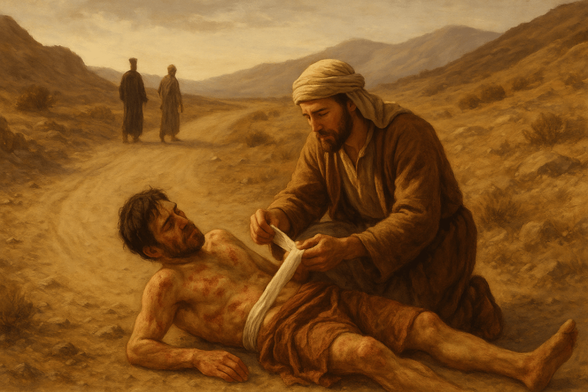
I was not the only one who passed by that day. There were others—people I had once called friends, people I had respected. The first was a priest, a man of God. He saw me lying there, wounded and broken, but he kept walking. I remember the look on his face—indifference mixed with a touch of superiority. In his eyes, I was nothing more than a nuisance, a distraction from his holy duties. He passed me by without a second thought.

Next came a Levite, a man of the law, someone who had always been quick to uphold tradition and righteousness. He saw me too, but his response was no different from the priest’s. He crossed to the other side of the road, avoiding me with the same cold detachment. It wasn’t that he didn’t see me; it was that he didn’t care.

But then, something unexpected happened.

A man appeared from the distance. He was a Samaritan—a man from a group that my people had long despised. The Jews and the Samaritans had been at odds for generations, locked in a bitter rivalry that went back centuries. Yet, as this Samaritan approached, something in his eyes told me that he was different.

He didn’t hesitate. He knelt down beside me, his hands gentle as they touched my wounds. I tried to speak, to thank him, but my voice was weak. He didn’t need my gratitude. Instead, he lifted me up, carefully and without judgment, as if I was a brother he had never met before.

The Samaritan didn’t just stop to offer a word of sympathy; he took action. He used his own supplies to bandage my wounds and then helped me onto his donkey. The journey to the nearest inn was slow and painful, but he stayed by my side, never once complaining, never once turning away.

At the inn, he paid for my care, ensuring that I would be well-treated until I had recovered. And before he left, he told the innkeeper that if the cost of my stay exceeded what he had already given, he would cover it. “Take care of him,” he said. “Whatever it costs, I will pay.”

I had been left for dead by those who were supposed to help me—by those who considered themselves righteous, by those who believed they were above the likes of me. But the one person I least expected to show mercy was the one who did.

Then Jesus.

It was in that moment that everything changed for me. The story of the Good Samaritan became more than just words. It was my story. I had once been like the priest, like the Levite, judging others from a distance, thinking that my position in society gave me the right to look down on those who were less fortunate. But in my hour of need, I was shown mercy by the one I had been taught to despise. It was as if God Himself had reached down and pulled me out of the pit I had dug for myself.

I realized that my choices had led me to this place. It wasn’t fate or bad luck. It was my pride, my refusal to see the humanity in others, my selfish desire for more. And now, I had been given a second chance. The Samaritan didn’t owe me anything, yet he gave me everything.

The moral of the story isn’t just about helping those in need. It’s about understanding that we all have a choice—to be like the priest, to be like the Levite, or to be like the Samaritan. We can choose to turn away, to ignore the suffering of others, or we can choose to step into the mess, to offer mercy where it is least expected.

In that moment, I understood what it truly meant to love my neighbor. It wasn’t about who was worthy of my help. It wasn’t about whether or not they fit into my social circle, my ideology, or my expectations. It was about showing kindness, compassion, and mercy to those who need it the most—without conditions, without judgment.

And so, I was left with a choice. I could continue down the road of self-righteousness, clinging to my pride and my ambition. Or I could choose to live differently, to be a neighbor to those who were suffering, to show the same mercy that had been shown to me.

I chose the latter. And though I may never fully repay the Samaritan for his kindness, I have vowed to be a good neighbor to others, just as he was to me. I can only hope that my actions, however small, might one day make a difference in someone else’s life—just as the Samaritan’s actions changed mine.

Now, I see the road differently. It’s no longer a place of isolation and pride, but a reminder of the choices I make and the impact they have on the world around me. And every time I walk it, I remember that no one is beyond mercy, and that love has the power to transform even the most broken of lives.

And so, my story continues—not as one of ambition and pride, but as one of grace, humility, and the redemptive power of compassion. I hope it’s a story worth sharing, not just for me, but for all of us.

D. Bryan King

Sources

Disclaimer:

The views and opinions expressed in this post are solely those of the author. The information provided is based on personal research, experience, and understanding of the subject matter at the time of writing. Readers should consult relevant experts or authorities for specific guidance related to their unique situations.

Related Posts

#biblicalCompassion #biblicalKindness #biblicalLessons #biblicalParables #biblicalRedemption #biblicalStory #biblicalTeachings #ChristianFaith #ChristianForgiveness #ChristianMorality #compassionInAction #compassionInChristianity #compassionOverJudgment #divineMercy #faithAndRedemption #forgiveness #GoodSamaritan #graceAndMercy #helpingOthers #helpingOthersInNeed #helpingThePoor #humilityInFaith #JesusParables #JesusTeachings #JesusMessage #kindness #lessonsFromJesus #lessonsOfMercy #loveAndForgiveness #loveThyNeighbor #loveYourNeighbor #mercy #mercyAndCompassion #mercyInChristianity #moralParables #moralityInTheBible #neighborlyLove #overcomingPride #parableMeaning #parableOfTheGoodSamaritan #powerOfKindness #prideAndDownfall #redemptionStory #religiousCompassion #SamaritanCompassion #SamaritanHelp #SamaritanKindness #SamaritanStory #secondChances #selfReflection #selfRighteousness #spiritualAwakening #spiritualLessons #walkingWithGod

Amazon.com