
Selco’s solar innovations for the poor

No, not that Selco, the UK builders’ warehouse with the radio jingle. I’m talking about Selco India, another winner to profile from this year’s Ashden Awards. Selco are, at first glance, a solar company. They provide solar installations in rural locations, including clinics and hospitals – something that can be life-saving when you consider the consequences of child-birth or surgery with an unreliable electricity supply.

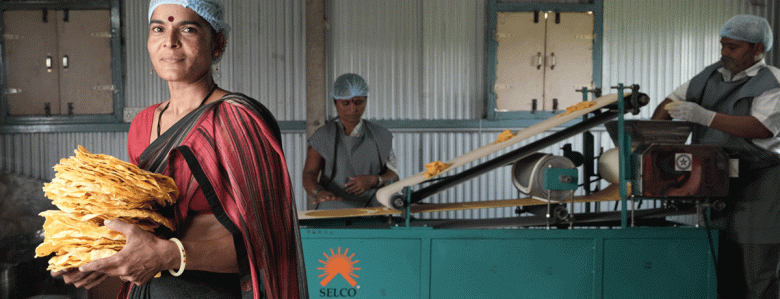
They also develop and sell ‘solar powered livelihood systems’, machines designed to pair with solar and empower small businesses. There’s a whole range of these, from solar powered milking machines for dairies, to pottery wheels, a rope making machine or a chilli grinder.

These sorts of things can revolutionise a small business. A farmer with a simple milking machine saves a huge amount of time with each cow, meaning they can run a larger herd in the same amount of time. It can also remove drudgery, the most boring and repetitive types of work. A solar powered blower for a blacksmith’s furnace replaces hand-operated bellows. The aforementioned chilli grinder takes over the manual pounding of chillies, a handful at a time, with a stone or wooden pole.

These sorts of machines already exist, but they’re not always suited to small off-grid solar. Selco adapts them to run on DC power or adds batteries to account for variable power. Thinking off-grid sometimes opens up new possibilities, such as this mobile photocopying service that runs off the back of a scooter, adapted to create a business for an entrepreneur with disabilities.

Technology isn’t enough in this context. In order to make their pioneering machines affordable to those that need them, Selco have to find innovative financing models as well. That’s an important part of their work, providing business loans or working with local government to offer grants. This needs presence on the ground, and Selco are committed to listening and being accessible to the marginalised communities they serve. They talk about going the ‘last mile’ and providing a service on the doorstep.

Selco won an Ashden award in 2005 and then again in 2007, which helped them to scale up. They were able to expand into new regions, and are now sharing their expertise through the Solutions Portal, and replicating their model in other locations in Asia and Africa.

https://www.youtube.com/watch?v=HpmkYO9cIq4

  • Featured photo shows Surekha Gopal Gokak with her solar-powered roti maker . Photo by Selvaprakash Lakshmanan for Ashden.
#appropriateTechnology #ashden #india

Your home has a digital twin

When Russell Smith was retrofitting his own home in 2005, he had a lot of research to do into how his house was performing, what its energy needs were and what the most cost effective solutions might be. As he worked on it and developed a spreadsheet to investigate, he realised that this was useful information for others to learn from. It grew into a business, Parity Projects, now part of a larger company called Cotality.

Cotality provide building analysis to inform retrofits, and they have a ‘digital twin’ of every single home in the UK. Using their software, you can optimise that home for energy use, and work out the best ways to retrofit it. The main customers for this service are social housing companies and local authorities, with over two million homes managed this way.

A guided retrofit cuts carbon emissions, and makes homes warmer and healthier. It also saves money, cutting costs for the nine million households in the UK who are living in fuel poverty. The many co-benefits of retrofits, across so many homes, won Cotality the Ashden Award for Outstanding Achievement at this year’s awards, and here’s the video that was shown on the night:

https://www.youtube.com/watch?v=eWR1362ag_c

Want to look into retrofitting your own home? Have a look at the not-for-profit National Retrofit Hub or Ecofurb, both of which are projects that Russell Smith is also involved in.

#ashden

Solar for everyone with RePowering London

One of the risks of climate action is that, if done without an eye on justice, it can benefit society’s winners and entrench inequality. Solar is a case in point. Wealthier households who own their own homes can get cheap energy from installing solar panels. Renters and those on lower incomes would benefit more from the savings, but don’t get to take part.

Community energy can be similar, providing an investment opportunity for those with some surplus cash. It’s better than energy from big corporations, but it might not reach those at the margins.

Repowering London have pioneered a people-centred approach to community energy that addresses some of these problems. They set up local energy cooperatives in London, which take on solar installations that are planned and owned by the community. It’s proactive in getting out and reaching people, diversifying the community energy sector and keeping barriers to participation low: you can become a voting member for as little as £1. They also create jobs and learning opportunities, and 150 young people have taken part in their clean energy training and mentoring schemes.

Their projects extend to over a megawatt of solar capacity on housing estates, schools and community buildings, and they are now sharing their approach with others around the country. For their impact over the last 12 years, Repowering London won the Ashden Award for Outstanding Achievement this year.

https://www.youtube.com/watch?v=aDGBZuBJLyo

#ashden #communityEnergy #UK

Celebrating 25 years of the Ashden Awards

The Ashden Awards were held last night, marking 25 years of the awards for climate innovation. To mark the occasion, four previous winners were honoured with outstanding achievement awards, in a ceremony presented by Myra Anubi, with special guests Vanessa Nakate and UK Climate Envoy Rachel Kyte. Two new winners also took home awards, Emergent Energy in the UK and Sosai Renewable Energies from Nigeria.

The awards were set up by Sarah Butler-Sloss, who told the story of their genesis at the ceremony. She had been researching the connections between sustainability and poverty in Africa, recognising that clean energy could be a powerful tool for improving people’s lives – an idea that was ahead of its time in the 1990s. A particular moment of inspiration came when visiting schools in Kenya, and noticing the difference between kitchens that cooked on traditional three-stone fires, and those that had more efficient cookstoves. The traditional fires burned more wood and were thus more expensive to run, and the smoke filled the kitchen, blackening the walls and harming the health of the cooks. Clean-burning cookstoves were healthier, cheaper and quicker. The technology was available, and so the challenge was to popularise them and help the manufacturers to scale up and meet demand.

The purpose of the awards is to showcase these sorts of ideas, bringing attention and funding to organisations with outstanding solutions, and helping them to accelerate their impact. As Butler-Sloss noted, the concept was proved in year one, when one of the winners returned home and was greeted at the airport by the president and a crowd of journalists. The award helps to draw in both investors and policy-makers, with Ashden providing support to help them grow and take advantage of the attention.

Over the years the awards have evolved, adding a second stream for UK innovators in 2003, alongside winners from the global South. The focus has remained on inclusive solutions, ones that bring the benefits of clean technologies to those at the margins, including awards for those working specifically in refugee contexts. There was also a series of awards for sustainable travel, clean air, and awards for schools.

Ashden itself has evolved in response to the awards, developing an alumni network for the growing number of winners, and launching various supporting projects. For example, when the National Trust won an award in 2006 for its sustainability initiatives, they were inundated with queries from people who wanted to learn from them. That led to the forming of Fit for the Future, a sustainability learning network for the heritage sector. Other projects within Ashden focus on forests, affordable cooling technologies, or renewable energy.

In total, there have now been 271 winners from across Asia, Africa and the UK. Many of them have successfully grown into much larger organisations, reaching millions of people. Some have gone on to further recognition, such as S4S in India or D.Light in Kenya, both of whom have won the Earthshot Prize. The winners and their projects are what the awards are all about, so while I wanted to write about the awards themselves today, I’ll feature a series of winners in the weeks to come.

#ashden