Black Panthers – Rare and Everywhere

Tales of black panthers are widespread and repeated from the US and Canada to Europe. A cryptid conundrum arises from the fact that there are no documented populations of these melanistic cats in those places. Yet people see them, report them, and insist that they are around. The black panther phenomenon is so entrenched in cryptid content that many suggest they are not regular animals but zooform phenomenon – paranormal beings in animal shape, unable to be tracked and caught.

Real big black cats

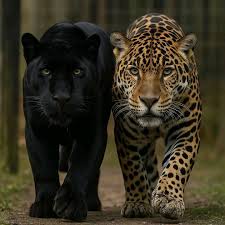
Melanistic variants of large cats include the jaguar and leopard, both of which produce a genetic combination that result in a black coat color. In both cases, the typical coat color is tan with spots or “rosettes”. The excess of dark pigment overwhelms the spotted pattern, even though the spots are visible on the black background in certain lighting up close.

Jaguar coat colors

A common assertion from witnesses or those repeating local accounts is that the animal seen was a black mountain lion/puma. Melanistic mountain lions are not recognized as biological possibilities. Hunted for centuries and rendered extinct in the northeastern states, there has never been an example of a black puma. A logical conclusion is that the species Puma concolor does not carry the mutation to account for melanism, so it cannot naturally appear. Therefore, it’s not reasonable to accept this explanation for a big black cat. Even if, one day, a black puma is found (or close to it), it will not be reasonable to conclude that this one-off individual could account for the extensive sightings. So what can account for sightings?

This recent video does a fine job of presenting all the possible explanations for reports. However, EVERY media post about the mystery inevitably includes comments cluttered with unverified (and unverifiable) stories from people who claim to have seen them, regardless of the impossible odds that such a creature exists, particularly in that area.

Black jaguars are a possibility in the southern US. While still a rare variation, individual jaguars can cross into Arizona and may range far enough for people to occasionally spot them. With the rarity of individuals and the additional rarity of the black coat color, the odds just don’t favor black jaguars.

With black leopards only native to Africa (Edit: and tropical Asia), the next reasonable guess is that imported, kept cats have escaped. Escaped kept cats are also a low-odds, but not impossible, option. However, missing animals usually are recovered fairly quickly or end up dead.

In the UK, where the idea of “alien big cats” has a long and exciting history from the early 1900s, certain areas were said to be home to their own named large cat, often described as black. These include the Beast of Exmoor, Surrey Puma, Beast of Bodmin, Norfolk Panther, Cotwolds Big Cat, Beast of Dartmoor, Galloway Puma, and Beast of Buchan. In 2020, Spain was the center of a black panther flap. Like in the U.S., there is a serious problem with no known animals upon which to pin the sightings. But the option of released or escaped animals remains a commonly suggested, though infrequently confirmed, solution.

Photos and hoaxes

Several photographic examples exist from people claiming to have encountered black panthers. The photos often lack scale, or a follow-up to determine scale isn’t done. The black coloration obscures details that allow us to accurately judge size and characteristics. Wildlife experts can tell if the animal is proportioned like a big cat or a regular house cat. In most cases, it’s obvious that the animal is Felis catus (domestic cat), which can get pretty hefty.

Black jaguars have been caught on game cameras in Panama. Even in remote areas, rare snow leopards have been caught on camera in Northern Pakistan. Yet, with the multitude of game cameras everywhere in the US, no black panthers have been discovered. The negative evidence suggests they really aren’t there.

Hoaxed photos abound. Every so often, a real photo of a black leopard or jaguar will be promoted as taken from a local camera. Or, as is more frequent, a photo has been manipulated or created. Some examples are used so often, reappearing every few years, commenters joke about how the same cat really gets around.

My favorite “hoaxes” are those involving stuffed animal toys that people mistake as real animals.

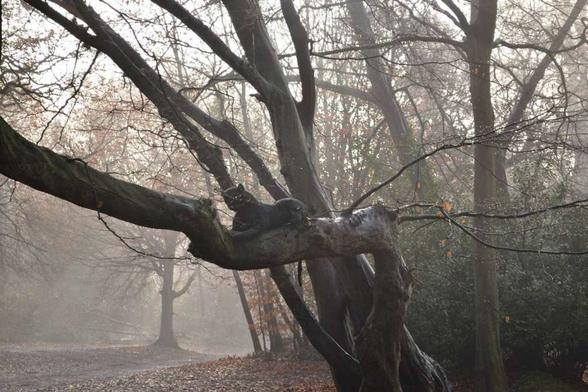
The Epping Forest cat (UK) of 2013 – a stuffed toy.

The black panther mascots

A curious observation I have made is the multitude of school and sports mascots that are black panthers. A big fearsome cat is a common icon to use, and often it is depicted as black even though the location can’t claim any large representative native cats. Pop culture images of black panthers are now so well-known that people have a frame of reference and may assume that the presence of a “black mountain lion” isn’t as far-fetched as it actually is.

The repeated imagery and stories of black panthers are influential in interpreting sightings. Witnesses may have no idea that such large cats are not plausible in their area. If they see a glimpse of a large, sleek dog in low light, or a bulky tom cat in the distance, they can easily jump to the wrong conclusions.

We are primed to see what our culture suggests we could see. The black panther image is ubiquitous. We will always fear the large, dangerous predator that might be in the forest, no matter how rare (or impossible) scientists say they are.

This post is part 2 of the 12 days of Cryptids.

#12DaysOfCryptids #alienBigCats #bigCats #BlackPanthers #blackPumas #cryptid #mysteryCats

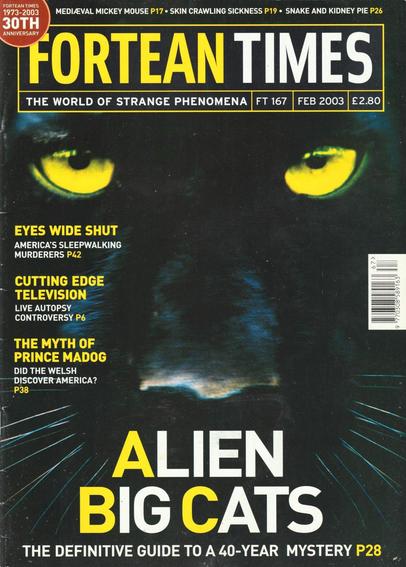
#1054 Bob Rickard and Paul Sieveking (eds) - Fortean Times: The Journal of Strange Phenomena, No 167. John Brown Publishing Ltd, London, February 2003.

#ForteanTimes #BobRickard #PaulSieveking #Cryptozoology #AlienBigCats #BookOfTheDay

Pop Cryptid Spectator 12

Hello and welcome to Pop Cryptid Spectator no 12 – an “approximately weekly” collection of thoughts and opinions about Pop Cryptids. What are Pop Cryptids? Well, I’ve been working on idea that for a while now and it is coalescing around the observation that cryptozoology is far less about zoology than about the various creatures of cryptozoology and their popularity. And, the subject creatures are far less zoological than ever before, at least since the term “cryptozoology” was invented. Hence, this week’s collection of the various examples of how mainstream cryptids are these days.

In this edition:

  • New cryptid alert: North American Pine Squid
  • Bigfoot in the Backyard
  • Be the Bigfoot
  • Cryptid media: Nessie, the Musical
  • Big little cat makes headlines in UK
  • Fiji mermaid seen at Margate beach in Kent
  • The mokele-mbembandwagon

North American Pine Squid

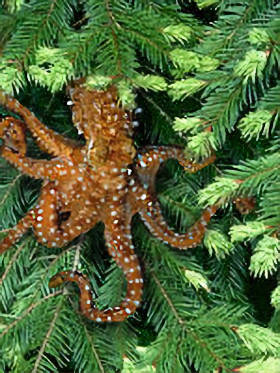
I bet you haven’t heard of this cryptid! Or, if you live on YouTube, you might have. But if you know of hoaxes from the late 1990s, it might sound familiar. The North American pine squid is being touted online, particularly on TikTok, as a large, black mass of tentacles that emerges from a pine tree and feeds on people and/or pinecones. The creature is said to be lurking in the forests of the Pacific Northwest and the Appalachians (clue #1 – these would likely be different species because of the lack of pine forests in between). It “swims” above the forest floor. From what I can tell, the tall tale of this fearsome creature went mainstream around September of 2024. I totally missed it, maybe because I’m not a regular consumer of TikTok that is like 90% garbage content. The NAPS is a rip off of the Pacific Northwest tree octopus, a hoax from 1998. But, hey, it’s the 21st century and we can haz AI naow! Someone birthed the new, more evil variant and it grew. So we can count the NAPS as another in a growing list of AI cryptids. And, make no mistake, there are many people who have no education regarding the natural world and may assume these are real animals. Here is the “fascinating truth” about the pine squid.

Bigfoot in the Backyard

A group of National Weather Service investigators, documenting storm damage, captured an image of a dark figure in the woods west of Uniontown, in western Pennsylvania. The incident made it to the local news. What they saw was not Bigfoot but an extremely common Bigfoot sillouette placed in the forested land surrounding the property. Bigfoot sighting reports are quite common here, as the area is part of the Chestnut Ridge, now known as a “Gateway to the Paranormal” thanks to a local county tourism initiative. I often wonder who makes the choices about stories to include in the news. But, maybe it was someone who wanted to demostrate the Pop Cryptid idea. You will quickly run out of fingers with which to count the properties who have a Bigfoot sign or marker in their yard like this or more obvious. They abound. People seem to enjoy displaying their love for Bigfoot, or their hope that the yard ornaments will attract a curious monster, or at least some like-minded neighbors. Check out the article, if you can spare a minute you will never get back.

Be the Bigfoot

If you really are obsessed by Bigfoot, soon you will have the opportunity to be one in a digital simulation called Bigfoot Life. The Demo is out now. You can scare animals and other humans, throw rocks, bang on a tree with a big stick, eat berries, steal picnic baskets, etc.

https://www.youtube.com/watch?v=vOX_lUAs1Dw

Cryptid media: Nessie, the Musical

The Guardian posted a short trip through some interesting depictions of the Loch Ness monster on TV and in film. The headline for “From The Simpsons to Werner Herzog: the coolest, craziest, scariest Nessies ever” turned out to be misleading and disappointing as the short-ish article only touched upon a handful of selections including an appearance on The Simpsons, and the movies The Secret of the Loch, and Incident at Loch Ness (which I need to rewatch because it was lots of fun). Mostly the piece was intended to publicize a new Nessie musical in Edinburgh this summer.

Big little cat makes headlines in UK

Hardly a week goes by without some story from the UK adding to the rumors that big cats (usually of the zoologically ambiguous “black panther” type) are slinking around the villages and fields. The examples are almost universally terrible. But people want so badly to believe they have encountered the elusive creatures, which are typically named after their locations (Beast of Bucks, in this case). This recent claim comes from a man who lives “near” Wycombe in Buckinghamshire, England and it’s accompanied by a video. The entirely black feline is seen on the edge of a “skip” or dumpster in USAnian English, and then it jumps in to pick at the trash. The video does not show it exiting so we never see the creature head on. You can see the video here. This is not a big cat. It’s a hefty domestic cat. The camera location and angle give the impression of it being large. But it does not at all resemble a jaguar or leopard (the only two wild cats that fall under the general term “black panther”). Many photographic and video claims show similar black felines that are all almost certainly just regular house cats where the surroundings allow for a perception of exaggerated size.

As an aside, in the US, our locally named beasts aren’t usually big cats but varieties of bipedal monsters. (Beast of Whitehall, Beast of Boggy Creek, Beast of Bray Road, etc.)

Fiji mermaid seen at Margate beach in Kent

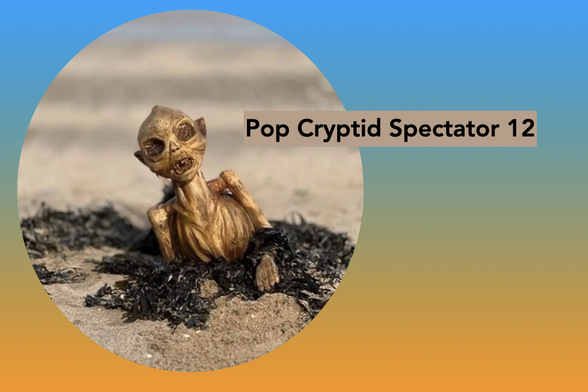
A news story circulated this week about a couple walking the beach on March 10 in Margate, Kent, England, who came across a strange object. With a front described as “skeletal” and the back end of a fish, the object, which looks to be about 2 ft long, is a replica of the Fiji mermaid. The original story from Kent Online didn’t pick up on this but subsequent outlets recognized the relation to the infamous hoax from 19th century associated with P.T. Barnam. Clearly, this object copies that depiction. However, what was most frustrating is that no article that I could find described what the Margate object was made from. There is no way it could have survived made of a real fish and paper mache – and it definately does not look like a genuine fish tale. It seems most likely it was made of resin. I could not find a good match online; the head is more alien-like than most depictions. Also, there is no mention of who picked it up and took it, because SOMEONE had to. This makes me think that it could have been a deliberate plant as a hoax.

The mokele-mbembandwagon

In PCS no. 7, I linked to an article on SyFy that was spun off from a February Nat Geo article regarding the increased local sightings of mokele-mbembe in the Congo Basin in Africa. The Nat Geo article was a good one, noting the resurgence of a contemporary legend in response to deforestation in the region. The story of this cryptid began in the very early 20th century when it was framed as a “saurian”. Cryptozoologists and Creationists loved the highly romanticized, “Lost World” idea of a surviving dinosaur living in the unexplored African jungles. With the rise of Pop Cryptids in culture, mokele-mbembe is having another spotlight moment along with growing interest in sightings of other prehistoric survivor cryptids such as Kasai Rex, the thunderbird, megalodon, and the ropen. This week, not only did IFLScience copy SyFy (I often think these two enties are related), but now Popular Mechanics joined the fun with an article that took snippets from knowledgable writers such as Darren Naish (who is an expert on the “Prehistoric Survivor Paradigm” – the cryptozoological habit of resurrecting extinct animals as potential explanations for mystery animal reports), Eddie Guimont, and Loren Coleman regarding their view of living dinosaurs to get clicks related to the creature. Like the other copycats, this article uses the same brontosaurus imagery and also drops clues that the writer doesn’t actually know much about cryptozoology. At least this piece may introduce readers to the thoughts of more qualified individuals than those of Creationists or uncritical cryptozoological explorers who seem to simply embellish and repeat witness stories.

There remains zero evidence that any large creature that went extinct many millions of years ago is still out there for us to find. But the facts never seem to stand in the way of a good story about popular cryptids.

According to Google trends, it does not appear that people are searching for more info on mokele-mbembe. Maybe they don’t know how to spell it. But speculation on the creature regularly turns up on Reddit and in other online cryptid content.

For more on the background of cryptids as extinct animals, see my 2014 article “Prehistoric Survivors? They are Really, Most Sincerely Dead”. (Excuse the terrible formatting, though, since the publishing website never checked their pages after a upgrade years ago.)

And to close out, I was sent this pic of a very cryptid sign posted at the Venice canals in California this week.

Thanks for reading! Send comments, questions, or suggestions to sharon(at)sharonahill.com. If you want to send some cryptid plushies or other merch, or books to review, email for my physical mailing address.

For more, click on Pop goes the Cryptid landing page. Make sure you subscribe to all the posts – it’s always free and I don’t send annoying spam. 

Pop Cryptid Spectator is also available on Substack. Please share this with cryptid fans you know!

Pop Cryptid Spectator Pop Cryptid Spectator 11

Pop Cryptid Spectator 11

Pop Cryptid Spectator 10

Pop Cryptid Spectator 10

Pop Cryptid Spectator 9

Pop Cryptid Spectator 9

Pop Cryptid Spectator 8

Pop Cryptid Spectator 8

Pop Cryptid Spectator 7

Pop Cryptid Spectator 7

Pop Cryptid Spectator 6

Pop Cryptid Spectator 6

Pop Cryptid Spectator 5

Pop Cryptid Spectator 5

Pop Cryptid Spectator 4

Pop Cryptid Spectator 4

Pop Cryptid Spectator 3

Pop Cryptid Spectator 3

Pop Cryptid Spectator 2

Pop Cryptid Spectator 2

Pop Cryptid Spectator 1

Pop Cryptid Spectator 1

#1 #AICryptids #alienBigCats #Bigfoot #BigfootLife #cryptid #cryptids #Cryptozoology #FijiMermaid #mokeleMbembe #NorthAmericanPineSquid #PacificNorthwestTreeOctopus

https://sharonahill.com/?p=9707

Pacific Northwest tree octopus - Wikipedia

Since it was originally reported in the late 1970s, this creature—often described as a beast resembling a panther—has posed a mystery and a source of fascination. The cryptid known as the Beast of Bodmin Moor represents more than just the ongoing conflict between the known and the unknown, science and mythology, and fascination and terror. #beastofbodminmoor #alienbigcats https://connectparanormal.net/2024/03/02/cornwalls-cryptid-the-legend-of-the-bodmin-beast/
Cornwall's Cryptid: The Beast of Bodmin Moor

Uncover the mystery of the Beast of Bodmin Moor. Explore the legend of the ghost wild cat that still roams the hills of Cornwall.

Connect Paranormal Blog
#289 Bob Rickard and Paul Sieveking (eds) - Fortean Times: The Journal of Strange Phenomena, No 101. John Brown Publishing Ltd, London, August 1997. #ForteanTimes #BobRickard #PaulSieveking #AlienBigCats #Cryptozoology #RennesLeChateau #BookOfTheDay
Driver spots 'big cat' while waiting at traffic lights in the West Country

The previous sceptic of big cats' existence in our countryside described the creature 'as tall as the headlights on his Land Rover Freelander'

BristolLive
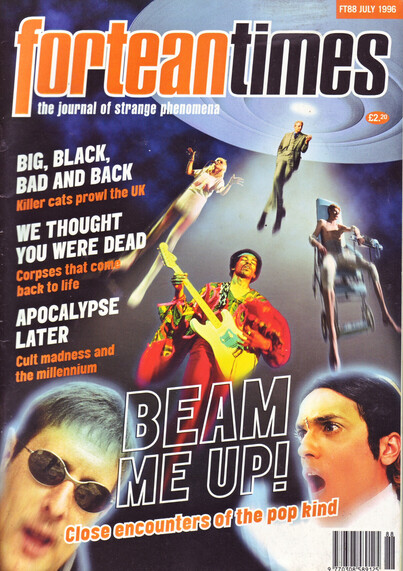
#168 Bob Rickard and Paul Sieveking (eds) - Fortean Times: The Journal of Strange Phenomena, No 88. John Brown Publishing Ltd, London, July 1996. #ForteanTimes #BobRickard #PaulSieveking #AlienBigCats #Ufology #BookOfTheDay
Any and all biologists … what are your thoughts on Alien Big Cats, Mystery Cats, or Out-Of-Place Cats? #cryptozoology #cryptids #alienbigcats

Mog-watch #5

Some relative good news, thank goodness. I say 'relative' because people shouldn't own big cats as pets in the first place, and this is an ongoing problem in the USA.

"Tiger missing in Houston turned in to authorities, police say

"The nine-month old Bengal tiger that has been missing for days in Houston was found Saturday and was transferred to the appropriate authorities, officials said."

#cryptozoology #caturday #alienbigcats

https://edition.cnn.com/2021/05/15/us/houston-tiger-found/index.html

Mog-watch #3

"Beast of Exmoor caught on video in one of the most convincing big cat sightings ever...

"...A couple have captured what could be the clearest footage yet of the Beast of Exmoor as a 'big cat the size of an Alsatian' was seen stalking the English countryside - leaving people claiming it is a PUMA..."

#cryptozoology #caturday #alienbigcats

www.devonlive.com/news/uk-world-news/beast-exmoor-caught-video-one-5399825