Greek restaurant interior by Masquespacio takes cues from ancient ruins

3D-printed "broken" columns join walls and floors created with an adobe effect at the Egeo restaurant in Valencia by interiors studio Masquespacio that aims to put a modern spin on traditional Greek architecture.

Masquespacio created the interiors for the Egeo Greek restaurant, which is spread across one floor and characterised by a blue and off-white colour palette that is reminiscent of many Greek houses.

A blue and white colour palette defines the space

Egeo features a cavernous interior with microcement-coated seating areas and walls carved from curvy shapes punctuated by statement blue columns.

The Mortex used for these walls and floors intends to give the space an adobe effect.

It features 3D-printed columns

Fractured into two pieces, the restaurant's columns were created using 3D printing and are fitted with tubular lighting that connects each piece together.

"We wanted to recreate the concept of a broken column from the past, but uplift it with a contemporary look," Masquespacio co-founder Christophe Penasse told Dezeen.

Wooden stools provide seating areas

Wooden stools resembling chunky chess pieces are scattered around built-in metal and wooden tables in the various seating areas arranged across the restaurant.

Sconce lights were attached to decorative organic shapes that protrude from the walls while olive trees sit in large, neutrally-hued pots.

[

Read:

Masquespacio puts colourful spin on traditional Italian restaurant concept

](https://www.dezeen.com/2022/03/10/masquespacio-colourful-spin-traditional-italian-restaurant/)

A central ordering bar was designed to recreate the atmosphere of a bustling market where you might order traditional souvlaki from a mobile vendor, according to Masquespacio.

"The restaurant was inspired by Greece's ancient architecture – from its typical white and blue houses to the ruins that are part of its important foundations in our world," explained Penasse.

A central bar intends to give the restaurant a lively feel

The eatery is the first Egeo branch in Valencia, although the chain already has two similar locations in Madrid.

Based in Valencia, Masquespacio was founded in 2010 by Penasse and Ana Milena Hernández Palacio.

Similar projects in Spain by the studio include another cavernous restaurant that nods to adobe architecture and an eatery with curved forms that take cues from the nearby Pyrenees mountains.

The photography is bySebastian Erras.

The post Greek restaurant interior by Masquespacio takes cues from ancient ruins appeared first on Dezeen.

#restaurantsandbars #all #interiors #instagram #spain #restaurants #greece #valencia #3dprinting #masquespacio #adobeconstruction

Schaum/Shieh Architects draws on original warehouse design for Marfa art gallery renovation

American studio Schaum/Shieh Architects has restored the John Chamberlain building, an art gallery in a former warehouse in Marfa, using local, traditional building techniques.

The gallery is part of the Chianti Foundation, a contemporary art museum in Marfa created by artist Donald Judd.

Constructed during the 1940s as three warehouses devoted to storing wool and mohair, it was turned into a gallery by Judd in the 1980s but had been deteriorating because of the desert conditions.

Donald Judd turned the 1940s structures into an art gallery

While Schaum/Shieh Architects studied the interventions that Judd had made to the space, which was created to hold works by artist John Chamberlain, it also referenced characteristics of the original warehouse structure in its redesign.

The architects worked with Texas construction company JC Stoddard Construction, a firm known for its renovation of the historic Alamo mission, on the project.

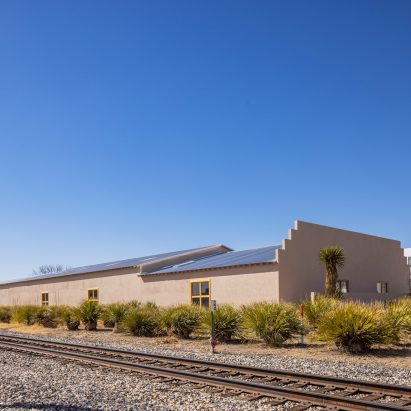
The result is a long, low-lying building with a two-tier roof and a restored facade that caps the building on one side.

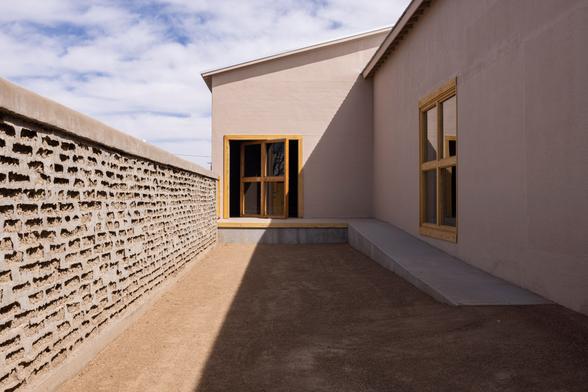
An adobe wall surrounds the narrower part of the building, creating a courtyard

The facade of the 23,000-square-feet (2136.7 square metres) building takes its cues from the designs of adobe structures in the American southwest and has an oversized gable with stepped sides.

“We knew we had to take special care to make a restoration that did not lose the 'as found' character of the historic building as we stitched the pieces back together," said Troy Schaum, partner at Schaum/Shieh Architects.

The windows were specially treated for the desert climate

The studio aimed to showcase the building's original design, including wooden beams and wooden collonades that run through the middle of the open interior.

A narrower section at one end of the building opens up to a courtyard surrounded by an adobe wall.

The doors and windows were given steel frames to pivot open

Inside, three dividing walls articulate the space and reference the three original structures that made up the warehouses. The narrow section leads to a longer, wide section.

This wider section is further divided into two spaces and there are restrooms in the dividing element.

Skylights were placed on the corrugated metal roof, which the studio renovated, in order to better light the gallery during the day.

The wooden support beams were restored from the originals structure

Special attention was paid to the doors and windows to the outside.

"The windows are Marfa-specific adaptation of pinewood coated in a traditional treatment of turpentine and linseed oil which gives them their unique patina," said Schaum/Shieh Architects.

Steel frames were incorporated into the windows, which had been inoperable for decades. This allows them to open on a pivot.

Outside, there are gardens of sotol, a desert plant similar to agave, which were part of Judd's redesign of the building in the 1980s.

[

Read:

Gitai Architects builds rammed-earth observatory in the Negev desert

](https://www.dezeen.com/2020/08/31/landroom-rammed-earth-observatory-negev-desert-gitai-architects/)

“We were fascinated by what we saw in Donald Judd’s work on the John Chamberlain Building as a restoration not to a historical moment, but to an ideal state," said Rosalyne Shieh.

"He is not restoring the warehouse in a historic way but instead to an idea of a warehouse, rather deliberately as a typology.”

The completion of the John Chamberlain Building, which will hold 24 large-scale sculptures, is the first in a master plan of renovations and additions announced by the Chianti Foundation in 2017.

The building is part of the Chianti Foundation's renovation master-plan

Marfa is known for its desert architecture and arts scene, and in January 2022 the Central Marfa Historic was recommended for consideration as part of the District National Register of Historic Place.

Other architecture projects in Marfa include an accessory dwelling unit by DUST built for isolated desert living.

_The photography is byAlex Marks. _

Project credits:

Architects: Troy Schaum, Rosalyne Shieh, Tucker Douglas, Andrea Brennan, Zhiyi Chen, Giorgio Angelini of Schaum/Shieh Architects.
Engineering: SGH Engineering
Landscape: Jim Martinez
Construction : JC Stoddard Construction

The post Schaum/Shieh Architects draws on original warehouse design for Marfa art gallery renovation appeared first on Dezeen.

#all #architecture #cultural #deserts #usa #galleries #renovations #culturalbuildings #texas #marfa #donaldjudd #adobeconstruction

Masquespacio designs cavernous restaurant interior that nods to adobe architecture

Local studio Masquespacio added undulating, earthy-toned walls to an intimate Valencia restaurant that takes cues from the "organic forms" of Middle Eastern architecture.

Living Bakkali is located in the Spanish coastal city of Valencia and features bespoke furniture designed entirely by Masquespacio, a design studio known for its use of colour in projects.

Living Bakkali's interiors are informed by Middle Eastern architecture

The restaurant is characterised by sloping, sandy-toned microcement walls that pay homage to the decorative motifs often found in Middle Eastern architecture, such as multifoil arches.

Designed in various hues of desert-like browns and pinks, Living Bakkali's curved arches are arranged in intricate formations that create intimate seating areas within the restaurant.

Masquespacio used microcement to create walls, floors and ceilings

"We used the recognisable brownish colour from the East, although we added slightly different colours to the palette – such as red – but always in a soft way and through earthy tones," Masquespacio co-founder Christophe Penasse told Dezeen.

"Middle Eastern seating is also almost always lower and more loungy than in the western world," he added, referring to the restaurant's low-slung dark crimson sofas and chairs.

A central hall intends to evoke the feeling of walking down a street

Guests enter the space at a central hall that is connected to the kitchen, which was designed to create the feeling of exploring a street filled with ancient houses.

"Interiors [in the Middle East] are almost never shown directly from the outside, although you can [often] find windows of arch forms that create a sense of double walls," explained Penasse.

Intimate booths are framed by the cavernous walls

The restaurant's thick walls are interrupted only by cut-out holes that create small windows between each table, some of which are tucked away in intimate booths. Among the various dining areas is a private room, which is reached through a corridor flanked by gauzy curtains.

Described by the restaurant itself as an "ode to adobe architecture," Living Bakkali takes cues from this natural construction material, as Masquespacio said that the venue's walls were designed to create an adobe effect, which means mud-brick in Spanish.

[

Read:

Studio Wok designs cavernous pizza restaurant to recall rocky coves of Sardinia

](https://www.dezeen.com/2021/08/12/studio-wok-myrto-sardinia-interior/)

The studio also designed all of the floors and ceilings in microcement in order to immerse visitors in a wholly cavernous environment that is intended to be reminiscent of traditional Middle Eastern houses.

Penasse said that Masquespacio's design process for Living Bakkali involved the exploration of many aspects of Middle Eastern culture – from architecture and materials to ways of eating through history.

A private dining room can be reached through a narrow corridor

"We got connected with the organic forms that have been used throughout Middle Eastern architecture, which was made mainly with clay materials by hand," Penasse explained.

"We wanted to bring the [traditional] Arabic aesthetic to the future in a new and more modern way, but still sought to maintain its essence," he said.

All of the seating was designed to be low-slung

Masquespacio was founded by Penasse and Ana Milena Hernández Palacios in 2010. Similar projects by the studio include Pukkel, a restaurant in Aragon that features winding stucco walls that were informed by the curvature of the nearby Pyrenees mountains.

The photography is bySebastian Erras.

The post Masquespacio designs cavernous restaurant interior that nods to adobe architecture appeared first on Dezeen.

#restaurantsandbars #all #interiors #spain #restaurants #valencia #cement #colour #arches #adobeconstruction

Masquespacio designs cavernous restaurant interior that nods to adobe architecture

Masquespacio added undulating, earthy-toned walls to a Valencia restaurant that takes cues from the "organic forms" of Middle Eastern architecture.

Dezeen

Emerging Objects builds 3D-printed mud hut for a cohabiting couple during Covid-19

Casa Covida is a hut in Colorado made from 3D-printed adobe by American studio Emerging Objects for two people to live together in isolation during the coronavirus pandemic.

Emerging Objects used Casa Covida as a case study for how a combination of modern and ancient technology could be combined to create a home big enough for two people to live in.

An inflatable pink roof can be added as weatherproofing

The experimental hut in the desert of San Luis Valley is formed of three connected cylindrical volumes that bulge slightly in the middle.

Its adobe walls are made from sand, silt, clay and water, printed using a three-axis SCARA (Selective Compliance Articulated Robot Arm) and left to dry and harden in the sun.

Casa Covida is formed of three rooms

For the construction, the adobe was sifted by hand and mixed using a cement mixer before being pumped into the three-axis SCARA and sprayed out via a nozzle.

The robotic printer is light enough to be carried by two people and can be operated by just one person with a mobile phone.

Emerging Objects also created the software for the project, which it christened Potterware.

The central room features a hearth and benches

A wooden door in the central volume opens on to an open space that has two earthen benches, called tarima, as well as an open fireplace for cooking food and keeping warm during cold nights.

An inflatable pink roof can be erected if it rains or snows, or to keep the heat from the fire in when desired. From the outside, this colourful addition makes the ridged hut look "like a blooming cactus," said Emerging Objects.

Emerging Objects 3D-printed cookware too

One of the volumes next to the central cylinder is covered and contains a sleeping platform made from beetle kill pine – wood from trees killed by mountain pine beetles.

A heat-treated blackened version of the same wood was used for the doors and lintels.

A sleeping platform is made of dead pine

On the other side, the third volume contains a sunken bathtub surrounded by black and shiny tumbled river stones.

The tub draws its water from an aquifer deep below the mountain desert landscape. An oculus in the roof frames views of the stars at night.

The bath is surrounded by shiny stones

Emerging Objects also used 3D-printing to create some of the homeware objects for Casa Covida.

The door handles were made using a 3D-printed bioplastic mould, which was burned away as the handles were cast from aluminium cans that were collected from the desert roadside.

The tub draws its water from an aquifer

A clay cooking pot and lid, a form taken from the Pueblo pottery of New Mexico, was 3D printed from locally sourced micaceous clay.

The benches are furnished with woven textiles. In the bedroom, the sleeping platform is covered with sheepskin, woven churro wool blankets and cushions that Emerging Objects designed in collaboration with local weaver Joshua Tafoya.

A circular opening above the tub is open to the sky

Founded by Ronald Rael and Virginia San Fratello, Emerging Objects has previously 3D printed a pavilion out of salt and a tiled shed covered in succulents.

Photography is by Elliot Ross and Emerging Objects.

Project credits:

Design: Emerging Objects
Team: Ronald Rael, Virginia San Fratello, Mattias Rael, Sandy Curth, Logman Arja.
3D Potter: Danny Defelici.
Textiles: Joshua Tafoya
Special thanks: Christine Rael, Johnny Ortiz (Shed Project) and Maida Branch (Maida Goods)

The post Emerging Objects builds 3D-printed mud hut for a cohabiting couple during Covid-19 appeared first on Dezeen.

#residential #all #architecture #usa #deserts #3dprinting #huts #3dprintedhouses #colorado #coronavirus #emergingobjects #adobeconstruction

Emerging Objects builds 3D-printed mud hut for a cohabiting couple during Covid-19

Casa Covida is a hut made from 3D-printed adobe by Emerging Objects for two people to live together in isolation during the coronavirus pandemic.

Emerging Objects builds 3D-printed mud hut for a cohabiting couple during Covid-19

Casa Covida is a hut in Colorado made from 3D-printed adobe by American studio Emerging Objects for two people to live together in isolation during the coronavirus pandemic.

Emerging Objects used Casa Covida as a case study for how a combination of modern and ancient technology could be combined to create a home big enough for two people to live in.

An inflatable pink roof can be added as weatherproofing

The experimental hut in the desert of San Luis Valley is formed of three connected cylindrical volumes that bulge slightly in the middle.

Its adobe walls are made from sand, silt, clay and water, printed using a three-axis SCARA (Selective Compliance Articulated Robot Arm) and left to dry and harden in the sun.

Casa Covida is formed of three rooms

For the construction, the adobe was sifted by hand and mixed using a cement mixer before being pumped into the three-axis SCARA and sprayed out via a nozzle.

The robotic printer is light enough to be carried by two people and can be operated by just one person with a mobile phone.

Emerging Objects also created the software for the project, which it christened Potterware.

The central room features a hearth and benches

A wooden door in the central volume opens on to an open space that has two earthen benches, called tarima, as well as an open fireplace for cooking food and keeping warm during cold nights.

An inflatable pink roof can be erected if it rains or snows, or to keep the heat from the fire in when desired. From the outside, this colourful addition makes the ridged hut look "like a blooming cactus," said Emerging Objects.

Emerging Objects 3D-printed cookware too

One of the volumes next to the central cylinder is covered and contains a sleeping platform made from beetle kill pine – wood from trees killed by mountain pine beetles.

A heat-treated blackened version of the same wood was used for the doors and lintels.

A sleeping platform is made of dead pine

On the other side, the third volume contains a sunken bathtub surrounded by black and shiny tumbled river stones.

The tub draws its water from an aquifer deep below the mountain desert landscape. An oculus in the roof frames views of the stars at night.

The bath is surrounded by shiny stones

Emerging Objects also used 3D-printing to create some of the homeware objects for Casa Covida.

The door handles were made using a 3D-printed bioplastic mould, which was burned away as the handles were cast from aluminium cans that were collected from the desert roadside.

The tub draws its water from an aquifer

A clay cooking pot and lid, a form taken from the Pueblo pottery of New Mexico, was 3D printed from locally sourced micaceous clay.

The benches are furnished with woven textiles. In the bedroom, the sleeping platform is covered with sheepskin, woven churro wool blankets and cushions that Emerging Objects designed in collaboration with local weaver Joshua Tafoya.

A circular opening above the tub is open to the sky

Founded by Ronald Rael and Virginia San Fratello, Emerging Objects has previously 3D printed a pavilion out of salt and a tiled shed covered in succulents.

Photography is by Elliot Ross and Emerging Objects.

Project credits:

Design: Emerging Objects
Team: Ronald Rael, Virginia San Fratello, Mattias Rael, Sandy Curth, Logman Arja.
3D Potter: Danny Defelici.
Textiles: Joshua Tafoya
Special thanks: Christine Rael, Johnny Ortiz (Shed Project) and Maida Branch (Maida Goods)

The post Emerging Objects builds 3D-printed mud hut for a cohabiting couple during Covid-19 appeared first on Dezeen.

#residential #all #architecture #usa #deserts #3dprinting #huts #3dprintedhouses #colorado #coronavirus #emergingobjects #adobeconstruction

Emerging Objects builds 3D-printed mud hut for a cohabiting couple during Covid-19

Casa Covida is a hut made from 3D-printed adobe by Emerging Objects for two people to live together in isolation during the coronavirus pandemic.