The Regent Road mistake: the thread about why the infallible Robert Stevenson got Easter Road wrong

This thread was originally written and published in February 2022. It has been lightly edited and corrected as applicable for this post.

Sometimes I get asked a question to which I kind of know the answer, but want to check on my facts before I respond, and the answer ends up being much more involved that I ever thought it might be.

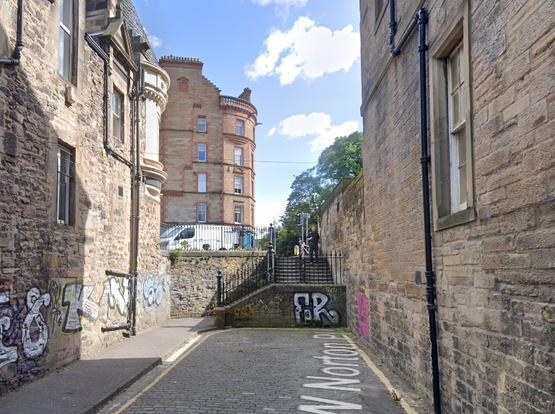
Q. What is it with these steps at the top of West Norton Place? What is the construction history? Are they something to do with easing the gradient of Regent Road / Montrose Terrace for trams?

Steps at the top of West Norton Place, leading to Montrose Terrace

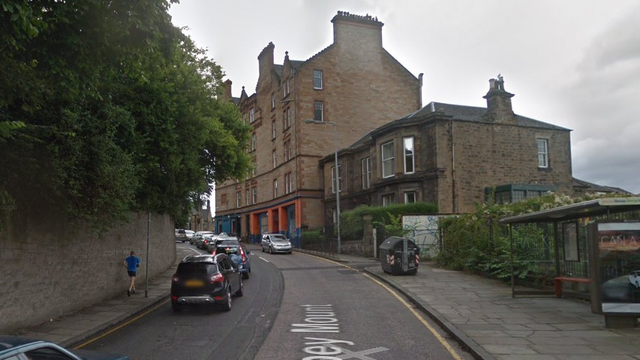
If you don’t know this bit of Edinburgh, where we are is called Abbeymount, where beyond London Road, the top bit of the Easter Road starts climbing steeper and in a circuitous manner around the old Regent Road School, up to the junction of Montrose Terrace and Regent Road, and then drops right back down the other side towards Holyrood.

Abbeymount, looking north towards Montrose Terrace. The tenement on the corner is also called “Abbeymount”

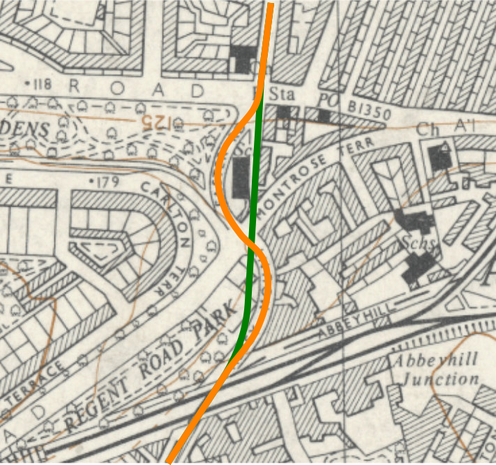
So why does Easter Road take a winding, S-shaped course (orange line) to get to Holyrood, when logically it should just plough straight ahead at the top of Easter Road, along the cul-de-sac of West Norton Place and onwards (green line)? The short answer of course is that it wasn’t always this way. In fact it wasn’t this way at all prior to 1816. We are going to have to dive back into what this part of old Edinburgh looked like via the National Library of Scotland’s online map library.

OS 1:10,000 Survey, 1955. Reproduced with the permission of the National Library of Scotland

Prior to 1800, most horse and cart traffic between Edinburgh and its port of Leith went via the Easter Road (the name means exactly that, it is the east road to Leith from Edinburgh) and into the city via the Canongate, past a tollbar at the Water Yett (Water Gate) via the little village of Abbeyhill. This was also the principle route to the village of Restalrig, if you continued along the magenta line and off the map to the right, and for those brave enough to try an overland journey, east and south to London past Jock’s Lodge on the white arrow.

Roy Lowland map of Scotland, c. 1755, showing the route between Edinburgh and Leith via the Canongate, Abbeyhill and Easter Road. Reproduced with the permission of the National Library of Scotland

At the turn of the 19th century, the land at Abbeyhill was a small estate known as “Baron Norton’s Feu” or “Norton Park“. Fletcher Norton was an English lawyer who settled in Edinburgh and established himself prominently in the world of Scottish law and ingratiated himself into local society.

Feuing map of Norton Park, 1801, by John Ainslie. Fletcher Norton’s land is coloured blue, his mansion is right of centre, highlighted. Reproduced with the permission of the National Library of Scotland

To the south of Norton Park was Abbey Hill itself (highlighted green), a village just outside the city boundary and really just a street of taverns, stables and smithies like you might expect as being needed on the way into and out of town. It only extended to the limits of the green boundary. In yellow is a little suburb of villas known as Maryfield (from where the current streetname comes) and in orange is the Upper or Over Quarry Holes, an ancient Edinburgh place with a fascinating and gruesome history all of its own of executions, witches, skirmishes, drownings and treachery.

Anyway, you’re probably already ahead of me and have seen those faint pencil lines on the map above and have realised they’re very close to the modern street alignment and you probably now want to know what they’re all about; so let’s move on. At the turn of the 19th century, Edinburgh has a problem (well, it had many, but let’s just look at this specific one). It was increasingly renowned and lauded for its neoclassical New Town architecture, its flourishing society and its place as a beacon of learning and enlightenment. But the physical approach into this “modern Athens” is rubbish!

The visitor arriving from the south by sea will approach from Leith. They can choose to pick their way up the footpath along the line of General Leslie’s old 1650s fortifications that will become Leith Walk, or they could take a horse and coach up the Easter Road and enter this grand modern town through the ancient and crumbling – and frankly embarrassing – Canongate. Or if you had come the hard way overland, as you approach the city you can see little of this renowned new metropolis unfold before you as your carriage bumps and sways its way past Jock’s Lodge and into the Canongate via Abbeyhill; looking out the window you could be back in the early 18th century.

Something had to be done! And who better to do it than that most eminent of Scottish Georgian engineers – Robert “Lighthouse” Stevenson. Stevenson doesn’t need many introductions, but his role in shaping, and forever changing, this end of Edinburgh I had not until now appreciated.

Robert Stevenson by John Syme, 1833. CC-by-NC National Galleries Scotland

Stevenson planned to improve the approaches to the city from Leith by the widening and levelling of the “Walk of Leith” into that wide boulevard we now call Leith Walk. Show-piece Georgian townhouses and fine tenements were built at the top as you entered the city, at Gayfield Place, Antigua Place, Picardy Place and Baxter’s Place. And of course who should live in one of these fine new townhouses at the latter address than the Stevenson clan themselves! , at Baxter’s Place

The Stevenson house at Baxter’s Place, CC-by-SA Stephencdickson

However that was only one part of the improvements. The next scheme was the “Great Post Road from London“, the road we now know as London Road – or the western extremity of the A1. This was proposed from around 1800 and an Act of Parliament was made in 1803 approving its construction. You can see the route on this 1804 map highlighted in red, also by John Ainslie.

1804 Town Plan by Ainslie, overlaid on modern aerial photography. Reproduced with the permission of the National Library of Scotland

However, Stevenson and the magistrates of the city were not entirely satisfied. Although this new road created a wide, flat and straight processional approach, it meant the arriving visitor had their view of the city obscured by the Calton Hill and to get to Princes Street they would have to go up Leith Street – this spoiled the whole point of the new road! Robert Barker’s panorama from Calton Hill of 1793 shows that Leith Street was hardly a grand and splendid gateway to the city.

Panoramic view from Calton Hill, aquatint by Robert Barker, 1793. © Edinburgh City Libraries

No, what was needed was an even better way into the city; one with breathtaking and statement views of the metropolis as you entered it and with the smoothest and flattest possible route for horse carriages. The answer was obvious to one Magistrate, William Trotter (“Scotland’s greatest cabinet maker“) and also to Stevenson. Instead of the road around, below and to the north of the Calton Hill, they were going to have to go over it to the south. This might seems the obvious route with the benefit of 200 years of hindsight, but this proposal was a vast engineering challenge. That side of the Calton Hill was known as the Dow Craigs (black or dark rocks) and was all towering cliffs. There was a good reason it had never yet been built on, as this 1796 print (depicting a scene of about 1790) shows.

View from Queen’s Park with Clockmill House, unknown artist, 1796. The mast on the Calton Hill was for semaphore communication with shipping in Leith Roads © Edinburgh City Libraries

We can tell that the above print dates to before 1791, as between then and 1796, Robert Adam (“Scotland’s Greatest Architect“) built the city their new house of punishment, “the Bridewell,” on the south slopes of the Calton Hill, where St. Andrew’s House now stands. It was the magistrate William Trotter again who hady been instrumental in getting the new jail sited here, as the original idea of locating it in the Nor’ Loch Valley was anathema to him. The Bridewell was constructed from stones hewn out of the Salisbury Crags of Arthur’s Seat themselves (the ridge directly behind the Bridewell in the below print). These provided a ready supply of stone to which Stevenson would also turn to realise his grand scheme for a road around the south of the hill to connect the London Road directly with Princes Street.

The Bridewell

We are hugely fortunate that Stevenson’s beautiful drawings for his plans have survived and have been digitised by the National Library of Scotland, you can view the full map and zoom right in on it here.

Plan for a new road or street from the Muscleburgh [sic] road, at or near Jocks Lodge to Princes Street, Edinburgh. Reproduced with the permission of the National Library of Scotland

There were some other problems to solve however. Firstly, the yawning gap of the Calton Gorge had to be bridged, where the ancient Leith Wynd entered the city via the nominally independent burgh of the Calton. This required the construciton of the Regent Bridge. However, at that time Princes Street was closed off at its eastern end by a rather humdrum collection of buildings known as Shakespeare Square (where Trotter lived and worked).

Stevenson drawing of the area to be cleared for the Regent Bridge

No problem, they would just be demolished. They were hardly very grand anyway.

Demolition of Shakespeare Square as seen from the south east corner of the Register Office. Daniel Somerville, 1817 © Edinburgh City Libraries

And as for the decrepit buildings below in the ancient High and Low Calton? Demolish those too.

Demolition in the Low Calton to make way for the Regent Bridge, by Daniel Somerville, 1818. © Edinburgh City Libraries

With demolition complete, the Bridge could start to be constructed. You don’t get an idea of just how impressive the bridge is – and just how slender the arches supporting Waterloo Place are – until you see it unhidden by the buildings that have long enclosed it.

Construction of the Regent Bridge, from the Calton. Daniel Somerville, 1817. © Edinburgh City Libraries

The viaduct of Waterloo Place and the Regent Bridge allowed Stevenson to build a wide and constant road with a 1-in-35 gradient from the East End at Register House to a summit outside the Bridewell. From there the road ran relatively straight at a 1-in-26 decline for the 1,000 or so yards down to a junction with the new London Road. This required a lot of cuttings and bankings as illustrated in his plans.

Plan for a new road or street from the Muscleburgh [sic] road, at or near Jocks Lodge to Princes Street, Edinburgh. Reproduced with the permission of the National Library of Scotland

Stevenson quarried the rock for the bridges, embankments, infill and road surface from Salisbury Crags, needing at least 10,920 cubic yards. Indeed in the 4 years 1815-1819, some 45-50,000 tons of stone were quarried off of the crags for this and other schemes. It was estimated that each ton of stone won from the Salisbury Crags meant 2 more lost in rubble and waste, which was simply tipped down the slopes of the crags. Some of this waste was recovered, but such was the alarm caused by the rapid and significant alteration to the appearance of the Crags that they were never quarried again after this. Work proceeded quickly and was formally completed in 1821, although the route was passable as early as 1819. Although that’s an important part of the story, it still doesn’t answer why the area around West Norton Place looks like it does now. We need to keep going. If we look closely at Stevenson’s Plan, something strikes you. There’s what looks to be a bridge at Abbeymount. Yes, there’s definitely a bridge. It’s not a very big bridge. But there’s a bridge.

Plan, the Easter Road below the new Regent RoadSouth Elevation, the Easter Road passes through this arch

Now I bet that’s news to you – it was to me! So was this bridge ever actually built? Or was it altered to the current road layout before completion? Let’s check the 1817 town plan. Yes there’s still a bridge. But the problem with the town plans of this time is they frequently record what was intended to be built, not what was. (Just look at those 2 canals there running through the Upper Quarry Holes!)

Kirkwood’s 1817 Town Plan, “Bridge” is clearly marked, but this was before the road was completed. Reproduced with the permission of the National Library of Scotland

Winding the clock forward slightly to 1821 and what is this? Oh no! The bridge is gone! And we also see the distinctive S-shaped road up to and down from the Regent Road between Easter Road and the Canongate.

Kirkwood’s 1821 Town Plan, there’s no bridge and the road layout is very close to what is there nowadays. Reproduced with the permission of the National Library of Scotland

So what’s going on here? Was the road built exactly to Stevenson’s plan? Was there ever a bridge over Easter Road? Or did it change as construction proceeded to the arrangement we all know and love to this day? The answer wasn’t readily obvious in maps or the books. The next best place to look is in the newspapers of the time.

Stevenson had a great vision for his new road, envisioning three grand tiers of townhouses rising above it, impressing those entering the city but also not impeding the residents’ views south to Arthur’s Seat. He showed real determination to drive this scheme through. He didn’t just demolish buildings, but had half a graveyard dug-up and its contents exhumed and relocated to make way for his road. I think in his tunnel vision to complete it, he overlooked something; angry people in local newspapers. (No, that’s not a joke, he really did.)

Stevenson’s vision for Calton Hill. Only one of these tiers of housing would ever be built, as Regent Terrace. Reproduced with the permission of the National Library of Scotland

If you trawl through the green ink sections of the Scotsman and Caledonian Mercury at this time then what you will find is, even before the scheme was completed, the residents of the rapidly expanding and affluent South Side of the city were deeply aggrieved at there being two big new roads into and out of the city but none for them. They felt that having to cross the North Bridge, then turn to cross the Regent Bridge to proceed east out of the city was far too circuitous a route. His bridge at Easter Road to carry the Regent Road over was also felt to be too narrow for cart traffic to pass easily through, so he upset the carters of Leith and the Canongate too. The residents of Abbeyhill were aggrieved by the dark and narrow defile he had created.

And to be honest, the “Angry People in Local Newspapers” were right here. The new road provided a smooth and monumental access to the city from the east, but it got in the way of existing traffic and was convoluted to access from the Easter Road or Abbeyhill; the usually infallible Stevenson had made it too small. The “Commissioners for the New Road” obviously felt they had a serious problem on their hands here and as early as May 1819, it was reported that the Easter Road bridge (work on which had only started in September 1817) was to simply be filled in, and the road carried up to the Regent Road level and back down the other side by new embankments. Of course, this wasn’t ideal either as although it connected the new Road to the Easter Road, it was going to be much too for the carters. So the green ink vented its ire on behalf of the carters of Leith and the Canongate into the Caledonian Mercury once again.

What they wanted was a wider bridge, with better approaches to it. But that would have cost money, and a huge amount had already been spent, so the Commissioners went with the easy option and filled it in, and built the Easter Road up to the Regent Road and the Abbeyhill likewise up on the other side. This required a sweeping curve of new road at the top of Easter Road to reduce the gradient for the carters (although it was still a challenge!). The old alignment of Easter Road was simply cut off by the Regent Road where the bridge was infilled; this short stretch was renamed West Norton Place and it explains why it terminates in a stone retaining wall at Montrose Terrace.

1849 Ordnance Survey Town Plan showing West, East and South Norton Place, and the new curved approaches up to the Regend Road from Easter Road and Abbeyhill. Reproduced with the permission of the National Library of Scotland

The other sides of the gushet (Scots for a triangular portion of land) formed by the new roads being East and South Norton Places it was common in Edinburgh at this time to give the buildings different streetnames to the roads they were actually on – East Norton Place is on London Road, South Norton Place on Regent Road, later Montrose Terrace. For the convenience of people on foot, a small staircase was provided for getting between the Regent Road and West Norton Place. It’s still there, and was only recently shut off as a through route as being in disrepair.

The original staircase between West Norton Place and Regent Road / Montrose Terrace

Norton Place developed into a little block of Regency tenements in its own right at the eastern end, but remained undeveloped at the west until much later. The below image shows the junction of the original London Road alignment (right) with Stevenson’s Regent Road (which is now Montrose Terrace) on the left. The former Regent Road school, where the steps are, is to the left of the crane.

London Road, looking west, at the junction with Montrose Terrace

But what about the steps in the picture that started this thread off? Well, in 1872 or so, the Heriot Trust built a school in the sliver of land between West Norton Place and the new alignment of Easter Road. This would become the Regent Road Public School when the School Board took it over from Heriot’s, later it was the Abbeymount Techbase and more recently the Out of the Blue Abbeymount Studios. The school was split into upper and lower levels, to make use of the awkward site, with separate entrance gates into high and low-level playgrounds..

1876 OS Town Plan showing the new Heriot’s School, but at this stage no steps up to Regent Road. Reproduced with the permission of the National Library of Scotland Former Regent Road School from the upper section of Easter Road

And between the maps of 1876 and 1893, our staircase is built, with tenders being sought for it in 1891 to be precise! I imagine that this was because of the huge increase in population in the neighbourhood as the tenements sprung up on Easter Road and in Abbeyhill. The original staircase was too steep and narrow for heavy public use and a wider, more direct one was built instead.

The Scotsman, 21st November 1891

All because the city had to block up the ancient “desire line” for foot traffic between Easter Road, the Abbeyhill and the Canongate 72 years previously when they filled in Stevenson’s bridge. So next time you stand at the top of Easter Road and look up the hill in front of you and wonder why the road ahead sweeps around the old school in a cutting, rather than straight ahead, the answer is that you’re looking at a Georgian on-ramp that was put in in a hurry to solve some Georgian traffic-flow problems caused by a bridge that was built too narrow.

The former Regent Road School, looking south from where Easter Road meets London Road. West Norton Place is on the left, Easter Road continues uphill and curves around the school towards Montrose Terrace.

If you have found this useful, informative or amusing, perhaps you would like to help contribute towards the running costs of this site – including keeping it ad-free and my book-buying budget to find further stories to bring you – by supporting me on ko-fi. Or please do just share this post on social media or amongst friends.

Explore Threadinburgh by map:

Travelers' Map is loading...
If you see this after your page is loaded completely, leafletJS files are missing.

These threads © 2017-2026, Andy Arthur.

NO AI TRAINING: Any use of the contents of this website to “train” generative artificial intelligence (AI) technologies to generate text is expressly prohibited. The author reserves all rights to license uses of this work for generative AI training and development of machine learning language models.

#Lochend #Logan #Restalrig #StMargaret
The Grand Edinburgh Fire Balloon: the thread about James Tytler and the first manned aerial flight in the British Isles

This thread was originally written and published in August 2023.

Today is August 27th 2023. So what is special about this date? Well, it was today, 239 years ago, when the eccentric Edinburgh character of James Tytler ascended in his “Grand Edinburgh Fire Balloon” and flew the 3,000 or so feet from Comely Gardens to Restalrig on the outskirts of the city, thus making the first, manned aerial flight in the British Isles, immortalising himself in the process as Balloon Tytler.

A rather optimistic engraving of Tytler’s balloon flight, from “The Literary World”, 25th July 1840. In reality the bird-like gondola and the stove was absent during his flight and he sat instead in a small, wicker basket

James Tytler hailed from Fearn in Forfarshire, the son of a minister of the Kirk of modest means, who had been sent to Edinburgh to pursue and education and make a better life for himself. He was many things, but he was mainly persistently skint and in debt. Had he not been so, he may have been remember as a polymath. He had failed as a preacher, as a doctor as an apothecary and as a poet, but succeeded in scraping a living and keeping his creditors at bay as a pen for hire; he wrote much of the 2nd edition of the Encyclopædia Britannica. But we are interested in him here as an aviator.

James Tytler, engraving of him as author of Encyclopaedia Britannica

In September 1783, a “fire balloon1” constructed by France’s Montgolfier brothers successfully flew with a sheep, a duck and a rooster on board (the animals all survived!) In late November, Pilâtre de Rozier and the Marquis d’Arlandes were the first human passengers in one of the brothers’ machines. Tytler, reading of these endeavours in far away Edinburgh, was captivated and – like many of his contemporaries -caught the flying bug . Working on the second edition of the encyclopaedia at the time, he devoted a whole 8-page section of the Encyclopaedia to ballooning, writing “In future ages, it will be as usual to hear a man call for his wings, when he is going on a journey, as it is now for him to call for his boots“. “By this invention” he continued “the schemes of transporting people through the atmosphere, formerly thought chimerical, are realised”.

The first flight of a Montgolfier fire balloon from Versailles in September 1783, the passengers were a sheep, duck and rooster
  • At the time, hot air balloons were known as fire balloons and hydrogen balloons as inflammable air balloons ↩︎
  • It was around this time, late in 1783 or early 1784, that Tytler took the bold step of determining that he would not just read and write about ballooning, he would also build and fly one of his own. This whole scheme may have arisen as an after-dinner wager in one of the dining rooms of enlightenment Edinburgh, as a scrap of handwritten paper was kept by Professor Dugald Stewart, in the style of a newspaper advertisement, announcing the intention:

    We have the authority to assure the Public that it is neither Mr Tytler of Woodhouselee nor Mr Frazer Tytler, Advocate and Professor of Civil History in the University of Edinburgh, that means to go up with the Air Balloon on the 7th of May, but Mr James Tytler an ingenious chemist and distant relation of the others, whose friends it is hoped will accept of this intimation of their having no intentions of going up with air balloons at present, what ever-malicious or interested persons may chuse (sic) to give out, or credulous people may believe.

    Wager or not, Tytler certainly had the brains, the self-confidence and the ambition to see this project through, but there was a big stumbling block; he had not the money. Indeed, this lack of funding would plague the project from beginning to end and seriously compromised his results. But he pressed on with planning nevertheless. On June 19th he took out a front page advert in the Edinburgh Evening Courant newspaper announcing a public demonstration of a scale model hot air balloon, both for his own testing and to try and raise precious funds by charging an admission fee:

    On Monday next, the 21st current, will be exhibited
    AT COMELEY GARDEN
    By JAMES TYTLER, CHEMIST
    A FIRE BALLOON, of 13 Feet Circumference,
    AS A MODEL OF
    THE GRAND EDINBURGH FIRE BALLOON,
    with which he intends to attempt the Navigation of the Atmosphere

    Edinburgh Evening Courant, June 19th, 1784

    Comely Gardens, if you didn’t know, was a Georgian pleasure garden between Holyrood and Abbeyhill, “a wretched imitation of Vauxhall“, where for a few pennies you could stroll the ornamental garden, take tea, and listen to whatever music or entertainment had been laid on. The gardens both offered shelter within their walls and trees, from (most of) the prevailing winds, and an ability to charge people for entry. This tethered exhibition was successful and enough money was raised to fund construction of the full-scale “Grand Edinburgh Fire Balloon

    1804 Edinburgh Town plan by John Ainslie, centred on Comely Gardens. Reproduced with the permission of the National Library of Scotland

    James got to work at once. The basic machine was quite crude – unlike the gaily decorated French contemporaries – limited both by his funds and his skills. The design was basically a 30 feet wide by 40 feet tall linen cylinder, lined with paper to make it “leak proof” and surrounded by ropes to attach a basket for the occupant and a stove to heat the air. Unfortunately, many of those gentlemen who subscribed to the scheme refused to part with their money until after the machine had flown (or at the very least risen from the ground), so he was caught in a Catch 22 situation, between having to follow through to prove himself to his sponsors, but also lacking the money or credit to actually do so.

    Engraving of Tytler’s balloon from his own promotional tickets. The characters in the balloon are well out of scale. The “wings” projecting from the car were intended to “row” and “steer” it through the air but were entirely useless.

    There was also the threat of the Edinburgh Mob, there being rumblings that they would either destroy the balloon as some sort of affront to God before it could fly or destroy it in disappointment if it failed to fly. The authorities were nervous and made it be known they might forbid the scheme entirely on public order grounds. Somehow Tytler managed to scrape together enough funds to complete the basic balloon envelope and resolved to demonstrate a public inflation of it to try and confound his doubters and convince some of the sponsors to convert their paper promises into actual money. But he needed somewhere enclosed to trial the inflation of his fragile linen and paper balloon and there was only one building big enough in town; the incomplete shell of the Register House – “the largest pigeon house in Europe“, still incomplete after 10 years of stop-start construction and a lot of finance.

    The Register House, partially complete, some time before 1787. Sketch by John Brown, Cc-by-NC National Galleries Scotland

    And so an advert was placed in the Courant on July 17th 1784, requesting the presence of “the Gentlemen who have subscribed or intended to subscribe“. The reporters from that paper and its rival The Advertiser were also invited to help publicise the scheme. This demonstration was also a success – sort of… the balloon did inflate – but the stove was inefficient and smoky, it coated the inner walls of the envelope in soot and sent up sparks and cinders which burned holes in the paper and linen, causing it to leak like the metaphorical sieve and slowly deflate. Tytler put a brave face on things, but couldn’t afford to start from scratch or buy a better stove, so resolved to patch up the leaky balloon and go for broke. The week of the Leith Races commences on 2nd August and it would provide the crowds and occasion to launch a flight.

    William Reed, the Leith Races, late 18th century or early 19th. © Edinburgh City Libraries

    There was a further reason to pick race week for the demonstration; it gave Tytler the perfect cover if things went wrong and the Mob was stirred. In this event, he could say it was the fault of the races for whipping up any trouble and not his flying machine. So the day after the test inflation at Register House he took out adverts across the local papers. In these, he announced the Edinburgh Fire Balloon would fly (tethered) after the first race, and every day thereafter, and that on the Friday it would be unleashed and might “cross the Frith (sic) of Forth”. He made yet a further appeal for financial support and made sure to note that Major Masters, commanding officer of the garrison at Edinburgh castle, had offered up his men to guard the balloon and any “Ladies and Gentlemen that may attend the different exhibitions“, lest the Mob spoil the occassion.

    Tytler’s announcement in the Caledonian Mercury, 31st July 1784

    So in amongst the drinking, the gambling, the debauchery, the freak shows and the general chaotic merriment of the Leith Races, Tytler was going to fly across the Forth! He removed the balloon back to the Comely Garden and got to work at once. For the occasion, he had tickets printed up, which he signed and numbered by hand. He also scored out the printed line “Constructed by William Brodie“, being unable to afford to pay a subcontractor he would now be doing all the work for himself.

    Ticket to the Edinburgh Fire Balloon, British Museum number C,2.11-28

    With what remained of his scant funds, he had constructed a mast 50ft tall, with a 64ft long arm at the top, to hold the envelope of the balloon as it inflated. But his relentless scrimping meant it was built too weak, and the day before race week began, Sunday 1st August, it collapsed under test. The crowd that nevertheless assembled at Comely Garden the next day to see the tethered flight was therefore denied such a spectacle. On each of the subsequent 3 days the west wind did blow – a direction from which the site was not sheltered – so disappointment prevailed again and again. Things were getting desperate for Tytler, he needed a success, and so he moved the balloon and the repaired mast to the most sheltered corner of the garden and on Friday 6th August – the date he had promised to fly across the Forth – he lit the stove and started inflating. But the wind again started to blow as the envelope filled and it strained at its mooring ropes. Tytler’s helpers struggled to contain it and it was only the ripping of the envelope and partial deflation that probably saved it from being blown clean away. The crowds left angry and dismayed. The Courant was scathing: “The Edinburgh Fire Balloon has been struggling hard to make its public appearance during the race week. Masts and yards and scaffolds and furnaces had lent their aid, but to little purpose. Its gravity and affection for the earth cannot be overcome“.

    But Tytler was irrepressible, the winds dropped and the next day he tried again. This time the balloon inflated, but as he was about to clamber aboard the basket “a gust of whirlwind, as if send by divine command to blast the hopes of this devoted projector, attacked the Balloon, drove it hither and thither and by compressing it on all sides, soon reduced it to a state of flaccidity” and it once more deflated. The Mob had finally had enough; angry scenes followed this failure and Tytler fled before he could be accosted for any refunds. When the crowd could not find him they turned instead on his balloon, detached its basket and paraded it around the local streets in triumph before throwing it on the still-glowing stove and burning it to ciders. Their anger thus sated, they drifted home. Tytler was at rock-bottom and wrote about his feelings at this time:

    I was obliged to hear my name called out wherever I went, to hear the insults of every black-guard boy, to hear myself called Cheat, Rascal, Coward and Scoundrel by those who had neither courage, honesty nor honour. I was proscribed in the newspapers and pointed out by tow of the Edinburgh News-mongers as a public enemy

    His name may have been mud with the Courant and the Advertiser, but the Caledonian Mercury was more sympathetic about the failure, giving him the benefit of the doubt – he could after all not control the weather. It also pointed out that if more of his claimed backers would pay up, he might have the funds needed to succeed.

    Perhaps encouraged by that forgiving take on events, Tytler soon slunk back to Comely Garden to examine the remains of his machine. The main flaw of his design was that it lacked a neck, so the wind easily blew or sucked the hot air out. About this he could do nothing, but he could at least try patch it up and get a new basket. The fragile paper lining was now covered in soot and full of cinder-holes and tears, so he painstakingly removed it, and instead varnished the linen to try and make it airtight. He could not afford to build a proper basket, and so one used to carry crockery was sourced as a passenger compartment. But this meant that the stove could no longer be carried. In fact this was probably a good thing as it weighed 300lbs and had a habit of mainly burning holes in the balloon. So he had to settle to try and fly without it, using only whatever hot air he could fill it with on the ground (and keep captive within it) to provide the lift for flight. His reasoning was simple, if he could make any sort of flight in the repaired machine, he should be able to raise the money for a full rebuild. In his own words it was “the resolution of a madman and which nothing but my desperate situation could excuse“.

    And so the word went out that he would try again for a flight within a fortnight. Fortunately at this time, the attention of the public and of the press was drawn to the election of a new MP for Edinburgh, giving him some breathing space from both (even if there was only one candidate and the only electors were the Town Council!) Not wanting to incur the attention of the Mob again, the next attempted inflation on Wednesday August 25th had no crowd invited. The balloon was filled for over an hour to help dry out the varnish. At about 630AM, the fire was put out and Tytler climbed into his basket. The restraining ropes were cast away, the balloon floated, and then… nothing happened! Perhaps there was not enough hot air, or the morning was too cold, but at least there had not been a disaster and he had demonstrated “the practicability of the scheme“. The previously sympathetic Caledonian Mercury was not convinced however and under the title of “The Rise and Fall of the Edinburgh Fire Balloon”, they took a satirical imagination of his first flight,with it ending with the balloon pierced by a church steeple and its occupant being cast into a duck pond.

    But success was in Tytler’s grasp and after a final few tweaks and another coat of varnish, he was ready to go again. It was Friday 27th August, 1784, 239 years ago today, it was about 5AM and the stove was once again lit beneath the envelope. An uninvited crowd had formed, either to be sure to see success or to be amused by failure. The balloon slowly filled, straining at its mooring ropes. Maybe Tytler – a deeply religious but unaligned man – said a prayer for success or salvation first, but he soon climbed into his basket again and the ropes were once more undone. And this time, to everyone’s surprise, up he went, eliciting a great cheer from them. Ascending rapidly, a loose rope caught a tree and the mooring mast, but such was the lifting force it simply snapped free of both. A height of 350ft was reached, the length of that loose rope, the crowd tried to grab it but it tore free from their grasp too. Up, up, and quite literally away he went! Carried on the western breeze, he drifted slowly eastwards and away from the city. The crowd gave chase, Tytler recalling afterwards that he was much amused by “looking at the spectators running about in confusion below“.

    With no stove to keep the balloon hot, it rapidly cooled and the intrepid aviator was soon drifting back to earth. He came down about half a mile distant in the village of Restalrig, possibly in the minister’s glebe (but neither in a dung heap or a duck pond as his detractors had forecast). And for once, Tytler, the crowd, his supporters, and the press were all jubilant. The downtrodden little man with a moth-eaten coat, whose shoes were falling apart and who had a hole in his hat had succeeded! The previously hostile Advertiser declared him “the first person in Great Britain to have navigated the air“. The Courant were “amazed at the boldness of the undertaking” and made something of a mealy-mouthed apology for their previous scepticism. The Caledonian Mercury called it “a decisive experiment” and that Scotland could at last “boast of its aerial navigator“.

    Filled with the confidence of success a 2nd flight – well advertised to the public – was planned for the 31st, the day of the foregone conclusion of the election of Sir Adam Fergusson as the city’s new MP. After completing the requisite formalities, the newly elected member and the Council committee hastily made their way to Comely Garden to join the assembled spectators. Once again the balloon inflated. Once again Tytler climbed bravely aboard and once again it took off. But it had been under-inflated and this time it rose to only about a hundred feet, coming down not far over the garden boundary wall. But it had still flown and it was enough to convince some of his backers to finally follow through financially and he was able to raise enough money to rebuild his basket properly and to have a new stove built for it. The clock was now ticking in the “Balloon madness” capturing the country and on September 15th Italian Vincenzo Lunardi made a balloon flight from Moorfield Barracks, in London. In Perthshire, an enterprising but unknown gentleman sent up a model balloon, 22 feet in diameter, which was seen to travel as far away as Moulin, some 25 miles, before being blown back on the wind almost to where it had lifted off.

    Lunardi makes his first balloon flight in London. Note the different balloon design to Tytler’s, but that he too carries the useless oars and rudders © The Trustees of the British Museum

    The autumn weather delayed proceedings in Edinburgh, it rained or it was too windy, or both, for weeks for any inflation or flights. But on September 29th Tytler was ready to go again. And so the balloon was hoisted on the mast and the new stove was lit beneath. A huge crowd assembled, packing out St. Ann’s Yards (now part of Holyrood Park) and the slopes of the Calton Hill. The first attempt deflated and so it was hoisted and filled again. But once again a sudden and spiteful gust of wind caught it. This time the supporting mast broke, the balloon collapsed and the whole lot came crashing down. One helper on the mast leapt for his life and landed in a tree, another was badly injured in his fall. Tytler’s luck and popularity was now trickling rapidly away from his grasp, as was the support of the press, who once again took up their sceptical stances. But he was no stranger to this and refused to give up, and went back to his repairs and planning another attempt.

    That day came on October 11th. Everything proceeded as before. When the balloon tugged at its ropes Tytler climbed aboard and cast off. Nothing happened. He climbed out again to see what was wrong and now it took off! The Courant described that the balloon “rolled about a short time like an overgrown porpoise“, reaching a height of about 300 feet before falling sideways back to the ground and landing heavily, destroying itself in the process. Excuses were made – the stove was too small, the calculations had been gotten wrong, but surely now it was all over? Indeed it was not – Tytler just would not give up. He tried to raise more money for repairs but by March 1785 he had fled to the debtors’ sanctuary of Holyroodhouse (to which he was no stranger). It may have been he was being sued by the proprietor of Comely Garden for damages caused. Amusingly, his entry in the Register of Protections in the sanctuary recorded him as “James Tytler, chemist and balloon maker“. In the sanctuary, he was safe from his creditors but could not work on his balloon, and he was not safe from the fever that incapacitated him for 6 weeks.

    The Canongate looking towards the Abbey Sanctuary, by James Skene 1820. A debtor, his coat flying behind him, is chased by his creditors and their batten-wielding henchmen © Edinburgh City Libraries

    By the time he was free of debt and fever however, ballooning had moved on and a simple half mile flight wouldn’t cut it. He would – in his own estimations – have to fly at least as far as Dundee! A date was set of July 26th. And so once more, Tytler lit his stove. And once again it began to inflate. An ominous rumble of thunder was heard in the distance, the wind suddenly got up, the balloon was torn from its moorings and upended, the stove smashed to pieces and the envelope totally destroyed. And that was that. Tytler finally admitted defeat and gave up. He was consoled by kind words in letters from none other than Vincenzo Lunardi, now a national hero. In reply, Tytler composed a sad poem, including the couplet: “Lost are my wishes, lost is all my care, And all my projects, flutter in the air“. While the two were rivals they were so on friendly terms, Tytler beat Lunardi into the air, but it was the latter who made a success of it. Edinburgh satirist John Kay captured the two of them in a caricature entitled “Fowls of a Feather, Flock Together“, Lunardi holding out a conciliatory hand.

    Lunardi, centre, holds out his hand to Tytler, 3rd left, in John Kay’s caricature of 1785, “Fowls of a Feather Flock together”

    Robert Burns corresponded with Tytler, and gives as a contemporary opinion of him:

    An obscure, tippling, but extraordinary body known by the name of Tytler, commonly known by the name of Balloon Tytler, from his having projected a balloon – a mortal, who, though he trudges about Edinburgh as a common printer, with leaky shoes, a skylighted hat and knee buckles as unlike as “George-by-the-Grace-of-God and Solomon-the-Son-of-David”, yet that same unknown drunken mortal is author and complier of three-fourths of Elliott’s pompous ‘Encyclopaedia Britannica’, which he composed at half a guinea a week.

    Robert Burns, describing James Tytler

    Tytler very soon had to flee Edinburgh, on the run yet again from his creditors, apparently a method he had devised for bleaching linen, which could have made him his fortune, had been stolen from him by unscrupulous dyers. His wife sued for divorce in 1788 on account of him having taken up with another woman with whom he fathered twins. He returned to the city in 1791 to work again on the third edition of the Encyclopædia Britannica but he did not stay long; in 1792 he wrote a seditious pamphlet calling the House of Commons “a vile junto of aristocrats” and was outlawed. In 1795 he left for America, writing a further radical pamphlet en route, “Rising the sun in the west, or the Origin and progress of liberty“. He lived out his last decade in Salem, scraping a living from his writing and selling medicines. Turning increasingly to drink as a counter his disappointments in life, he left his house one day in January 1804, inebriated, never to return. The sea washed his body up 2 days later.

    James Tytler, an 1804 portrait by American artist Hannah Crowninshield. Copy of a missing watercolour supposedly held by the Peabody Essex Museum

    James Tytler is long gone, but he’s not quite forgotten locally. On the 200th anniversary of his achievement, a hot air balloon meeting was held in Holyrood Park, over the wall from the location of Comeley Gardens, the largest balloon being decorated specially for the occassion

    James Tytler bicentennial commemorative balloon in 1984

    Two modern streets are named for him in the vicinity of where the Comeley Gardens were located, Tytler Gardens and Tytler Court and there are two murals dedicated to his aerial adventures in Abbeyhill, the most recent by the Abbeyhill Colony of Artists in 2021 at the top of Maryfield.

    The Colony of Artists mural to James Tytler at Maryfield. Note the map marks Tytler Court and Tytler Gardens.

    If you have found this useful, informative or amusing, perhaps you would like to help contribute towards the running costs of this site – including keeping it ad-free and my book-buying budget to find further stories to bring you – by supporting me on ko-fi. Or please do just share this post on social media or amongst friends.

    Explore Threadinburgh by map:

    Travelers' Map is loading...
    If you see this after your page is loaded completely, leafletJS files are missing.

    These threads © 2017-2026, Andy Arthur.

    NO AI TRAINING: Any use of the contents of this website to “train” generative artificial intelligence (AI) technologies to generate text is expressly prohibited. The author reserves all rights to license uses of this work for generative AI training and development of machine learning language models.

    #Lochend #Logan #Restalrig #StMargaret
    Battles, treachery, murder, witchcraft and execution: the thread about the dark and bloody history of the Quarryholes

    This thread was originally written and published in September 2022.

    The “things I’d like to write a thread about” intray can get pretty overcrowded so it brings me more than a little bit pleasure to say that it’s only taken me 7 months to get around to my promise of following up on writing about the Quarryholes. This is not one but actually two distinct places, the Upper or Over Quarryholes (blue on the map below) and the Nether or Lower Quarryholes (red below). You can see the tailburn of the loch at Lochend cutting between the two.

    Roy’s 1750s Lowland Map of Scotland showing Upper (blue) and Lower (red) Quarryholes. Reproduced with the permission of the National Library of Scotland

    As the name suggests, the Quarryholes were areas where quarrying had once taken place and left behind pits in the ground and a hamlet grew up at both of the locations.

    The Quarry by William Strang, 1893. This is not a bad approximation of what the Upper Quarryholes might have looked like in the 18th century before the New Town expanded onto the Calton Hill.

    In 1554 the Querrell Hollis feature in David Lindsay’s “Ane Satyre of the Thrie Estaits” as a location where a horse is drowned; the quarry pits had long been flooded and were dark and dangerous bodies of water. The distinct Ovir Querrelholis is recorded in 1588. Quarrel was the Scots for quarrying but obviously in modern use means a squabble or disagreement and that is quite apt given the subsequent history. In the early 17th century, the charter of both of the Quarryholes was in the possession of William Rutherford of Quarryholes, the son of an Edinburgh Burgess and merchant, one Bailie William Rutherford. William junior was a merchant and shipowner in Leith who in 1612 was in trouble for cutting off a man’s finger and in 1617 was back before the Privy Council for illegally exporting tallow and cheese.

    A son of William junior, also William, sold the Quarryholes to the City of Edinburgh in 1634, and they in turn passed them on to Heriot’s Hospital (Upper Quarryholes) and the Trinity College & Hospital (Lower Quarryholes). Another Rutherford son, Andrew, was born at Quarryholes in the early 17th century and would rise to become the Lieutenant-General of the Garde Écossaise, the bodyguards to the French Crown, and a favourite of King Louis XIV of France.

    Two soldiers of the Garde Écossaise. CC-by-SA 4.0 Count of Zielin

    On his return to Scotland, Andrew was made the Lord of Teviot by King Charles II and given a regiment to command. Later he was Governor of Dunkirk and arranged its sale to the French on behalf of the King. He died on active service in 1664 as Governor of Tangier, one year after becoming Earl of Teviot.

    The Battle of Tangier, 4 May 1664. A Morrocan force under Khadir Ghailan ambushes the Tangier Regiment under Andrew Rutherford, killing ~470 including Rutherford, who died trying to rally his men.

    But links with military violence and the Quarryholes were not just in far off Morocco. In July 1559 the Lords of the Congregation, the Scottish protestant nobility fired up by John Knox, who had been energetically “reforming” Churches in Stirling and Linlithgow now moved on to Edinburgh. At the Quarryholes they parlayed with supporters of Queen Regent Mary of Guise to agree a temporary mutual toleration, avert further conflict and avoid the potential for full blown urban warfare in the city.

    A meeting of soldiers. An excerpt of the woodcut of the 1573 “Lang Siege” of Edinburgh Castle from the Hollinshead Chronicles – a very good representation of Scottish and English military forces in the mid-late 16th century.

    Mary of Guise died the following year but things didn’t get much more peaceful as a result in Scotland; or at the Quarryholes. On 16th June 1571, during the ensuing Marian Civil War, “Drury’s Peace” took place at the Quarryholes – which proved to be anything but peaceful. “Black Saturday” as it was also known occurred when pro-Mary Queen of Scots forces under the Earl of Huntly rode out from Edinburgh Castle to confront pro-King James VI forces from Leith under the Earl of Morton and his enormous hat.

    There was ample bad blood between Morton and Huntly and their heavily armed parties were spoiling for a fight. To try and negotiate between them, emissaries were sent to meet at the Quarryholes under the mediation of Sir William Drury, the English Ambassador . Drury (of Drury Lane, the Strand) proposed terms which both parties seemed to accept, but neither side could agree which would turn and leave the field first. Eventually he got them to agree that they would leave at the same time when he threw up his hat. The emissaries returned to their own lines and Drury duly threw up his hat.

    The Queen’s men under Huntly duly turned and left as had been agreed but the King’s men under Morton treacherously did not and charged at their opponents retreating towards the Canongate and ran them down. They were “pursued with cruel and rancorous slaughter to the very gates of the city. The whole road was covered with dead and wounded“. Lord Home, several other gentlemen, 72 soldiers, colours, horses and two cannon were marched into Leith by a triumphant but treacherous Morton. Back in Edinburgh, the citizenry suspected that Drury had betrayed the Queen’s forces and he had to be protected from the city’s notorious mob.

    “A skirmish outside Leith”, led by a gentleman in a very tall hat. From “British Battles on Land and Sea” by James Grant

    The Quarryholes were the scene of a second military conflict 80 years later when English forces under Oliver Cromwell arrived in Musselburgh in 1650. Their goal was to try and take Edinburgh and Leith which were fortified and held by the Covenanter government of Scotland under Generals Alexander and David Leslie (no relations). The Leslies were a match for Cromwell and his New Model Army, but it turned out not for the interfering Covenanter ministers on their own side. However their initial plan of throwing up defensive lines between the Calton Hill and Leith, sitting behind them and waiting it out worked surprisingly well.

    David (L) and Alexander (R) Leslie remonstrate with the Covenanter ministers in front of the arrayed forces of the Scottish Army in 1650.

    The Covenanter army was reasonably well armed and equipped and had burnt the lands before it, it could afford to sit firm and let the elements, disease, hunger and dissent take care of Cromwell. Cromwell however, with his usual divine guidance, charged straight at the Leslies’ fortifications on the 24th July 1650. He chose the area of the Quarryholes as being a weak point and made a “furious attack… at the head of his whole army” from the east .

    New Model Army infantry on the attack.

    Cromwell’s forces approached from Restalrig and Jock’s Lodge while twelve of his warships fired on Leith from the Forth. The Leslies however were waiting and their artillery opened fire from positions on the Calton Hill and around Lower Quarryholes. Along a rampart constructed on the line of what is now Leith Walk the Scottish foot unleashed “a rolling fire of musketry” towards the English, supported by the cannon mounted on the old walls of Leith. The feared New Model Army was easily beat and rapidly “retired in confusion

    Covenanter musketeers form lines and fire. The ubiquitous “hodden grey” clothing and broad, blue felt bonnets were in practical terms a uniform for the Scottish infantry of this time.

    Cromwell’s men left their dead and wounded and two cannon behind in their haste. Unperturbed, Cromwell circled around Arthur’s Seat and tried to attack the city from that direction. He was met by the regiment of Campbell of Lawers, one of the best in the Scottish Army. On seeing Cromwell’s intent, Campbell had marched double-time up the glen of Holyrood Park and taken up position around the ruins of St. Leonard’s chapel in the shelter of the numerous old walls there. Here he ambushed Cromwell’s men and caught them in an enfilade; firing into the exposed sides of his formations. Again the New Model Army broke. “They threw aside their muskets, pikes and collars of bandoleers and fled, abandoning their cannon, which were brought off by the [Scottish] horse brigade“. Cromwell – not used to being beaten twice in one day – retired to his HQ at Musselburgh to lick his wounds. He would rue the day he visited the Quarryholes, but ultimately had his revenge at the Battle of Dunbar – which went catastrophically badly for the Scots forces under the meddlesome interference of the Kirk men.

    The Covenanter infantry are bested at Dunbar by Cromwell.

    While this was the last time the Quarryholes was troubled by military matters, its dark and dangerous reputation persisted. Drownings in its dank and lonely pools were commonplace.

    A Pond, by Adolphe Appian, 1867. A suitably dark and brooding representation that fits well the Quarryholes. From the collection of the Met.

    As early as 1677 the Trinty Hospital had been ordered to fill up their holes on account of the danger. They did not, however, and in 1691 an English soldier, Lt. Byron, drowned there. The holes were ordered to be filled in again. Again they were not. In 1717, a chaplain by the name of Robert Irvine was found guilty of the murder of two boys in his charge by cutting their throats with a pen knife when out walking with them near the holes. Irvine was found lurking with the bodies that he had dragged into the place. Justice was swift and merciless; Irvine was sentenced to have his hands cut off and then hung until dead at the Gallow Lee at Shrubill. His hands were then placed on spikes on the Broughton Tolbooth and his body cast into the Quarryholes where he had committed his vile crimes.

    Broadside Regarding the Trial and Sentence of Robert Irving, 1717, see the full thing and transcription on the NLS site.

    In 1753 a butcher in the Grassmarket by the name of Nicol Brown was executed for the murder of his wife. He had gained notoriety for reputedly eating, for a drunken bet, a pound of flesh cut from the rotting corpse of wife murderer Nicol Muschet as it hung on the gibbet. Brown in turn killed his wife by setting her on fire. He too was found guilty, executed by hanging and hung in chains on the gibbet at the Gallowlee. But the body disappeared two days later, having been taken down by the Incorporation of Butchers and tossed into the Quarryholes. It was fetched back to the gibbet, but again 2 days later was back in the Quarryholes. It was said that the butchers felt mutual disgrace “thrown upon their fraternity by his ignominious exhibition there“.

    The Gibbet, Sir John Gilbert. 1878 Philip V. Allingham.

    In 1598 a court messenger named Thomas Dobie was found guilty of committing suicide by “drownit himself maist violentlie” in the Quarryholes. For such a slight to his profession his corpse felt the full wrath of the forces of justice. His body was taken to the Tolbooth and imprisoned before trial. Found guilty, he was sentenced to be dragged through the town backwards and hung (despite being dead) before being displayed on the gibbet. For good measure he was also handed down a fine of £1,340 Scots – the largest ever recorded in Scotland for a suicide.

    The Quarryholes had traditionally been used for ducking moral offenders or for executing women by drowning“. There are records of a woman being drowned in the Quarryholes over a case of infanticide. In 1585, Marion Clark was condemned “to be drounitt in the Quarrell hollis” for the crime of “going about the pestylens and seiknes beand apone her” i.e. she had caught the plague and had not stayed at home; concealing sickness and breaking quarantine was dealt with severely in the 16th c.

    The gruesome history goes on. In 1649 a woman named Magie Bell from Corstorphine was executed for witchcraft. It was said that she had cursed a neighbour’s son to die, that he had fallen sick, and that she had then restored him by an appeal to god. Bell was further charged with making a girl sick who had refused to lend her thread, and then making worms come out of her mouth before she recovered. Under torture, Bell confessed that 18 years previously when living in the West Port of Edinburgh she had “met the Devil at the back of the town wall at the Quarrell Hollis” and was the only surviving witch of that coven, the others dying in the plague of 1646. On moving to Corstorphine she met with the devil “in the Broome” i.e. around modern Broomhall. She recanted her confession but was burned as a witch. Some of her accusers including the girl with worms in her mouth were also tried, convicted and burned.

    By the middle part of the 18th century, the reputation of the Quarryholes finally began to improve. After a disastrous farming season in 1715 and relentless banditry and thieving of crops and cattle, the occupiers petitioned for the formation of the Leith Burlaw Court. Burlaw Courts were the lowest form of rural law enforcement, where disputes could be settled without going on to law courts. The farms of both Upper and Lower Quarryholes were entered into the books of the Burlaw Court. Quarrying was restarted at the Lower in the 1730s to provide local building stone but by 1766 those holes are recorded as having been filled in again. From that point on, the Lower Quarryholes was only ever a farm, and the OS town plans show it clearly .

    Lower Quarryholes, from Fergus & Robinson’s 1759 plan of the North of Edinburgh. © SelfOS Town Plan of Edinburgh and Leith showing Lower Quarryholes farm. Reproduced with the permission of the National Library of Scotland

    The farm survived until the late 1920s, and an 1887 photograph of it exists in “The Story of Leith” by John Russell, surrounded by new tenements. On the opposite corner of Easter Road is the pub of Tamson’s Bar, which at one time was the Quarryholes Bar.

    Lower (Nether) Quarryholes taken from Easter Road, looking west along Dalmeny Street towards the tenements of Sloan Street.

    The farm survived as long as it did due to protracted development of the tenements between Dalmeny Street and Lorne Street, which can be seen in the below 1918 Bartholomew plan for the Post Office.

    Bartholomew 1918 Post Office plan of Edinburgh and Leith. Lower Quarryholes is the irregular shaped collection of 3 buildings in the centre, at odds with the alignment of the streets of Victorian tenements. Reproduced with the permission of the National Library of Scotland

    The late 1920s Corporation housing infill on Dickson Street, Dalmeny Street and Easter Road marks the site of the Lower Quarryholes farm. Funny to think that as late as 1920 there was a farm on Easter Road.

    Animated transition from current day Google Streetview to the photo of Lower Quarryholes farm. The mid-1920s Corporation flats at the corner of Easter Road and Dalmeny Street occupy this site now. © Self

    At the Upper Quarryholes, quarrying commenced again in 1761. The holes and the buildings can be seen in the corner of a panoramic sketch by Thomas Sandby from Arthur’s Seat looking towards Leith in about 1751, looking over the roof of Holyroodhouse Palace and its Abbey church.

    Looking towards Leith from Arthur’s seat, from a 1750s panorama by Thomas Sandby. Upper Quarryholes is the collections of building beyond the quarry pits in the centre of the image. The roof in the foreground is that of Holyroodhouse Abbey and Palace. CC-BY-SA National Galleries Scotland.

    And the Fergus and Robinson survey of 1759 clearly shows the Upper Quarryholes and circular objects that one might imagine are actual holes!

    Upper Quarryholes, from Fergus & Robinson’s 1759 plan of the North of Edinburgh. © Self

    An 1801 feuing plan clearly shows the Upper Quarryholes farm buildings and at least one hole behind. The pencil lines give an idea of what was about to become of them.

    1801 Feuing plan of Baron Norton’s estate at Abbeyhill. Reproduced with the permission of the National Library of Scotland

    The Upper Quarryholes were in the way of Heriot’s Hospital’s feuing plan for the Calton Hill and of Robert Stevenson’s schme for Regent Road and so they had to go. They would have been demolished around 1819.

    Kirkwood’s town plan of 1821, with new planned buildings coloured in pink. The Upper Quarryholes were located in the centre of the image, between the triangle of building around Norton Place and the curving terrace of Carlton Place. Reproduced with the permission of the National Library of Scotland

    Some of the landscape features of mounds and depressions in the London Road Gardens are said to be the remains of some of the quarrying around the Upper Quarryholes.

    The pits and mounds of London Road gardens, now ornamental features belying their past (CC-BY-SA Kim Traynor)

    The Quarryholes, their quarries, holes and farms are long gone now, but the name does oddly linger on. If you walk to the bottom of Easter Road and look at a street sign outside the Persevere pub, you’ll see it pointing to Quarryholes. It’s not actually pointing to the site of the Quarryholes themselves but the name long persisted – both locally and officially – for the lands occupied by the Eastern Saw Mill, now the Leith Academy and its playing fields. A curiously low profile end of days for a placename that has both tumultuous and surprising (but brief) prominence in some key moments of Scottish history – and a thoroughly long and gruesome past.

    The forlorn sign for Quarryholes at the foot of Easter Road.

    If you have found this useful, informative or amusing, perhaps you would like to help contribute towards the running costs of this site – including keeping it ad-free and my book-buying budget to find further stories to bring you – by supporting me on ko-fi. Or please do just share this post on social media or amongst friends.

    Explore Threadinburgh by map:

    Travelers' Map is loading...
    If you see this after your page is loaded completely, leafletJS files are missing.

    These threads © 2017-2026, Andy Arthur.

    NO AI TRAINING: Any use of the contents of this website to “train” generative artificial intelligence (AI) technologies to generate text is expressly prohibited. The author reserves all rights to license uses of this work for generative AI training and development of machine learning language models.

    #Lochend #Logan #Restalrig #StMargaret
    City of Brewing: the thread about 150 years of brewery opening and closure in Edinburgh

    In December 2019, the Edinburgh Evening News ran an article about a new brewery planned for the city which it claimed “will be the first major brewery to be built in Edinburgh for 150 years.” (and also the biggest).

    Edinburgh Evening News headline, 17th December 2019

    By my count (luckily, I keep a handy spreadsheet of such things for such counting eventualities) there were actually fifteen major breweries built in Edinburgh in the last 150 years and a good number of these were larger. So let’s take a closer look at them.

    Starting us off at number 15 is the Caledonian Brewery – universally known as The Caley – it was opened by Lorimer & Clark 150 years ago (at the time of first writing) in 1869 in Shandon. This was one of the first Edinburgh brewers taken over by an English firm, Vaux, in 1947, who closed it in 1985. It reopened soon after in a management buyout and was one of the pioneers of the real ale revival locally. It was still going strong currently under threat of closure closed by then owners Heineken in 2022 and will likely be sold off for housing.

    At number 14, G. & J. Machlachlan’s Castle Brewery opened in the Grassmarket in 1875, some 144 years ago. It relocated out to Craigmillar in 1901 as the New Castle Brewery (not to be confused with the Newcastle Brewery!). The Grassmarket site was sold in 1913 and was used as a mines rescue and research station by a consortium of Lothians mining companies. It is now part of the site of George Heriot’s School.

    A non-mover at number 13, Jeffrey’s opened the New Heriot Brewery at Roseburn in 1880. This replaced a facility in the Grassmarket along from the Castle which was known, unsurprisingly, as the Heriot Brewery and took its name from that nearby school (see picture). Brewing took place at Roseburn until 1992, by which time it was an outpost of Glaswegian lager manufacturer Tennent Caledonian. Coincidentally the Grassmarket brewery was built on top of the Crawley Pipe which brought water into the town. That little brown wooden door you can see to the left of the gateway gives access to the conduit in which the pipe runs.

    Holding steady at number 12, brothers Thomas & James Bernard opened the New Edinburgh Brewery on Robertson Avenue in Gorgie in 1888. For obvious reasons the firm used a St. Bernard dog as its mascot and logo (a Saint that has a local connection too), except with a bottle of their beer around its neck instead of a flask of brandy. They were bought up by the industry giant Scottish Brewers in 1960 who shut them down in order to reduce the competition and industry over-capacity.

    At 11, the Edinburgh United Breweries of 1889. This company consolidated the existing smaller brewers of David Nicolsons; Robin, McMillans; Dishers and George Ritchies. The Robin, McMillans site at the Summerhall was demolished to make way for the new buildings of the Royal Dick Veterinary School, Dishers’ facilities were sold to rivals Aitchisons, and brewing was consolidated at Nicolson’s Palace Brewery at Abbeyhill and Ritchie’s Bell’s Brewery at the Pleasance. EUB’s remaining assets were acquired by Jeffrey’s in 1935 after what was (at that point) the UK’s largest tax duty scandal; the firm had been brewing off the record out of hours for years and avoiding taxation.

    Sneaking in at number 10, the Craigmillar No. 1 Brewery was opened in 1891 by the firm of William Murray & Co. Murrays were an old, established brewer in the town of Jedburgh at the Caledonian Brewery but Mr Murray and his Wife died on the same evening on Wednesday 6th January 1886 leaving no living partner to take the firm on. The business was sold and its new owners relocated it to just outside the (then) city boundary at Craigmillar in 1890, where transport links were good, as was the water, and land was plentiful. This was the first brewer to locate to what would become a hotspot of this industry in this district. This operation was bought by United Breweries in 1960 and closed in 1963 by which time they were United Caledonian.

    Holding steady at number 9, Drybrough’s were one of the bigger Edinburgh brewers. They were long established on the North Back of the Canongate but followed the lead of Murrays and joined them in the Craigmillar suburb in 1892 at the Duddingston Brewery. They were bought out by the firm of Watney Mann in 1965 as the big English brewers moved north of the border to expand into the Scottish market and were closed by Allied Lyons in 1987. Most of the brewery buildings remain here, in various uses as workshops, storage and offices .

    A new entrant at 8, Daniel Bernard was a son of the T. & J. Bernard family, but fell out with the other partners in that business in 1889 in an acrimonious dispute that ended up in him leaving the firm and taking them to court. He set himself up in business in the Canongate as Bernards Ltd, and moved to a site in the Damhead area of Gorgie in 1893 where there were some good wells, just down the road from the family’s New Edinburgh site. When Daniel died in 1901, there was nobody to take it over. It was used for a while as a distillery before pharmaceutical company T. & H. Smith of Canonmills moved there in stages between 1904-1908. It is still in use for those purposes by their successor company.

    At number 7, Pattisons were a big new name in the Leith whisky distilling, blending and bottling industry. Formed from the dairy of Pattison, Elder & Co., they were also the sole Scottish agent for St. Anne’s Well beer from Barnstable in Exeter and decided to enter the brewing market for themselves. This they did in 1896 at Craigmillar, the third such operation in the district. They were known for lavish spending on facilities, advertising and their directors personal lives. But their empire was built too quickly and built on sand; sand sitting atop a huge financial bubble which collapsed in spectacular stile 1899, bringing down much of the Scotch whisky industry with it. The Pattison brothers ended up in court for mixing cheap grain whisky with malt and passing it off as mature malt to increase their profits and ended up in jail. Their brewery assets were taken over by Robert Deuchar, a name now associated with Edinburgh brewing but actually from the northeast of England. Deuchars were closed by Scottish & Newcastle in 1961.

    Up one at 6, Somerville’s joined the growing brewing suburb at Craigmillar in 1897 when they opened the North British Brewery. Messrs. John Somerville & Co. were an established wine and spirits merchant on Quality Street in Leith who amalgamated with Blyth & Cameron, a company formed that same year by business partners of Somerville to build the new brewery at Craigmillar. The consolidated firm was known as John Somerville & Co. Ltd. Neighbouring Murray’s took it over as the Craigmillar No. 2 in 1922 and when United Breweries took over Murrays in 1960 they quickly shut it down.

    We’re in the top 5 territory now. Robert Deuchar (whose name would later be given to that pioneer India Pale Ale of the 1980s real ale revival in Edinburgh) built their own premises at Craigmillar in 1899 to complement those they had recently taken over from Pattisons. Deuchar is an old Scottish family name from Lauderdale in the Borders, but their brewery was established in Newcastle-upon-Tyne in 1888. They made the move up the railway to Edinburgh when they bought Pattisons and would transfer all their brewing operations north in 1920, but kept their tied public houses in the northeast of England. They were bought by Newcastle Brewery in 1954 and closed by that firm’s successor, Scottish & Newcastle, in 1961.

    Straight in at number 4; T. Y. Paterson & Co. opened the Pentland Brewery, the smallest of the Craigmillar breweries, in 1898. Thomas Yule Paterson was a brewer and maltster established in Glasgow’s Bridgeton in 1884 who decided to move to Edinburgh when the advantages of the Craigmillar location became obvious. They were bought out by Edinburgh brewer Aitkens in 1936 and the site was used for other purposes thereafter. Only the gates remain now.

    Another entry for Maclachlans in at 3. They moved from the Grassmarket to Duddingston (a bigger site, a more modern brewery and a rail connection beckoned) in 1901 at the New Castle Brewery. In 1960 the company were bought by Glasgow’s Tennent’s, a move which made sense as Maclachlan’s main market was in that city (as was their head office). But this was a period of rapid industry consolidation and Tennent’s in turn was in turn taken over by London’s Charrington United in 1963. A further reorganisation took place, with Charrington merging their Scottish subsidiaries – United Caledonian – with Tennent’s to form Tennent Caledonian. But it did not end there; in 1967 Charrington merged with Bass of Burton-upon-Trent to form Bass Charrington, under whose ownership the New Castle was shut down, Edinburgh operations of Tennent Caledonian were instead concentrated at Jeffrey’s former New Heriot Brewery in Roseburn

    At number 2, W. & J. Raeburn were the last to open a brewery at Craigmillar, in 1901. Raeburn’s Brewery relocated from Merchant Street off the Cowgate in the Old Town where they had brewed since 1863. They were bought over by Robert (not William!) Youngers in 1913. They in turn sold it to the Brewer’s Food Supply Company of Fountainbridge in 1919, formed by a syndicate of Edinburgh brewers. They turned it over to dry waste brewers malt, enriched with surplus yeast, for use as cattle and poultry feed. The Inland Revenue took exception to the missed tax potential of turning a waste product into a commodity and took them to court, but lost. The War Office requisitioned the site over in 1939 to produce industrial yeast. It was returned to the BFSC and later found its way into the Scotish & Newcastle empire and the site seems to have closed around 1975.

    And no surprises and still at no. 1, for the umpteenth year in a row since 1973, Scottish & Newcastle built the then ultra-modern Fountain Brewery in that year to replace the older William McEwan brewery of the same name on the other side of the road. S&N dominated the Scottish brewing scene and, along with the big English brewer, bought it up bit by bit then slowly tried to kill it. They very nearly almost did.

    The graph below charts the rise and fall of the brewing industry in Edinburgh – note there would have been many more brewers operating prior to 1800, but small concerns rather than on an industrial scale. Treat the earlier end of the timeline with caution therefore. It can be seen that by numbers alone, the 1890s were the peak but there was a long, slow decline thereafter, with things falling off a cliff after the 1950s.

    A graph of the number of commercial breweries operating in Edinburgh & Leith since the late 18th century

    It’s worth noting too that many of these were, even by the standard of the day, relatively small concerns and overall production would actually have increased into the 1960s even though numbers were dropping due to modernisation of the larger breweries on the periphery of the city and closure of older, smaller, less-efficient city-centre sites.

    If you look in the right places, it’s not hard to find the evidence of many of those old breweries not already covered in this post. Alexander Melvin’s at the Boroughloch Brewery has surviving outer walls and buildings, with tenement flats long ago built within its courtyard. If you get a chance to see it, the former brewery office off of Boroughloch Lane has a cracking Melvin’s frosted glass window still in place.

    Robert Younger , one of the three Youngers of Scottish brewing, brewed at St. Ann’s in Abbeyhill. Their brewery site was converted into sheltered housing, with some of the original buildings preserved. Look out for the RY monogram above the former office door on Abbeyhill.

    Archibald Campbell, Hope & King were an ancient name in brewing and distilling, they brewed at the Argyle Brewery off of Chambers Street, but which was at one time Argyle Square. They were one of the last old surviving city centre brewers when they were closed in 1970 by their new English owners, Whitebread. Many of the buildings have now been incorporated into the University of Edinburgh.

    Someone later built the King’s Theatre on top of it, but Taylor, Macleod & Co. brewed on the old site of Drumdryan House at the Drumdryan Brewery, an old placename that you can still find in a neighbouring street. Drumdryan comes from the Gaelic – Druim drioghion – a ridge covered in thorn bushes, describing the local topography at one time. Interestingly the nearby street Thorniebauk comes from Scots and means exactly the same, also called Brierybauk at one time.

    Steel, Coulson & Co. brewed at the Croft-an-Righ Brewery at Abbeyhill, next door to Robert Younger’s at St. Ann’s. Croft-an-Righ, named for the adjacent old house, at first glance seems an ovbvious Gaelic name meaning “King’s field” but is actually romantic corruption of an older Scots name, Croft Angry – with a possible German root. Some of the buildings were preserved and are in use by Historic Environment Scotland as workshops. These are called St. Ann’s, despite note being on the St. Ann’s brewery site, as St. Ann’s Yards is an even older placename for this area.

    Charles Blair started brewing in the Canongate around 1886 at a site known as the Craigwell and within a few years it was rebuilt and expanded into a model Victorian brewery; the Craigend Brewery. In 1898, Blair combined with his relatives James and Charles Blair who brewerd in Parkhead in Glasgow and with James Gordon, a wine merchant in that city, to form Gordon & Blair Ltd. The firm was taken over by local firm Mackay’s in 1955 and closed before 1963 when the latter were bought by Watney Mann. It was used as a cash & carry warehouse before being sympathtically convereted into flats in 1986.

    Thomas Carmichael’s Balmoral Brewery was on what is now Calton Road but was then the North Back of Canongate. This place appears to have always struggled financially (apparently due to water supply problems) and the site was used principally for its maltings or sublet to other brewers before being bought by Charles Blair in 1895 for use as the maltings for the Craigwell over the road.

    And lastly, until recently you could still see the ground storey of the Calton Hill Brewery on Calton Road in use as a rental car garage. The brewery went through a variety of ownerships, apparently founded in the first half of the 19th century by John Muir & sons before it too was taken over by Charles Blair in around 1890 to be incorporated with the Craigwell. The remains were demolished around 2019 to be replaced by student flats.

    In terms of numbers and production, Edinburgh was second only to Burton-on-Trent as the Empire’s second city of brewing. Most cities had breweries but to serve their local market, Edinburgh was notable as serving not just the whole country but also world. The McEwan’s logo, before the recognisable Laughing Cavalier, was a self-confident declaration of the Globe being supported by the strong hand of the Union Flag and the Royal Standard. This was as a result of the importance to McEwan’s business of export and military sales.

    Long story short. Don’t let your local paper fool you into believing things about the history of brewing in Edinburgh!

    Footnote. My personal ambivalence towards S&N is sincere; I believe they were a good company who lost their way and lost sight of what they did, and tried to grow fat by eating themselves; in the end nothing much was left worth mourning. I also have absolutely nothing against Innis & Gunn. Personally I think their beers taste of a mix of soap and marshmallows, but I also really like Tennent’s lager so I’m no authority on the matter of what “good beer” tastes like.

    If you have found this useful, informative or amusing, perhaps you would like to help contribute towards the running costs of this site – including keeping it ad-free and my book-buying budget to find further stories to bring you – by supporting me on ko-fi. Or please do just share this post on social media or amongst friends.

    Explore Threadinburgh by map:

    Travelers' Map is loading...
    If you see this after your page is loaded completely, leafletJS files are missing.

    These threads © 2017-2026, Andy Arthur.

    NO AI TRAINING: Any use of the contents of this website to “train” generative artificial intelligence (AI) technologies to generate text is expressly prohibited. The author reserves all rights to license uses of this work for generative AI training and development of machine learning language models.

    #Lochend #Logan #Restalrig #StMargaret

    Cockles & Mussels: the thread about the origins of a most Irish cultural anthem in Victorian Abbeyhill

    Question. What links the house with the blue door, a Victorian gas meter collector and an Irish cultural legend? Your answer will probably be “well, I never knew that!

    The house with the blue door

    The Irish legend to which I am referring is none other than Molly Malone, that most Irish of folk ballads, sometimes also called Cockles and Mussels.

    Molly Malone can be found in any number of collections of Irish music, or pop culture, history and children’s books about Dublin

    While there are actually quite a few earlier songs and ditties featuring an Irish lass called Molly Malone, the tune and words that are now recognised the world over can be traced back no further than James Yorkston (no relation), who almost probably was its original composer. James was a gas meter collector and part time music teacher from Edinburgh who would have been living at what was 24 Maryfield Place in the Abbeyhill Colonies at the time it was written.

    “Meet Me, Miss Molly Malone”, from a collection of 8 Popular Songs published in Glasgow in 1836

    From what I have read, most Irish musical historians will agree that the tune of Molly Malone is neither musically or lyrically related to Irish street tunes and isn’t recorded anywhere in 19th century Irish music. It is however closely related to the music hall style of the time and the tragicomic themes that were popular, such as “Oh My Darling, Clementine“. It first appears in print in 1876 in Boston, Massachusetts, in a collection of Student Songs of the English and German Universities . The earliest printed credit for it goes to James Yorkston, in an 1884 London publication by Francis, Brothers & Day, where it is by courtesy of Ernst Köhler & Son – despite the name, a very Edinburgh company. By reference to reprints, the earliest publication by Yorkston is thought to be in a copy of Köhler’s Musical Treasury which is now lost to even the National Library of Scotland. The oldest surviving Scottish copy is from 1891 in the Scottish Student’s Songbook.

    The 1891 publication by Köhler & Son, the oldest surviving Scottish version

    James Yorkston is one of the most widely credited writers of the music and words in contemporary sheet music and is also the earliest credit for it; so who was he? James Yorkston was born in 1839 to Alexander Yorkston (a “practical engineer”) and Catherine Phair in the Greenside district of Edinburgh, a fairly humble place which would later degenerate into slums. Yorkston is an old Midlothian name.

    The dark and towering warren that was the bustling but deprived community of Greenside in 1958, towered over by the tenements of Greenside Row. © Edinburgh City Libraries

    The Yorkstons have seven children, 5 boys and 2 girls, five of whom survive infancy; James is the 3rd son. His father dies when he is 10 of consumption (TB), in Stead’s Place off Leith Walk. This leaves Catherine Phair to raise the family. They moved to the area known as Maryfield, now the top of Easter Road in tenementland, but in the 1860s a mixture of villas and farm and quarry cottages on the edge of the city, clinging on to a rural setting. In 1867, the Edinburgh Cooperative Building Company started putting in their “colonies”-style terraced housing to the east.

    Maryfield, from the 1876 OS Town Plan. Reproduced with the permission of the National Library of Scotland

    If you don’t know what “colonies” refer to, it’s a peculiarly Edinburgh type of model workers housing, built by a workers cooperative. They look at first hand rather like English terraces in that they are long, two-storey rows of workers housing, but they are actually upper and lower flats, accessed from separate sides of the block by characteristic external staircases. Their finish of dressed stone was also characteristically Scottish and was as a result of them not being cheap, mass-housing thrown up by factory owners, but high-quality workers housing, built by skilled workers themselves, for themselves and others of their class.

    Conservation Area booklet for the Edinburgh Colonies

    Some of, if not the first residents of what was then number 24 Maryfield Place (now called just Maryfield and with all the doors since renumbered, if you’re looking for it) was Catherine Phair, her son James and two of her daughters – one a young widow. The 20 year old James Yorkston is a “Gas meter company collector”; he would have gone door-to-door to collect the money you were due for your domestic lighting gas. Initially this was a fixed rate per gas light jet you had, it later became metered and after that coin-operated and the collector would check the meeter and empty the coin box.

    It is likely that James had been apprenticed to become an engineer, like his father was, but perhaps the latter’s early death prevented that. He is recorded in official documentation as a “gas collector” for the rest of his life. But he was quite clearly a man of some musical talent, and for many decades he is also listed as a teacher of music and singing. This is both from the family colony at 24 Maryfield, a flat in Montgomery Street nearby, and also in commercial premises in the New Town.

    An 1874 advert for James Yorkston as a singing teacher (the “old notation” refers to sheet music)

    But this still doesn’t explain how a part-time Edinburgh music teacher comes to write Molly Malone. This is where Ernest Köhler comes in. Frederik Ernst emigrates from Germany to Edinburgh around 1800 and marries in the city in 1817. He is a maker of violin strings. Ernst’s sons Ernest and Philip become involved in the family business and throughout the first half of the 1850s it slowly but surely grows in size and renown. Frederik Ernst and Ernest die in 1857 and 1859, leaving Philip to continue the business, which he does in their name.

    An advert for Ernest Köhler & Son in an Edinburgh Post Office Directory

    By the 1870s the business had outgrown a succession of premises and was not just importing and repairing violins, but making their own. Apparently they were rather good too; an 1871 model went for £1,200 at Bonham’s recently. But where the Köhler’s really come into our story is with their sheet music business. They amassed a massive library of sheet music to serve the burgeoning Victorian market for musical entertainment; both professional, social and hobbyist. Their advert states they have over 10,000 compositions available – Victorian Spotify. They dealt in both traditional (stave) music notation and the then recent craze for “Sol-fa” notation.

    “Sol-fa” notation is what you might also call doh-ray-me and is used to teach singing to people who don’t read music. It was all the rage and people couldn’t get enough of it. Indeed, Köhlers published a monthly magazine of it called Musical Star; basically the Smash Hits magazine of its day, a blend of the latest pop music and news. And just who was editing Musical Star and helping Köhler bring popular music to the masses? None other than a certain Sol-fa teacher, James Yorkston. In amongst collecting the gas rates, teaching singing and editing Musical Star, he somehow also managed to fit in writing and arranging music to be published by his employer.

    Köhlers really were quite important in the Victorian popular music scene – serving the British market by mail order – and would have given the aspiring James Yorkston a ready outlet for his talents. He would have been intimately familiar with a wide range of popular tunes and ditties (probably including the earlier tunes featuring Molly Malone) and although it’s not exactly clear how he came about it, at some point in the early 1870s he wrote the definitive Molly Malone and it was published by Köhler, quickly finding its way to the London and Boston music scenes.

    James Yorkston married Elizabeth Henry in 1872 and they moved in together at 53 Montgomery Street. Note that if you go looking you will not find a flat at 53 Montgomery Street; much of this part of the street was demolished and rebuilt in the late 1880s as tenements, and parts had to be renumbered in the process, with some gaps appearing in the sequence as a result. Appropriately however, if you look on Google Streetview there is a Scottish Gas van approximately where the old number 53 was.

    Location of 53 Montgomery Street

    Elizabeth sadly died just 6 years later and James returned to Maryfield Place and his mother. He married again in 1883, to Agnes Hunter, a widow. They must have been relatively comfortably off and moved to 17 West Preston Street, a flat far removed from where he was born in Greenside. In 1889, the 50 year old James was still teaching singing from his house. He was also the precentor (the leader of congregational singing) and choirmaster at South College Street United Presbyterian Church, a position of some standing in his community, and was praised in The Scotsman for his contributions to the church’s music during the unveiling of the its new organ .

    17 West Preston Street

    About 1894, the James and Agnes retired to a flat at 3 Grange Road, although for a while he was still offering singing lessons. He died from complications after kidney surgery in the Chalmers Hospital in April 1906, aged 66. Agnes lived out her days at number 3, passing away in 1923.

    3 Grange Road

    James Yorkston probably never had any idea quite how popular and renowned the song he wrote was, and he probably never made much or any royalties from it. He didn’t even come up with the name Molly Malone but his music hall hit had a sufficiently powerful and memorable story contained within its three short verses that an entire back story and cult would be built around it and the tragic titular figure. People have embarked on Holy Grail-like quests to try and find the “real Molly Malone;” some have claimed she was a mistress of Charles II and you can guess what the Cockles and Mussels refer to…

    The song has been adopted by the Irish across the globe as a song of their own which is surely the greatest compliment that it could be paid? For better or worse, the City of Dublin officially claimed the figure of Molly Malone as its own and erected an inappropriately busty statue of her in 1988 as part of its millennium celebrations.

    The Molly Malone statue in Dublin, with her wheelbarrow of cockles and muscles. CC-BY-SA Rajeev Aloysius

    So there you go. That is the story of how one of the worlds most famous Irish songs was written by a Scottish gas meter reader from Abbeyhill and was brought to the attention of the world by its German immigrant publisher.

    If you have found this useful, informative or amusing, perhaps you would like to help contribute towards the running costs of this site – including keeping it ad-free and my book-buying budget to find further stories to bring you – by supporting me on ko-fi. Or please do just share this post on social media or amongst friends.

    Explore Threadinburgh by map:

    Travelers' Map is loading...
    If you see this after your page is loaded completely, leafletJS files are missing.

    These threads © 2017-2026, Andy Arthur.

    NO AI TRAINING: Any use of the contents of this website to “train” generative artificial intelligence (AI) technologies to generate text is expressly prohibited. The author reserves all rights to license uses of this work for generative AI training and development of machine learning language models.

    #Lochend #Logan #Restalrig #StMargaret

    When the brakes don’t work: the thread about runaway trams

    On this day in 1918 (June 23rd when written) there was an “Extraordinary Tramway Incident” in Edinburgh as a result of which, miraculously, nobody was hurt. This was the days of cable traction, when the city’s public transport wound its way slowly and noisily around the streets hauled by an endless loop of moving cable beneath the setts.

    Edinburgh Cable Car on route 2, Gorgie Road. Unknown photographer, 1920, © Edinburgh City Libraries

    It was just after 10 O’clock in the morning and an empty car (they were always called cars, never trams) was standing awaiting its next service at the Braids terminus, near where Comiston Road meets Braid Hills Road. The driver and conductor were on their break in the adjacent shelter (a replacement version of which is still there to this day). But the vehicle’s mechanical brakes had not been fully set and, imperceptibly slowly at first, the car began to creep away down Comiston Road towards the City.

    The tramway shelter on Comiston Road, with a cable car waiting at the former line terminus.

    The driver and conductor gave chase as soon as they noticed but were already too late and were unable to catch it as it began to speed up. The cable which moved the tramcars when in service was attached to by means of a mechanical “gripper” and whizzed anything attached to it along at a rather sedate 9½ mph (to which it was limited by Board of Trade regulations). The downhill runaway quickly passed this limiting speed and quickly caught up with the car running in service ahead of it. Fortunately there were no passengers aboard. The conductress saw the approaching danger, called a warning to the driver, and sensibly jumped for it. The inevitable collision happened and the two cars became entangled together. Luckily neither derailed. Less fortunately the driver – who had heroically stayed at his post – found that the gripper which connected his car to the traction cable had become jammed; the conjoined wreckage was thus firmly attached to the cable and was being hauled inextricably towards busy Morningside at a slightly less than terrifying nine and a half miles per hour. The danger was still real however as this was where Comiston Road changed from rural to dense urban in nature and the driver now had no way to stop at any approaching junctions, for any other tram cars ahead of him or to slow for any obstructions such as pedestrians, cyclists, horses, children crossing or workmen carrying sheets of plate glass across his path like they did in the movies then.

    1918 Post Office map of Edinburgh, rotated to align Comiston Road on the long axis (it actually points north:south). The Braids terminus is on the left where the line representing the tramway peters out, Belhaven Terrace on the right at Morningside Station. Reproduced with the permission of the National Library of Scotland

    At Belhaven Terrace, just one mile from where the runaway had started, there was a set of points manned by a pointsman for switching the cars which had terminated at Morningside Station between tracks. The driver managed to call out his predicament to the pointsman as he sailed helplessly past. The pointsman’s hut had a telephone connection to the winding house at Tollcross which was powering the cable and after a brief call the winding engine was stopped. This brought the runaway – and half of the tramway network in the south and west of the city which shared that cable – safely to a halt. It took time to untangle the damaged cars and extricate the gripper from the cable but within an hour and a quarter from the start of the incident the network was back up and running again as if nothing had ever happened. Sadly no further details were reported in the papers

    West Tollcross – showing Central Halls on the right and to its left the Tramway Power Station. J. R. Hamilton, 1914. This is a photograph by a member of the Edinburgh Photographic Society © Edinburgh City Libraries

    Runaways tramcars were fortunately very rare, but not unheard of. In April 1890 a horse-drawn vehicle had ran away down Montrose Terrace in the east of the city. One of the animals fell but its panicked companion dragged it and the tramcar along the ground a further 1,000ft before coming to rest outside the Abbey Church. “The passengers, who were greatly alarmed, were not, however, injured”. The same cannot be said about the poor fallen horse, as “on examination it was found… [to] not likely be of any more use.” Sadly it was probably a one way ticket to Cox’s Glueworks in Gorgie for that victim.

    Horse tramcars on Princes Street, late 19th century. The lighter coloured car is heading for Morningside © Edinburgh City Libraries

    On September 30th 1909 a cable tramcar was involved in a potentially much more deadly accident at Waterloo Place. The car approached the terminus from the direction of Abbeyhill to pick up passengers from a large crowd intending to travel to Musselburgh for the races, but failed to stop in the right place. The driver brought it to a halt further on at the top of Leith Street – outside the General Post Office – and got out to inspect why it had failed to stop in the correct place. The curious and frustrated crowd naturally gravitated towards the vehicle to see what the problem was and if they could board it.

    The Waterloo Place tramway terminus for cars to Portobello and onwards to Musselburgh, decorated in 1903 for the coronation visit of King Edward VII and Queen Alexandra © Edinburgh City Libraries

    Perhaps the driver prodded around underneath too hard, or perhaps an onlooker knocked something they ought not to have, but in an instant the car suddenly lurched back in the direction of Waterloo Place – and the thronging crowd – seemingly attached to the return cable by forces unknown. The vehicle ploughed through the crowd resulting in six people (including three police men) being injured. Again it was lucky that cable haulage did not work at faster speeds. But all was not yet over; “just at that moment a motor car.. appeared on the scene“. The motor became entangled in the front of the tramcar and was dragged along the road by it for thirty yards. The driver jumped clear, narrowly avoiding behind run over by another tramcar coming up Waterloo Place from Regent Road. And then, as soon as it started, the excitement was over: the tramcar released its unexpected grip on the traction cable and the tangle of public and private transportation ground to a halt.

    Laurel and Hardy come off worst from an interaction between motorcars and tramcars

    Of the four hospitalised, three had been in the car; the driver Archibald Carmichael and his passengers John McArthy and James Paton, through for the day from Gourock and Port Glasgow for the races. The fourth was a pedestrian, Mrs Mathieson of Gayfield Square. This wasn’t the result of black magic or enchantment however as a simple explanation was soon found. As the tramcar had approached Regent Road it had to switch between traction cables by releasing one cable with the rear gripper and grabbing the other with the front gripper (each tramcar had a front and rear gripper to attach itself to the cables.) At it had moved across the junction where Montrose Terrace branched off London Road the gripper had damaged the cable running in the slot between the rails. This had cut into some of the wire strands which had came started to unravel, preventing the gripper from releasing properly when the driver tried to stop on reached Waterloo Place. The fraying cable meantime had run around the pulley and come back towards the now stationary tramcar from the opposite direction and when the tangle of loose strands passed through the released gripper they quickly became tangled in it and enough unravelling wire built up to suddenly start the car in motion again in the return direction.

    1907 Post Office map of Edinburgh. Waterloo Place is on the left above Waverley Station. The tramcar had approached from the east (right) and had damaged the cable when it diverted off London Road at Cadzow Place up Montrose Terrace towards Regent Road (the junction is at the right of the map, near where Abbehill Station is marked). Reproduced with the permission of the National Library of Scotland

    It would prove to be a bad day for the Edinburgh & District Tramways Co. and there had already been an accident earlier that morning when at 11:40AM a car overshot a set of points and collided with the pawl near the Abbey Church between Abbeyhill and Meadowbank. This was an emergency stop device mounted in the traction cable slot beneath the road surface which, if it was hit by a tramcar gripper, detached it from the traction cable and brought the tram to a very instant stop. The pawl was a violent but important measure which prevent the gripper from entering and becoming entangled in the large underground pulleys around which the cable ran. The shock of hitting the pawl in this case was severe enough to snap the car’s front axle. But these were different and more efficient times; the tramway depot at Shrubhill simply sent out a gang with a complete new bogey, which they swapped out at the side of the road in Abbeyhill before getting the car quickly back in service.

    Cable tramcar No. 150 passing the Abbey Church in Abbeyhill, c. 1900. It is heading east down London Road towards Meadowbank. SC1592743 via Trove.Scot

    The return to service lasted just 15 minutes following the accident before the network had to be stopped again! A tramcar going from the Bridges to Leith Street had collided with another motor car and once again the pair became entangled and took some time to clear. This was the third and final accident of the day.

    An altogether more tragic runaway accident took place on Saturday 17th October 1925 when an electric tramcar proceeding down a single line section on Ardmillan Terrace ran away and jumped the points at the foot of the hill, crashing into St. Martin’s Episcopal Church. Young Edward Stirling, aged just 8, had been out to buy a toy train for his brother who was in hospital. He was killed instantly when struck by the tram and was buried in Saughton Cemetery on Wednesday 21st. The tram driver, 3 passengers and another pedestrian were hospitalised. The Corporation sent a wreath and his funeral was attended by Councillor Mancor, Convenor of the Tramway Committee and R. S. Pilcher, the general manager of Corporation Tramways. The Lord and Lady Provost sent a letter of sympathy. A subsequent Board of Trade enquiry found no fault with the tramway equipment or tramcar and did not apportion blame to the driver, who had tried to use the resistance brake to slow the tram followed by the hand brake. There was some popular discontent with the Tramways, a correspondent by the pen name of A. Mother wrote to the ‘News to complain about the speed of the electric trams – “too fast for either safety or comfort“- and to protest about plans to increase their speed even further.

    The next runaway took place in spectacular fashion on Saturday June 1st 1929. Miraculously, nobody was injured when car No. 349, waiting at the Liberton terminus with no crew but four elderly passengers aboard ran off down Liberton Brae. Anyone who has ever tried to cycle up (and down) that road can attest just how severe the gradient quickly gets! As the crew availed themselves of the facilities in the terminus shelter they didn’t notice their vehicle slowly begin to roll off down the hill; they had not applied the mechanical hand brake and the pressure had leaked out of the air brake hose causing it to slowly release.

    Former tramway terminus shelter at Liberton Gardens, on Liberton Brae.

    The four passengers (aged 59, 71, 71 and 84) were subjected to a terrifying half mile ride down the Brae before No. 349 came to the corner at Alnwickhill Road, jumped the tracks, slid across the road and pavement and impaled itself on a pole for the overhead wires before caming to rest in the garden of 42 Liberton Brae.

    No.349 in the garden of 42 Liberton Brae after the accident of June 1st 1929. © Edinburgh City Libraries

    Quite how only one passenger suffered only light bruising and all four had walked away from this defies logic. Indeed the two 71 year olds who had been aboard, a married couple from Leith Walk, simply waited for the next car and carried on home as if nothing else had happened. The house at number 42 was similarly unscathed, although the same could not be said for its garden wall, gate and neat privet hedging.

    A News photo of No.349 in the garden of 42 Liberton Brae after the accident of June 1st 1929

    As a result of this incident protective barriers were installed on the corner outside numbers 42 to 46 where they remain to this day; the dents in their metalwork show they still serve their intended purpose well.

    Crash barriers, No. 42-48 Liberton Brae

    Six years later, in 1935, an accident took place only a few hundred metres down the Brae at Braefoot Terrace. The current collection pole of a tramcar proceeding uphill became dislodged from the current wire and the vehicle lost power and ground quickly to a halt. The trailing SMT bus was following too closely to stop in time and swerved off the road to avoid a collision. Instead it demolished the shopfronts of a James Baxter’s butchers, Adam Smith’s chemist and the branch of the Commercial Bank of Scotland. There were fortunately no major injuries; the butcher’s boy had a lucky escape as he had just been sent outside to clean the windows only to find a thirty-two seater bus baring down on him. He was able to jump clear in the nick of time.

    On 25th October 1945, 64 year old Brownlow Grigor of Leith, a Corporation tram driver with 30 years experience was fined £3 by the Burgh Court for “having driven a tram culpably and recklessly“. Grigor was in charge of car No. 42 and had not been paying sufficient attention as he was trying to stow away his thermos flask. He had approached the sharp bend where cars travelling between Morningside and Marchmont turned off Church Hill and onto Greenside Gardens too fast and the laws of physics did the rest. His vehicle jumped the tracks and demolished a 24-foot section of the wall of – coincidentally – number 42 Greenhill Gardens. The embarrassment was all the more severe as this house was St. Bennets, the official residence and private chapel of the Roman Catholic Archbishop of Edinburgh and St. Andrews! Grigor’s claim that it was defective rails that were at fault was not upheld.

    1945 Ordnance Survey town plan of Edinburgh showing the traamway winding its way from Church Hill to Strathearn Place via Greenhill Gardens. Number 42, marked “RC Chapel (Private)” is St. Bennet’s, official residence of the Archbishop. Grigor’s car had jumped the rails as it made the sharp turn in front of it at too high a speed. Reproduced with the permission of the National Library of Scotland

    Our last calamity took place in 1951 and it was the heroic figure of James Ferguson, a 53 year old worker from Portobello Power Station, who averted a real catastrophe. The busy tramcar he was on was hit by a lorry near Piershill which injured the driver and caused him to lose consciousness. Ferguson leapt to his feet, ran the length of the car, punched through the glass door to the driver’s compartment with his bare fist and let himself into the cab to disengage the power lever and apply the brakes. Ferguson was treated in hospital for cuts to his hands but was otherwise unscathed.

    https://www.flickr.com/photos/127340508@N05/26917130321/in/photolist-226kxHm-2nsTewY-2nTHjmS-2hfcDKE-2iU8A9N-2jDXFBt-2n4mPiw-2n5L7wp-2j2SqzQ-QWjur3-UCFFfN-D5VnNV-dZN3tD-2iriC1Q-2eqrcdo-JXr4pn-DmKy8a-awA1sk-nwjsJs-awACNn-SETEZM-86nFZc-XaX2By-n1khke-2gwCUbu-QMWmmF-SYsgsg-KR12f3-e8bKFa-DwCURs-H1zk4P-E5T5Gs-2oCJnjm

    If you have found this useful, informative or amusing, perhaps you would like to help contribute towards the running costs of this site – including keeping it ad-free and my book-buying budget to find further stories to bring you – by supporting me on ko-fi. Or please do just share this post on social media or amongst friends.

    Explore Threadinburgh by map:

    Travelers' Map is loading...
    If you see this after your page is loaded completely, leafletJS files are missing.

    These threads © 2017-2026, Andy Arthur.

    NO AI TRAINING: Any use of the contents of this website to “train” generative artificial intelligence (AI) technologies to generate text is expressly prohibited. The author reserves all rights to license uses of this work for generative AI training and development of machine learning language models.

    #Lochend #Logan #Restalrig #StMargaret

    Colobee 🐝 aka Colony of Artists, the yearly #Abbeyhill open door / #artfair is happening this weekend, Sat 14 / Sun 15, 11am – 6pm in #Edinburgh! 🎉

    Come round for over 90(!?) #artists showing their work in their homes and gardens:

    https://www.colonyofartists.co.uk/

    I'm venue 42 with our friend Nika Novich who is doing amazing digital #collages, check out #colobee for more stuff.

    #JfmlArt #art #illustration #creative #DigitalArt #FediArt #MastoArt #CreativeToots #ArtistsOnMastodon #Scotland #prints

    Colony of Artists

    Colony of Artists
    The Artisan 01

    Flickr

    Quite a few older buildings sport these fake windows, painted on the stonework, but this building in Abbeyhill has a brace of them https://www.flickr.com/photos/woolamaloo_gazette/53826826815/in/dateposted/

    #Edinburgh #Edimbourg #architecture #photography #photographie #fenetre #window #tenement #immeuble #PaintedWindow #Abbeyhill

    Abbeyhill 03

    Flickr

    They're here! 🥰✨

    I'll be selling #GreetingCards printed by pennybatchgallery.co.uk at this year's #ColonyOfArtists!

    And they're #beautiful! Printed on #recycled paper, with #EcoKraft envelopes and #compostable wrappers (just like my #prints).

    Come round the #weekend after next to #Edinburgh's #Abbeyhill to have a look ^__^

    #FediArt #MastoArt #CreativeToots #JfmlArt #art #illustration #creative #DigitalArt #ArtWithOpenSource #Inkscape #fair #colobee23 #exhibition #birds #festival