 /ˈsnæp.ʃɒt/
A Folding Camera From The 1930s: The Zeh Goldi
A couple of weeks ago I picked up a small collection of cameras from eBay. My favourite camera of the group was a Zeiss Ikon Nettar 515/16, but there was also a Leidolf Leidox, a camera from a German manufacturer that I was unaware of. The Leidox is a 127 format camera, and there was a roll of Agfa Isopad ISS still inside it. I wound the film to the end of roll then respooled it back onto the original spool to make an ‘unexposed’ roll. The idea was to load the film into another 127 camera, but when I was respooling the film I wasn’t sure that it had loaded onto the backing paper correctly. So I abandoned that idea and will just get it developed later and see if there is anything on this found film.
Looking more closely at the Leidox, it was clear that the shutter was sticking, and it looks like I’m going to have to take the camera apart and give it a good flushing with lighter fluid to loosen things up a bit. However, by this time, I was starting to like with the idea of using 127 format film, and respooling 35mm film onto 127 format film spools. So back to the ‘Bay I went.
My initial search turned up a whole load of 127 format cameras, especially old 127 Kodak cameras. But these were quite basic, with limited options for shutter speed and aperture. Then I came across an interesting looking entry, ‘Zeh Zeca Goldi circa 1932 127 film camera’. I had not heard of a Zeh before, but it was a lovely little camera and very similar to the vintage folders that I already have, like the Belca Beltica or the medium format Zeiss Ikon Nettars.
It was described as ‘not tested’, but was not marked as not working, or sold for parts, and for 25€ plus delivery (47€ in total), seemed a reasonable risk. Besides, from what I’ve read about it suggests that repairing this camera will be like many other 1920s or 30s folding cameras. My understanding is that the company was founded in the early 1900s as a supplier to the photography industry. In the 1920s they made generic folding cameras which were sold under several brand names, and only started making their own branded cameras in the 1930s.
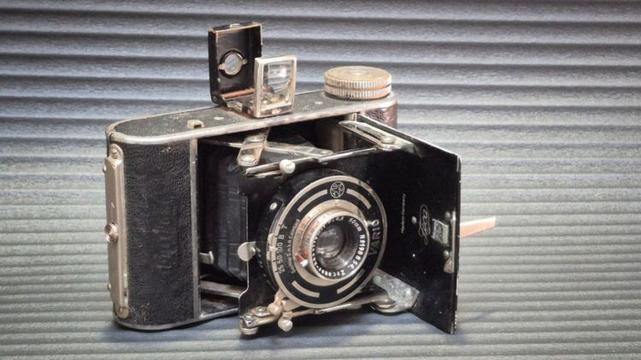
The Goldi came with a whole range of options for lens and shutter, but my version is quite basic, with a Gauthier Vario shutter with speeds of 1/25s—1/100s (plus B and T), and a Zenecar f4.5 lens. This suggests that it’s a model from the early 1930s, an idea reinforced by the name ‘Zeca’ inside the front plate. The shutter and bellows are stored behind a door that is unlatched by a little button next to the pop-up viewfinder and opens with a satisfying swoosh. To close the lens and bellows there are two metal tabs either side of the lens. Putting pressure on these slides the whole assembly slides away quite smoothly.
This camera’s really lived. It’s not that it’s heavily worn externally, like some in my collection (yes, I’m thinking of you, Kodak 3-A Autographic folding camera), but there are signs of wear all over it. On the rear of the camera, the two red windows were closed and the black metal surround was heavily scratched. Underneath, the red film counter windows were grubby. The leatherette, while not peeling, was bubbling in places, and the metalwork inside and outside the body was corroded and dirty. But when I opened the camera, the insides were quite clean, and the bellows were still light tight (tested by shining a light into the bellows and looking for pinholes). Also, the shutter sounded good at all speeds, and the aperture opened and closed smoothly.
The lenses, front and rear, were slightly hazy, as was the pop-up viewfinder, and all will need a clean before use. Accessing the rear lens was straightforward, I just needed to close the camera and unscrew the lens with a lens spanner (actually, it came loose just turning by hand). The front lens was a bit more fiddly. There’s a metal peg in the side of the front lens housing that acts as a ‘stop’ when focusing. Ideally, this should be removed (and stored safely as it’s really small) then the front lens can be unscrewed. However, the screw head was so fine it was too small for even my smallest screwdriver, so after I removed the rear lens I cleaned the back of the front lens through the rear of the camera with the aperture wide open and the shutter on ‘B’.
Generally, 127 cameras make full frame images in either 6x4cm or 4x4cm. Cameras like the Zeh Goldi are classed as half-frame and make 3x4cm negatives. The two windows on the back are used alternately to provide sixteen half-frame images. When you open the camera the film gate is in portrait ‘half frame’ format, so I need to remember that if I want to make a landscape I need to hold the camera on its side. Also, unlike most cameras that I’m aware of distance settings on the Goldi are in feet, not metres, so I’ll have to remember to adjust for that, too. Once the Goldi was cleaned and dusted, it was time to take it out for a test. I’ve ordered the last two rolls of Crossbird Creative 127 film from a supplier in Portugal, and the plan is to take the camera on a day trip to Nazaré, probably the best big wave location in Portugal, if not the world.
If you are on Mastodon, you can now follow this blog directly. Just go to Mastodon and follow the ‘Snapshot’ WordPress account at @keithdevereux.wordpress.com. All new posts will be automatically updated to your timeline.
#127 #1930s #Experimental #Folder #HarmanPhoenix #Sprockets #Vintage #ZehCompany #ZehGoldi