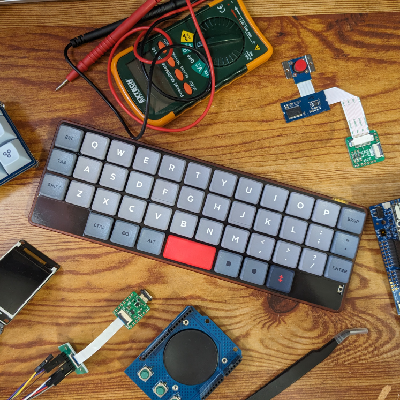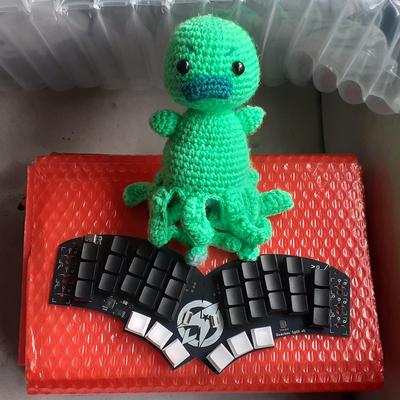
La spécificité de #Selenium, c’est que c’est une keymap configurable. On peut choisir parmi 4 « saveurs » de hold-taps :

  • EZ : aucun hold-tap
  • TT : hold-taps sous les pouces (thumb-taps)
  • HRM : homerow-mods 36/42 touches
  • 2TK : homerow-mods 34 touches

… et deux variantes :

  • Emacs (par défaut) : un seul layer navigation + numpad
  • Vim : un layer avec flèches en HJKL + un layer « NumRow »

On a donc envoyé un courriel à toutes les personnes qui ont commandé un Quacken, assemblé ou en kit, pour demander avec quelle configuration de keymap et pour quelle disposition de clavier on flashait leur Quacken.

On a pu tester la configuration HRM avec quelques débutants, et étonnamment, c’est très accessible. 🙂

Tout ça reste modifiable, bien évidemment — y compris à la souris, via #ZMKStudio — mais c’est primordial pour nous que le clavier soit aussi simple que possible à prendre en main.

4/n

@clementd Je vois super bien l’intérêt d’une reconfiguration sans flash (j’ai ça sur mes keyboardio), même si je regrette que ça ne soit pas faisable via Firefox. Pour le #Quacken, le plan c’est de mettre un serveur #ZMKStudio en place.

C’est juste Vial que je n’aime pas. Ma compréhension du sujet c’est que #Vial est basé sur un vieux fork de #QMK, et qu’il n’y a aucun plan pour se rebaser sur la branche principale, donc on renonce à certaines fonctionnalités que je considère indispensables.

Took a long time compiling #zmk (native installation) for my #lily58 #splitKeyboard ...
Couldn't figure out how to use a local zmk-config directory so I just modified the default keymap to suit my needs and then I proceeded to do more changes in #ZMKStudio 😂

For reference: https://zmk.dev/docs/features/studio

It would be nice to be able to export nice PNG, jpeg or pdfs of the cool new layouts, maybe even get a layout from a list of GitHub repos and so on

Overall amazing work @zmk !!!
ZMK Studio | ZMK Firmware

ZMK Studio provides runtime update functionality to ZMK powered devices, allowing users to change their keymap layers without flashing new firmware to their keyboards.

We're happy to announce we are entering the beta testing phase of #ZMKStudio.

Any and all testing from folks is welcome.

Ok. With some nanopb optimization I've comfortably gotten the #ZMKStudio RPC thread stack size down to 2K, which is bigger than I wished it to be, but acceptable enough that I can make usable studio firmware builds for stm32f072. That was my baseline target when starting the studio work, so 🎉.

Moving on to other things, including some documentation gaps, and we'll move into beta soon hopefully. Testing reports have mostly been positive after some initial bugs we squashed.

Months of work on @zmk is almost ready for formal alpha testing. Today I merged the main firmware PR needed for core #ZMKStudio support!

I've got a few lingering items for the frontend that I need to wrap up, including signing of the Windows @TauriApps app, before I can formally call for testers.

Feature doc: https://zmk.dev/docs/features/studio

If you're interested in testing, be sure to join our discord and join the testers role! (I'll also announce on the fediverse from the official @zmk account.)

ZMK Studio | ZMK Firmware

ZMK Studio provides runtime update functionality to ZMK powered devices, allowing users to change their keymap layers without flashing new firmware to their keyboards.

Working PoC for the @zmk #ZMKStudio protocol for interacting with the keyboard.

This shows:
* USB CDC ACM serial port with a listener on the firmware side to accept incoming framed data, then decode a contained CBOR message using ZCBOR code generated from a CDDL.
* Small web app using Web Serial via #Rust/WASM to connect, encode a message with CDDL generated types/encoder to CBOR, shove in the framing format, then write to the serial port.