 Bug Bounty Shorts
XXE Injection Guide: Fundamentals, Payloads, and Bug Bounty Strategies
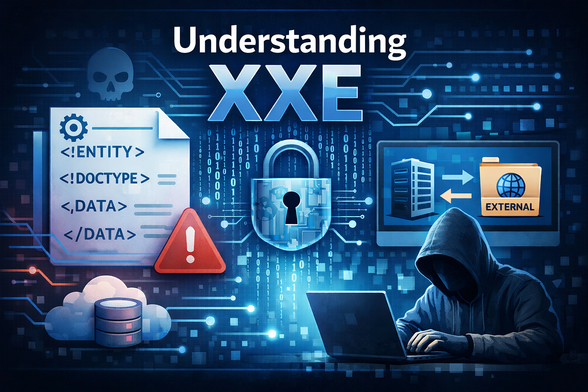
This write-up describes the XML External Entity (XXE) injection vulnerability, focusing on its fundamentals, payloads, and bug bounty strategies. The root cause is an application's failure to properly handle XML entities, allowing external data (DTD or XML entity references) to be loaded. By crafting payloads with DTD-based entities to force external file inclusions or Remote File Inclusion (RFI), the researcher discovered vulnerable applications. The mechanism involves tricking the application into parsing malicious XML entities, causing it to read and execute arbitrary files or network resources. This vulnerability can lead to serious consequences such as data breaches, information disclosure, and even Remote Code Execution (RCE). A $2,000 bounty was awarded for discovering an XXE vulnerability on a popular platform. To remediate, enforce strict XML entity handling, limit DTD processing, and consider using XML parsers with built-in protection against XXE injections. Key lesson: Always validate and sanitize user-supplied XML input to prevent XXE injections. #BugBounty #Cybersecurity #XML #XXEInjection #InformationDisclosure
 winnie, the disassembling bear
a cool code analysis path on how to arrive at the parser's vulnerable function: https://infosec.exchange/@_r_netsec/115450903679941887
/r/netsec (@[email protected])
404 to arbitrary file read in WSO2 API Manager (CVE-2025-2905) https://crnkovic.dev/wso2-404-to-arbitrary-file-read/