 Kirst Mason D'Raven
Kallikantzaroi
There’s something about December that makes even the most sensible among us glance a little suspiciously into the darker corners of the house. Perhaps it’s the thinning of the year, that stretch of nights where the world seems to hold its breath and wait for light to begin its long march back. Or perhaps it’s simply the weather – Derbyshire giving us endless rain again, with just a teasing hint of cold that might, if it feels generous, turn to snow.
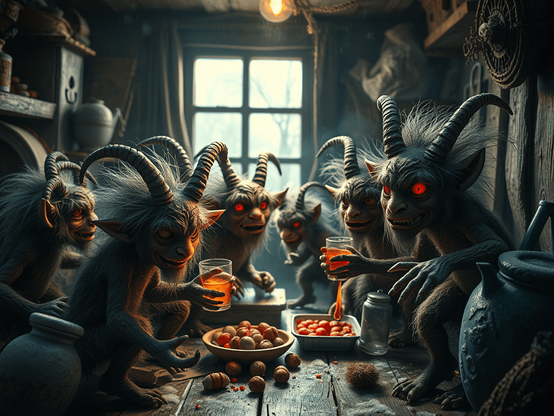
On these dreich afternoons, my thoughts drift across Europe to one of my favourite winter creatures, the kallikantzaroi, those chaotic little goblins who tumble into Greek and Balkan folklore with the enthusiasm of feral children set loose in a pantry.
The stories say the kallikantzaroi live underground for most of the year, hacking away at the World Tree, that cosmic trunk that holds all creation together. It’s a marvellous image, really… a gang of soot-blackened, wild-haired, half-witted imps sawing furiously at the roots of existence, nearly managing to topple the universe every December. Just when they’re about to succeed, the Twelve Days of Christmas arrive, and the holy power of the season forces them up to the surface.
While they’re distracted causing mischief above ground, the World Tree quietly heals itself, and the whole process starts again. There’s something deeply human about this cycle – monumental effort, a whiff of disaster, then everything being mended while you’re out causing trouble elsewhere.
Descriptions of the kallikantzaroi depend on which region you ask and how imaginative the storyteller is feeling. Some describe them as tiny, wiry men with burning red eyes and goat’s legs. Others as hulking, hairy, apelike figures with tongues lolling past cracked lips. A few tales give them hooves, others claws, some even snouts. They’re the folkloric equivalent of a child’s drawing. Messy, inconsistent, but bursting with chaotic personality. What’s always consistent, though, is their nature: hungry, disruptive, obnoxiously playful, and absolutely determined to wreak havoc in the short window they have.
In older village tales, the kallikantzaroi were believed to run rampant through streets and houses from Christmas Eve until Epiphany, howling, laughing, overturning anything not nailed down. They spoil food, sour milk, smash plates, steal pies, frighten livestock, and pinch people’s toes at night. They’re nearly always starving, desperate for warmth and a stray sausage. (Frankly, the way people describe them, they sound a bit like the rowdy boys who used to congregate outside the village shop in my childhood, hooting at passers-by and smelling faintly of bonfire smoke.)
The easiest way to understand the kallikantzaroi is to see them as midwinter personified – dark nights, unsettled weather, frayed nerves, too many people in small spaces, and the lingering echo of older fears from times when winter really could take you. They’re the embodiment of seasonal misrule, a reminder that the darkest nights have always belonged to strange company.
Naturally, winter folklore comes with instructions for keeping the chaos out. One widespread tradition was to keep the Christmas log – the *karyfýllion* – burning continuously throughout the Twelve Days. A warm hearth meant safety and the fire’s blessing kept goblins from creeping down the chimney. Families would save the charred stump from year to year as a protective charm, a bit like folk here keeping a piece of last year’s Yule log as a talisman.
Another favourite protection was the colander. This one always delights me: place a colander or sieve by your door, and the kallikantzaroi, compelled by some cosmic goblin law, must stop and count the holes. But they never can get past the number three, which is sacred, forbidden, or simply beyond their mental abilities depending on the teller. They get stuck in a mystical loop of…
“one… two… three… oh no, can’t say that… start again!”
…until dawn chases them back underground. I think there’s a special joy in knowing you can outwit supernatural chaos with basic kitchen equipment.
In other regions, people burned old shoes because the acrid smell was said to drive goblins away. Some families sprinkled flour around the hearth at night and if they found tiny clawed footprints in the morning, it was proof the kallikantzaroi had visited but been unable to slip past the fire.
Children born during the Twelve Days were considered at risk of becoming goblin-like themselves unless baptised immediately or given protective amulets – usually red thread, iron pins, or sprigs of basil tied around their clothing.
The kallikantzaroi don’t exist in isolation, of course. Once you start following their trail through European folklore, you find they have cousins everywhere.
In Bulgaria and Serbia, you meet the *karakoncolos* – a very similar goblin who lurks in shadows, mimicking voices to lure people outside.
In Turkey, he becomes the *karakoncol*, a night-haunting creature whose name possibly shares roots with the Greek one.
In the Slavic north, you get the *kikimora*, not a goblin but a house spirit whose mischief ranges from minor irritation to full-blown menace.
In the Alps, the Perchten run wild through winter streets, beautifully monstrous figures who blur the line between guardian spirits and goblin tricksters.
Closer to home, Britain has its own winter troublemakers, though they come in more genteel packaging.
The Welsh *bwgan* – a shapeshifting, household-haunting pest, shares a mischievous streak with the kallikantzaroi.
The English *hobthrusts*, lurking under bridges and in lonely places, have a similar knack for startling travellers.
Even our beloved Jack Frost has a streak of chaos beneath his frosty charm.
And then there’s the tradition of misrule itself.
The Lord of Misrule, the hobby horses, the mummers… that ancient winter urge to turn everything upside down before order returns.
Yet what sets the kallikantzaroi apart is their sheer, exuberant destructiveness paired with their strict time window. They represent the old medieval belief that the Twelve Days were a dangerous liminal zone. A time when spirits roamed freely, animals might speak, bread might refuse to rise, and the boundaries between worlds were uncomfortably thin. The goblins are the season’s last tantrum before light returns.
They’re also a reminder that winter has never been all candles and carols. It was once a season of deep uncertainty. Food stores ran low, weather could isolate entire communities, and long nights weighed heavily on the mind. Folklore filled the gaps, giving shape to anxiety and offering practical rituals that, even if they didn’t magically banish goblins, certainly gave people a comforting sense of agency.
Burn the log.
Hang the basil.
Mind the chimney.
Place the colander by the door, and you’ve at least done something to keep the wild things outside.
Some scholars argue that the kallikantzaroi may be remnants of older, pre-Christian nature spirits, perhaps genii of the underworld or localised earth demons reinterpreted through Christian festivals. Others suggest they reflect broader Indo-European traditions of winter monsters – beings who emerge during the dark season, trouble humans briefly, then vanish at the return of the sun.
Their yearly assault on the World Tree also echoes Norse myth, those great cosmic trees seem always to be in peril, whether from goblins or serpents or frost giants.
I love the stubbornness of them. Twelve days a year to cause havoc, eleven and a half months to brood underground and plot next year’s attempt to destroy the world. It’s almost sweet in a bizarre way. They’re not evil, exactly. Just committed to mischief the way some people are committed to complaining about the weather.
Even now, in modern Greece, they persist in jokes, Christmas cards, and the occasional village story told to make children behave. They’ve softened over time, becoming less of a threat and more of a seasonal nuisance. A reminder not to leave your sausages unattended.
When I look out into the rain-soaked Derbyshire dark and wish yet again for snow, I think about them fondly. Creatures of the threshold, birthed from centuries of winter fears and festive excess. A little bit frightening, a little bit funny, and – like so much folklore – a way of making sense of a long night.
If the cold ever sharpens into frost, I might go full Greek grandmother and leave a colander by the back door, just for the charm of it.
After all, you never know which stories still hold a spark of truth in the witching days of winter.
#DecemberLore #FairyLore #Goblins #kallikantzaroi #winterFolklore #WorldFolklore
 Megalithic Portal (Andy B)
 Hamma-Lama-DingDong ☑️