 Kingsley Uyi Idehen
New Rule re., #URIBurner: A #WebID (verifiable using #WebIDTLS, #OAuth, #OpenID, #Digest) is all you need re., #LinkedData services usage.
 Kingsley Uyi Idehen
#Identity #Authenticity, remains a HUGE problem at the #Internet->#Web->#SocialMedia levels. It's so big that it has trivially imploded #Twitter via the recent Blue Checkmark/Badge disaster.
A #SemanticWeb solves this headache, once understood, by way of #TLS integration using a #Hyperlink -- as demonstrated by protocol extensions such as #NetIDTLS and #WebIDTLS.
Here's a post that includes a NetIDTLS Sequence Flow Diagram to aid understanding.
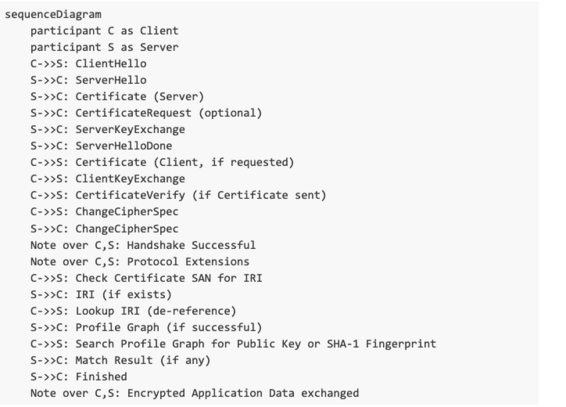
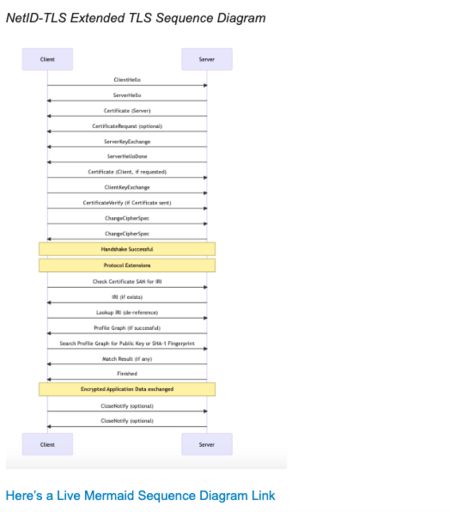
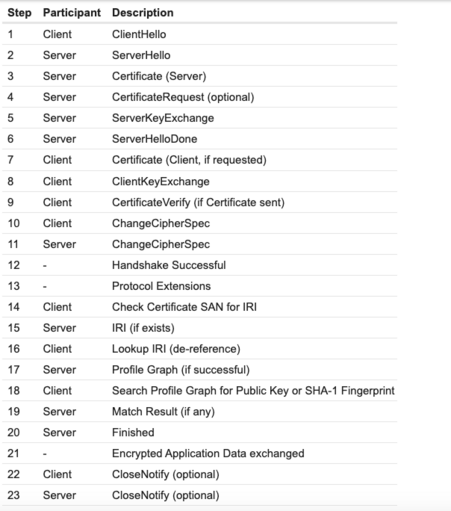
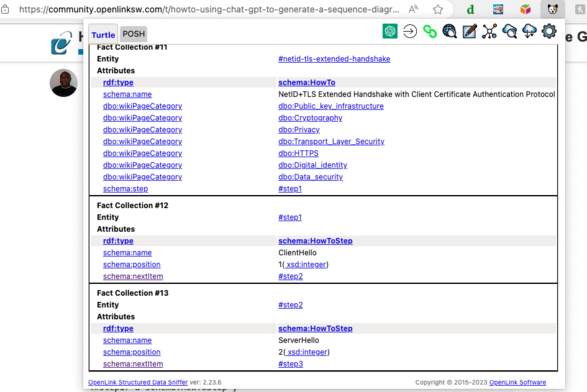

HowTo -- Using CHAT-GPT to Generate a Sequence Diagram & Knowledge Graph about the TLS Protocol using CHAT-GPT
Situation Analysis According to Key Internet Statistics in 2023 (Including Mobile) - BroadbandSearch, there are 5.25 billion+ people on the internet (and growing) who are increasingly challenged by control over their identity – due to the fact that identity authenticity still challenges both the Internet and Web. Transport Layer Security (TLS) is a globally supported protocol, deployed across every modern computing device, that adds identity authenticity and/or privacy to communications bet...
@atomicpoet @medium @evan @Gargron @Mastodon Existing #Github repos that implement the original #WebIDTLS variant of this protocol.
[1] https://github.com/linkeddata/node-webid -- node.js implementation
[2] https://github.com/bennomadic/django-webid-auth -- #Python
[3] https://github.com/OpenLinkSoftware/NetIDTLS/tree/main/demos/virtuoso -- Github repo of our #VirtuosoRDBMS implementation using VSP (our #PHP equivalent that's #DBMS hosted)
#NetIDTLS extends #WebIDTLS via support for mailto:, acct:, and ldap: identifiers; and looking SHA-1 hashes of Public Keys.

@aswath ,
If what I am demonstrating was based solely on #OpenIDConnect + #OAuth20 then we might be close to your characterization, but if you look closer you will see there are other protocol options including #NetIDTLS (labeled as #WebIDTLS), pure #TLS, Digest Authentication etc..
All ultimately providing unambiguous user #identity, post authentication that’s usable for #ABAC based ACL tests —in loosely-coupled fashion.