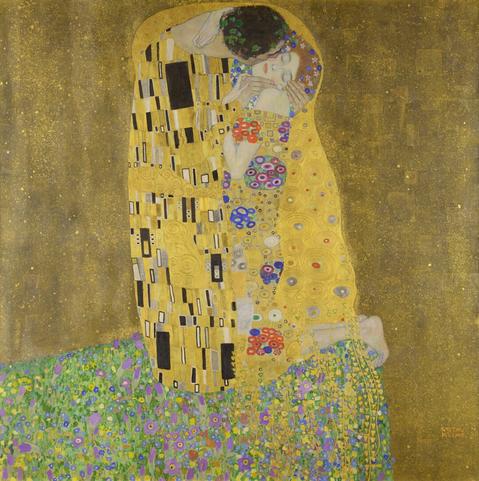
"Fulfillment (Lovers)," Gustav Klimt, 1910-11.

Klimt (1862-1918) was one of the guiding lights of the Vienna Secession movement, which gave birth to what we know today as Art Nouveau.

This work is actually a pattern for a mosaic. From 1905-11 he was involved in installing a mosaic frieze in the dining room of the Stoclet Palace in Brussels, Belgium. The central motif was the Tree of Life, which forms a backdrop for several figures, including the embracing couple we see here.

Klimt's works could often be frankly erotic; not smutty, to be sure, but openly depicting romantic and sexual passion in ways that some found almost pornographic at the time. Today, they're tame, but still evocative.

Mosaic work also fitted Klimt's style; quite a few of his paintings look like mosaics in two dimensions. While there are aspects of this that are frankly traditional, the overall execution, with flat areas of pattern with no attempt to make them seem three-dimensional, marks the beginning of the transition to modernism.

From the MAK - Museum für angewandte Kunst (Museum of Applied Arts), Vienna.

#Art #GustavKlimt #ArtNouveau #Symbolism #ViennaSecession #Mosaic #Eroticism

"One Thousand and One Nights," (portion), Vittorio Zecchin, 1914.

Zecchin (1878-1947) is best remembered as a designer for Murano glass; in fact, he's hailed as the first Modernist glass designer in Italy.

He worked in other media as well, including glass mosaics (in a very Vienna Secessionist style), but this is from his brief flirtation with painting. In 1914 he was commissioned to create a mural for the dining room of Venice's Terminus Hotel. Alas, the Terminus fell victim to bombings in WWII, but the murals were removed and are now in museums and private collections.

The style is an important transition from more traditional to more modern. It's plainly representational but done in a very 2-D way, with objects and people's clothes being flat patches of pattern, like a collage or applique project. It's intensely pleasing to the eye and I wish I could see the whole work together again in a single room. Reportedly it's a scene from the tale of Aladdin, with courtiers bringing gifts in preparation for the wedding.

From a private collection.

#Art #VittorioZecchin #ArtNouveau #ViennaSecession #Mural

"Secession XIV, Beethoven," Alfred Roller, 1902.

Roller (1864-1935) was an Austrian painter, graphic designer, and set designer, who was (very obviously) a founding member of the Vienna Secession, which gave us the Art Nouveau style.

Roller was very active early in his career as a graphic designer, as we have here in this lithograph, advertising the 14th Vienna Secession exhibition that celebrated Beethoven. This is classic Vienna Secession...the stylized figure, the embrace of two dimensions, the collage-like treatment of different parts of the image, as simple areas of pattern. It's genuinely lovely and makes me sentimental for advertising like this.

Roller would later go on to design sets for operas conducted by his friend, the composer Gustav Mahler. He ended up becoming the chief designer of the Vienna State Opera.

From the Leopold Museum, Vienna.

#Art #AlfredRoller #Lithograph #ArtNouveau #ViennaSecession #Advertising

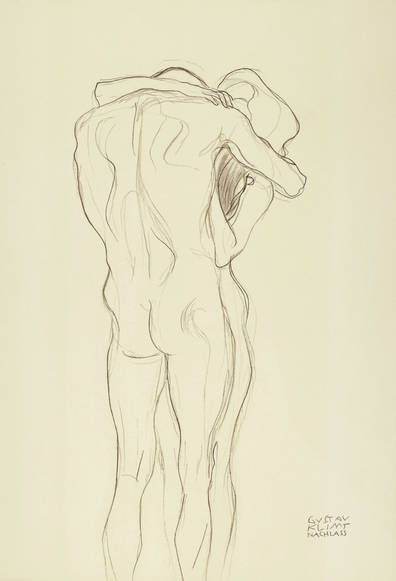
"Standing Naked Couple, Embracing, Study for "This Kiss to the Whole World" from the Beethoven Frieze," Gustav Klimt, 1901.

Y'all know Klimt by now.

This is a study done as a reference for a larger work. Klimt was putting together a large frieze for an exhibition of the Vienna Secession, that was also the 75th anniversary of Beethoven's death. The frieze was inspired by Wagner's interpretation of Beethoven's Ninth Symphony.

The frieze shows a knight being called to fight for Happiness, but also being tempted by lust and decadence (and being alarmed by a figure representing syphilis). In the end, a choir of angels sing, and a naked couple embrace. The frieze is still on display in the Secession Building in Vienna.

This sketch, though, is beguiling in its simplicity, and qualifies as a work of art in itself.

From the Leopold Museum, Vienna.

#Art #GustavKlimt #ArtNouveau #ViennaSecession #Beethoven #Love

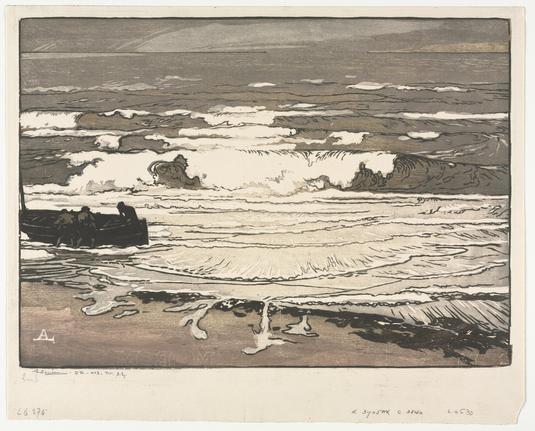
"Die Welle" by Koloman Moser captivates with its dynamic seascape, roiling waves, and a lone boat. The muted tones and bold lines perfectly embody the Vienna Secession's innovative spirit. How does this piece resonate with your own experiences of the sea?
#ClevelandArt #ViennaSecession #Woodcut
https://clevelandart.org/art/1949.526

Leopold Forstner, Poster (facsimile) for “Wiener Kunst im Hause” (Viennese Art in the House), 1903.

Get to know another nouveau through Jugendstil, the Vienna Secession, and Die Fläche: https://letterformarchive.org/news/die-flache-facsimile-and-the-vienna-secession/?utm_source=Mastodon

We did our best to transcribe the text in the image description. Help us fill in the blanks!

#Jugendstil #ViennaSecession #VerSacrum #LeopoldForstner #Lettering

Inside Our New Facsimile: Die Fläche and the Design of the Vienna Secession - Letterform Archive

Our latest book opens the vault on Vienna 1900, sharing a graphic design showpiece of the Secession’s leading artist-designers and their students.

Letterform Archive

Koloman Moser, Ver Sacrum, year 2, no. 4, 1899.

Get to know another nouveau through Jugendstil, the Vienna Secession, and Die Fläche: https://letterformarchive.org/news/die-flache-facsimile-and-the-vienna-secession/?utm_source=Mastodon

#Jugendstil #ViennaSecession #VerSacrum #ArtNouveau #KolomanMoser #Lettering

Inside Our New Facsimile: Die Fläche and the Design of the Vienna Secession - Letterform Archive

Our latest book opens the vault on Vienna 1900, sharing a graphic design showpiece of the Secession’s leading artist-designers and their students.

Letterform Archive

"Poppyheads," Koloman Moser, 1900.

Viennese artist Moser (1868-1918) was one of the guiding lights of Art Nouveau. He was one of the foremost artists of the Vienna Secession, and was a co-founder of the Wiener Werkstätte, a design workshop that had designers, artists, and artisans coming together to create functional works, in many ways forerunners of Art Deco and the Bauhaus.

Moser and his colleagues rejected the decadence of Viennese art from the previous century and embraced clean lines and imagery drawn from the natural world. Here, for instance, we have a textile design with stylized poppies.

He died young, from throat cancer, and one can only imagine what more he could have done. As it is, he truly revolutionized modern design.

Happy Flower Friday!

From the Art Institute of Chicago.

#Art #ArtNouveau #KolomanMoser #ViennaSecession #WienerWerkstatte #FlowerFriday #Design

AIGA - Die Fläche: Design and Lettering of the Vienna Secession, 1902–1911

Sealtember!

Our adventure with the seals continues!

here you can find illustrations from number 16 to 20:
https://www.artstation.com/artwork/QKX48d

All the illustrations are made with Krita (some are ugly, I admit, but I don't like some styles and the difficulty is high)

#art #artist #krita #twitchartist #twitchstreamer #noai #sealtember2024
#challenge #seal #digitalart #illustration #artstation #ViennaSecession