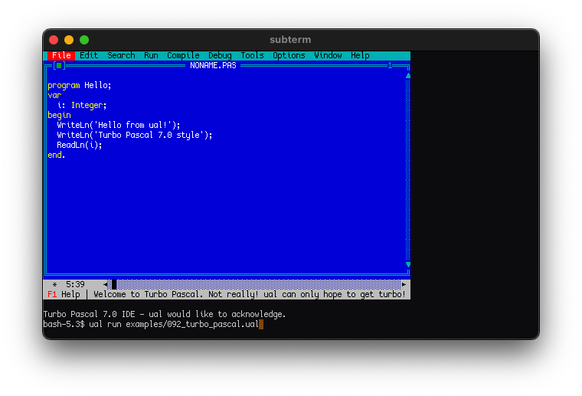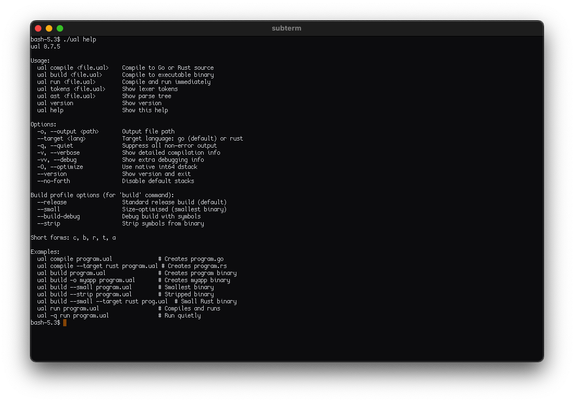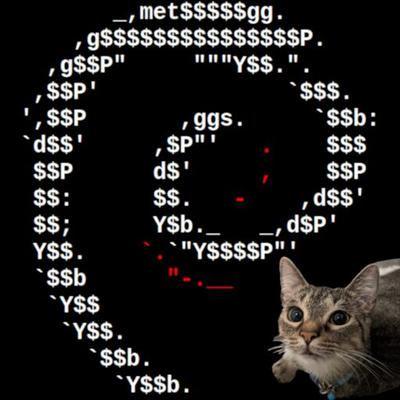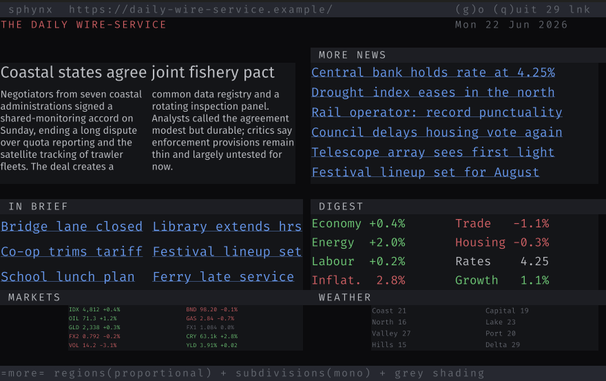
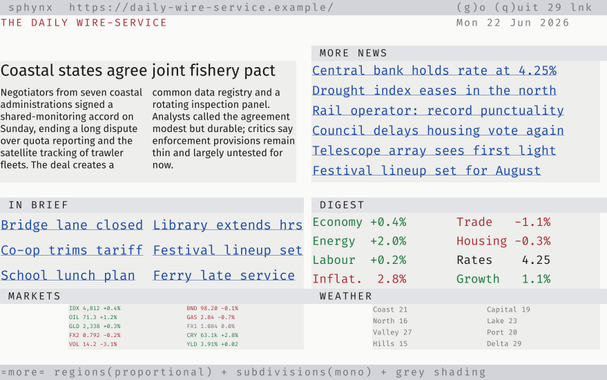
These screenshots are produced by the static renderer that transforms escape codes into a memory buffer, and then a memory buffer into pixels drawn on a png image. The static renderer is useful to set up tests and compare results visually during development. The real-time raylib/opengl renderer already supports ANSI codes and part of the new set of codes that enable this fine control over terminal rendering.
I know there is the Kitty term, but I had the feeling that it does too much, and I don't really want the terminal to stop being primarily about rendering text really fast. Different goals, different terms.
#golang #foss #subterm #vt100 #terminal #subterminal

Here's Subterm running a few little tools. It seems to be rendering properly most of VT100 / ANSI codes. The new ones I'm introducing use one single escape code with one embeded JSON object. Work will resume tomorrow improving font selection, proportional font metrics, colour themes, and other niceties. I think this little thing may save me the hassle of developing too many web applications.

#golang #foss #subterm #vt100 #terminal #subterminal

@passthejoe @frobozz @JdeBP @gumnos

I dunno, I have a vague impression of the #WYSE terminals being "weird," but it's been a quarter century.

Some of the later DEC VTs were dinky, but that #VT100 was LEGEND-STATUS classic. 😄

I literally remember seeing them in pictures and wondering "What is that groovy curved-looking computer??" and only years later learning that that was the ORIGINAL VT100.

I'd lose my mind to be able to play with one of those sweet machines.

This is not real-time rendering yet, I'm modeling the api and rendering to pixmaps, generating png screenshots. But I like how it's shaping up.

I couldn't in honesty reuse the venerable 'lynx' name to associate it with my experiments, so I renamed them to 'sphynx'. sphynx is now a code sample that will eventually serve as a demo for the subterminal.

#golang #foss #subterm #vt100 #terminal #subterminal

Using A VT-100 Today

You may not know what a ADM-3, a TV910, or a H1420 are, but you probably have at least heard of a VT-100. They are all terminals from around the same time, but the DEC VT-100 is the terminal that p…

Hackaday
Using A VT-100 Today

You may not know what a ADM-3, a TV910, or a H1420 are, but you probably have at least heard of a VT-100. They are all terminals from around the same time, but the DEC VT-100 is the terminal that p…

Hackaday
@mk A thing of beauty. #Unix #Retrocomputing #vt100
I've wanted a #vt100 since I found out about them many years ago, and I finally got one.
This one seems to have been built in 1980. It is in dire need of a good cleaning, but it powers on and provides a nice, clean picture. The keyboard seems fully functional. I don't think it has any of the options like current based comms but that's fine.
#Unix #RetroComputing

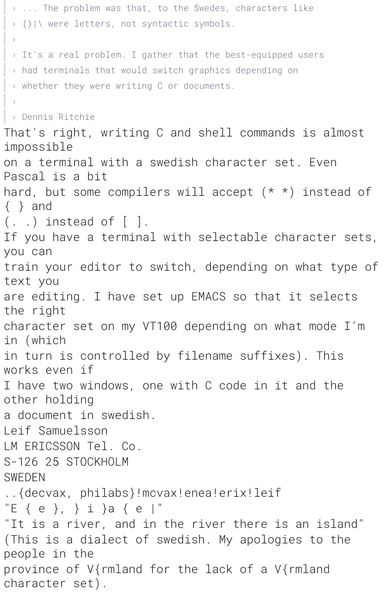
I found this reply that I made in 1984 to Dennis Ritchie in the net.followup newsgroup. I was at the time lobbying Sun to add 8-bit character set support to the firmware, but they wanted to hold out for a 16-bit system, like the as yet unnamed Unicode. There was eventually an interim solution but my memory of that is a bit foggy.

#Usenet #DennisRitchie #C #Pascal #emacs #VT100 #charactersets #ISO8859 #languages #Swedish #programming #unicode #SunMicrosystems #Värmland

I’ve just started disassembling the ROM for Digital’s VT320 terminal, which contains an 8051. I'm using D52 to direct the disassembly. The 8051 has a 16-bit register DPTR, through which you can access either ROM or RAM, which are separate spaces, requiring two symbol tables. The documentation describes a directive "d" which can say, for each opcode address, which symbol table should be searched. Except ... it doesn't work. So, to fix D52 before the real job! #retrocomputing #VT100 #VT320