Reflection On Recursion • Discussion 1

Re: Reflection On Recursion • 1
Re: Laws of FormJohn Mingers

JM: This is a very important and interesting topic.  I think you should consider the relationship to self‑reference, indeed are they really the same thing?

Also the work of Maturana and Varela on autopoiesis and the neurophysiology of cognition which also has recursion at its heart.

Thanks, John.  Yes, we certainly find the whole array of self concepts coming into play here — selfhood, autopoiesis or self creation, self reference and self transformation, just to name a few.  But one thing I need to emphasize from the start is how radically different such concepts appear when viewed under x‑rays of Peirce’s pragmatic semiotics.

I forget where I first heard it, but it’s fairly common observation that the persistence of a recurring problem is a symptom of how unlikely it is to be solved in the paradigm where it keeps occurring.

After a while, it simply becomes time to change the paradigm …

Just by way of a first example, take the very idea of “self‑reference”.  The moment we place it in the medium of triadic sign relations we realize signs do not refer to anything at all except insofar as an interpreter refers them.  And when we think to ask, “What is this that we call an interpreter?”, the pragmatic theory of signs tells us we do not know when we turn out the light but under the x‑ray of the pragmatic maxim the sum of its effects is effectively modeled by an extended triadic sign relation.

Everything I’ll be working at here will be done within a framework like that.

Regards,
Jon

Resources

cc: Academia.eduCyberneticsLaws of FormMathstodon
cc: Research GateStructural ModelingSystems ScienceSyscoi

#Arithmetization #CSPeirce #GödelNumbers #HigherOrderSignRelations #InquiryDrivenSystems #InquiryIntoInquiry #Logic #Mathematics #Quotation #Recursion #Reflection #ReflectiveInterpretiveFrameworks #Semiotics #SignRelations #TriadicRelations #UseAndMention #Visualization
Reflection On Recursion • 1

Ongoing conversations with Dan Everett on Facebook have me backtracking to recurring questions about the relationship between formal language theory (as I once learned it) and the properties of nat…

Inquiry Into Inquiry

Reflection On Recursion • 4

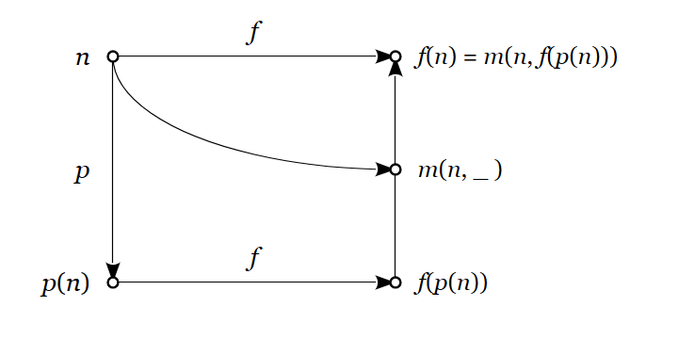
A feature of special note in the recursion diagram is the function traversing the square from one triadic node to the other.  It preserves an image of the object all the while its precedent is being retrieved and processed — thus it injects a measure of parallel process and a modicum of extra memory over and above that afforded by the serial composition of functions.

Resources

cc: Academia.eduCyberneticsLaws of FormMathstodon
cc: Research GateStructural ModelingSystems ScienceSyscoi

#Arithmetization #CSPeirce #GödelNumbers #HigherOrderSignRelations #InquiryDrivenSystems #InquiryIntoInquiry #Logic #Mathematics #Quotation #Recursion #Reflection #ReflectiveInterpretiveFrameworks #Semiotics #SignRelations #TriadicRelations #UseAndMention #Visualization

Reflection On Recursion • 3

One other feature of syntactic recursion deserves to be brought into higher relief.  Evidence of it can be found in the recursion diagram by examining the places where three paths meet.  On the descending side there is the point where three paths diverge.  On the ascending side there is the point where the middlemost of the three divergent paths joins the upshot arrow in medias res.

The arrows of the diagram represent functions, a species of dyadic relations, but nodes of degree three signify aspects of triadic relations somewhere in the mix.

  • The three arrows from the initial node represent a function such that
  • The three arrows at the penultimate node represent a function such that

For the sake of a first approach, many questions about triadic relations which might arise at this point can be safely left to later discussions, since the current level of generality is comprehensible enough in functional terms.

Resources

cc: Academia.eduCyberneticsLaws of FormMathstodon
cc: Research GateStructural ModelingSystems ScienceSyscoi

#Arithmetization #CSPeirce #GödelNumbers #HigherOrderSignRelations #InquiryDrivenSystems #InquiryIntoInquiry #Logic #Mathematics #Quotation #Recursion #Reflection #ReflectiveInterpretiveFrameworks #Semiotics #SignRelations #TriadicRelations #UseAndMention #Visualization

Reflection On Recursion • 2

Turning to the form of a simple recursive function the clause we used to define it earns the title of “syntactic recursion” due to the way the function name occurring in the defined phrase re‑occurs in the defining phrase

It needs to be clear there is no circle in the definition — each instance of the type is defined in terms of an instance one step simpler until the base case is reached and fixed by fiat.  Instead of a circle then we have two gyres, the gyre down via the predecessor function and the gyre up via the modifier function

Resources

cc: Academia.eduCyberneticsLaws of Form • Mathstodon (1) (2) (3)
cc: Research GateStructural ModelingSystems ScienceSyscoi

#Arithmetization #CSPeirce #GödelNumbers #HigherOrderSignRelations #InquiryDrivenSystems #InquiryIntoInquiry #Logic #Mathematics #Quotation #Recursion #Reflection #ReflectiveInterpretiveFrameworks #Semiotics #SignRelations #TriadicRelations #UseAndMention #Visualization

Higher Order Sign Relations • Discussion 1
https://inquiryintoinquiry.com/2025/03/27/higher-order-sign-relations-discussion-1-a/

Re: FB | Charles S. Peirce Society • John Corcoran
https://www.facebook.com/groups/peircesociety/posts/1768975423238442/

Questions about the proper treatment of use and mention from the standpoint of Peirce’s theory of signs came up recently in discussions on Facebook. In pragmatic semiotics the trade‑off between “signs-of-objects” and “signs-as-objects” opens up the wider space of Higher Order Sign Relations. In previous work on Inquiry Driven Systems I introduced the subject in the following way.

When interpreters reflect on their use of signs they require an appropriate technical language in which to pursue their reflections. They need signs referring to sign relations, signs referring to elements and components of sign relations, and signs referring to properties and classes of sign relations. The orders of signs developing as reflection evolves can be organized under the heading of “higher order signs” and the reflective sign relations involving them can be referred to as “higher order sign relations”.

References —

John Corcoran
https://johncorcoran.academia.edu/

Schemata : The Concept of Schema in the History of Logic
https://www.academia.edu/12691868/SCHEMATA_THE_CONCEPT_OF_SCHEMA_IN_THE_HISTORY_OF_LOGIC

Use And Mention, Use Without Mention, Mention Without Use
https://www.academia.edu/s/ea64a3484e/schemata#comment_525151

Resources —

Higher Order Sign Relations
https://oeis.org/wiki/Inquiry_Driven_Systems_%E2%80%A2_Part_12#Higher_Order_Sign_Relations

Survey of Inquiry Driven Systems
https://inquiryintoinquiry.com/2024/02/28/survey-of-inquiry-driven-systems-6/

Survey of Semiotics, Semiosis, Sign Relations
https://inquiryintoinquiry.com/2024/01/26/survey-of-semiotics-semiosis-sign-relations-5/

#Peirce #Inquiry #Logic #Mathematics #Reflection
#Semiotics #SignRelations #HigherOrderSignRelations
#InquiryDrivenSystems #ReflectiveInterpretiveFrameworks
#Arithmetization #GödelNumbers #Quotation #UseAndMention

Higher Order Sign Relations • Discussion 1

Re: FB | Charles S. Peirce Society • John Corcoran Questions about the proper treatment of use and mention from the standpoint of Peirce’s theory of signs came up recently in discussions…

Inquiry Into Inquiry