How confident can we really be in radiation risk estimates?
UNSCEAR 2024 Vol. II, Annex B p.17 applies a Bayesian framework to show how exposure and dose measurement uncertainties feed into cancer risk models. Honest science about what we know — and what we don't.
Essential for radiation protection, dosimetry, and public health professionals.
📄 https://www.unscear.org/unscear/en/publications/2024_2.html
#UNSCEAR #RadiationProtection #Dosimetry #CancerRisk #Radon #OpenScience

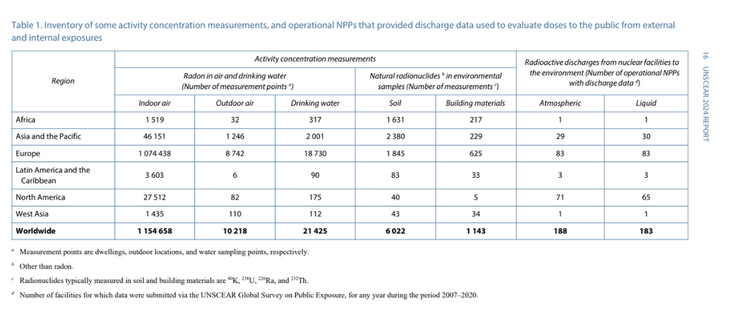
The UNSCEAR 2024 Report Vol. II is the most comprehensive global assessment of public radiation doses to date — covering radon, thoron, cosmic radiation, NORM industries, and human-made sources.

Start at page 16 for an overview of the measurement data behind the entire analysis.

Rigorous data. Global scale. Worth reading.

📖 https://www.unscear.org/unscear/en/publications/2024_2.html

#Radon #UNSCEAR #RadiationProtection #Dosimetry #PublicHealth

📘 The 2024 UNSCEAR report draws on a wide range of scientific sources — but the criteria used to select those publications matter enormously for how we interpret its conclusions.

Pages 13–14 detail the methodology. Essential reading for anyone working in radiation protection, environmental health, or public health policy.

🔗 https://www.unscear.org/unscear/en/publications/2024_2.html

#UNSCEAR #RadiationProtection #PublicHealth #EnvironmentalHealth #OpenScience #EvidenceBased

Just came across the UNSCEAR 2024 report — and the questionnaire topics covered are a genuinely interesting read for anyone following radiation science or environmental monitoring.
Page 12 in particular gives a clear picture of what the international radiation protection community is actively assessing. Well worth a look if this is your field.
🔗 https://www.unscear.org/unscear/en/publications/2024_2.html
#UNSCEAR #RadiationScience #EnvironmentalMonitoring #OpenScience #PublicHealth

What underpins global radiation risk assessments?

The UNSCEAR 2024 report provides a valuable overview of the scientific data sources used to estimate radiation exposure worldwide. Particularly interesting for professionals working in radiation protection, environmental assessment, and dosimetry.

🔗 https://www.unscear.org/unscear/en/publications/2024_2.html

#RadiationProtection #UNSCEAR #Science #PublicHealth #Dosimetry

When is dose assessment necessary—and how should it be expressed?

Clarity in quantities and units is essential for meaningful radiation protection.

Page 10 of this UNSCEAR report is a concise and useful reference:
https://www.unscear.org/unscear/en/publications/2024_2.html

#RadiationProtection #Dosimetry #UNSCEAR #PublicHealth

Accurate public radiation exposure assessment remains a key challenge across disciplines. The 2024 UNSCEAR report offers updated methodologies and useful insights for professionals working in radiation protection and environmental assessment.

📊 Page 9 is a good entry point:
https://www.unscear.org/unscear/en/publications/2024_2.html

#RadiationProtection #PublicHealth #UNSCEAR

☢️ Main sources of public exposure to ionising radiation—do you know the breakdown?

Natural background radiation and human-made sources both play a role. Understanding this is key for informed policy and protection.

UNSCEAR 2024 (see p.7):
https://www.unscear.org/unscear/en/publications/2024_2.html

#Radiation #PublicHealth #EnvironmentalHealth #UNSCEAR

The 2024 UNSCEAR report (Annex B, Vol. II) outlines key priorities shaping radiation protection 📘

Pages 5–6 offer a concise overview relevant for research, policy, and practice.

Worth a read:
https://www.unscear.org/unscear/en/publications/2024_2.html

#UNSCEAR #RadiationProtection #OpenScience

The UNSCEAR 2024 Scientific Report (Vol. II) has been published.

An essential resource on public exposure to ionizing radiation, including radon’s contribution. I’ll share key insights over the coming weeks.

https://www.unscear.org/unscear/uploads/documents/unscear-reports/UNSCEAR_2024_Report_Vol.II.pdf

#RadiationProtection #UNSCEAR #Radon #PublicHealth