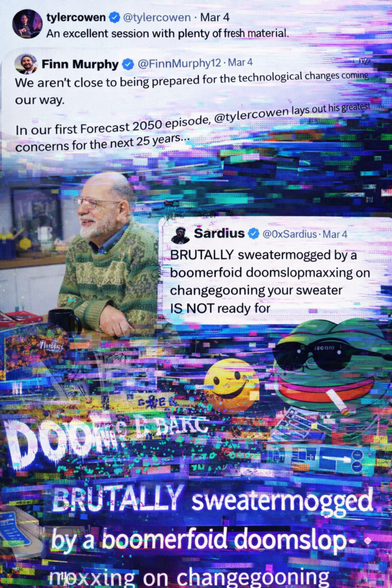
#Slopkultur #Denglisch #SprachChaos #TylerCowen
https://speakamerican.de/brainrot-slang-deutsch-tyler-cowen-mogging/
Australia has banned under-16s from using social media. #TylerCowen thinks that unwise:
https://marginalrevolution.com/marginalrevolution/2025/12/australia-should-not-ban-under-16s-from-internet-sites.html
I've seen posts around here opposing the policy too, on various grounds.
I tend to think it's good to keep under-16s away from social media; probably best for them to have less screentime overall. (I myself should probably have less screentime and spend less time on social media.) But even if that's true, will this law work out?
I hope we learn from Australia's experience.
From me in The Free Press: YouTube in particular, and sometimes X, are among the very best ways to learn about the world. To the extent that the law is effectively enforced, targeting YouTube will have a terrible effect on youth science, and the ability of young scientists and founders to get their projects off […]
Jacob Rintamaki (@jacobrintamaki): "I love Tyler Cowen so much" | nitter
https://nitter.net/jacobrintamaki/status/1986110025782469148#m
"Wait, Tyler Cowen has been writing about how to find virgins since 2009 while he was a professor at George Mason University"
https://bsky.app/profile/jsweetli.bsky.social/post/3m2ahejmu4c2w
Oh dear fuck, it's not a one-off....
AI take-off might still be relatively slow…
3. The O-Ring models makes AI hard to work with. The O-Ring model stipulates that, in some settings, it is the worst performer who sets the overall level of productivity. (In the NBA, for instance, it may be the quality of the worst defender on the floor, since the player your worst defender is supposed to guard can just keep taking open shots.) Soon enough, at least in the settings where AI is supposed to shine, the worst performer will be the humans. The AIs will make the humans somewhat better, but not that much better all that quickly.
Why I think AI take-off is relatively slow – Marginal REVOLUTION
This whole article is a good read. The human component of AI adoption is going to be fascinating. There might be many parts to a system before the system can get better and it’s important to understand which part of the system is holding back progress.
Consider the technical progress from 1600s and this statistic is fascinating to me.
6. Historically, gdp growth is remarkably smooth, albeit for somewhat mysterious reasons. North America is a vastly different place than it was in the year 1600, technologically and otherwise. Yet there are remarkably few years when the economic growth rate is all that far from two percent. There is a Great Depression, some years of higher growth, some stagnation, and a few major wars, but even in those cases we are not so far from two percent. I do not pretend to be able to model this satisfactorily (though the above factors surely have relevance in non-AI settings too), but unless you have figured this puzzle out, do not be too confident in any prediction that is so very far from two percent.
Tyler Cowen presents this as his reason to why AI take off will be slow. I think there might be some interesting advantages in being ready for when the final parts of a system that’s holding the system back will be ready for a change with AI.
I’ve already covered much of this in my podcast with Dwarkesh, but I thought it would be useful to write it all out in one place. I’ll assume you already know the current state of the debate. Here goes: 1. Due to the Baumol-Bowen cost disease, less productive sectors tend to become a larger share […]
"The right-wing populists are gaining ground in so many countries because the cultural liberals in various parliaments and congresses are extremely reluctant to meet the preferences of their median voters. On the immigration issue most of all. And then they wish to talk about threats to democracy!"
A median voter theory of right-wing populism
https://marginalrevolution.com/marginalrevolution/2025/08/a-median-voter-theory-of-right-wing-populism.html
1/2

From a recent paper: Populists are often defined as those who claim that they fill “political representation gaps” -differences between the policymaking by established parties and the “popular will.” Research has largely neglected to what extent this claim is correct. I study descriptively whether representation gaps exist and their relationship with populism. To this end, I analyze […]
"New Information Suggests Senior Pfizer Executives Conspired to Delay COVID-19 Vaccine Clinical Testing to Influence 2020 Election"
https://marginalrevolution.com/marginalrevolution/2025/05/new-information-suggests-senior-pfizer-executives-conspired-to-delay-covid-19-vaccine-clinical-testing-to-influence-2020-election.html
#TylerCowen suggests that this is a crime, if true, because delaying the roll-out of vaccines killed people. There's also the question of election interference.
1/2
“People like to feel repugnance, makes them feel morally superior.”
https://pca.st/episode/4f7da076-a9ec-4b9d-b69e-8aab3f8b1442?t=2762.0
Marginal Revolution has been one of the most influential economics blogs in the world for over two decades thanks to its sharp economic analysis and thought-provoking ideas. Now, co-creators Alex Tabarrok and Tyler Cowen are bringing their nerdy winsomeness to your earbuds. Each episode features Alex and Tyler drawing on their decades of academic expertise to tackle whatever economic idea is currently tickling their noggins.
A fascinating essay by #TannerGreer on Wang Huning as a kind of Chinese Tocqueville of the late 20th Century. Long but worth it. https://scholarstage.substack.com/p/american-nightmares ht #TylerCowen
(fixed broken link, thanks @marick)