 locastan
Als ich diesen Heimgebastelten Röhrentester für magische Augen bei eBay sah, musste ich einfach zuschlagen. :D
#röhren #tubetester #radio #alteTechnik
#röhren #tubetester #radio #alteTechnik
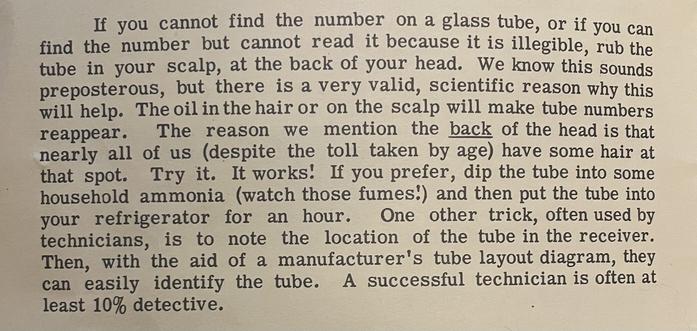
A buddy of mine picked up a model TV-11 tube tester for me at a flea market this weekend. I found this preposterous pro-tip in the manual.
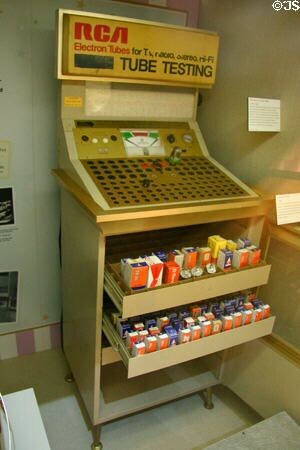
An essential resource to have in your neighborhood for all HiFi nerds
#HiFi
#InternetPictureShow
#RandomInternetPicture
#RCA
#TubeTester
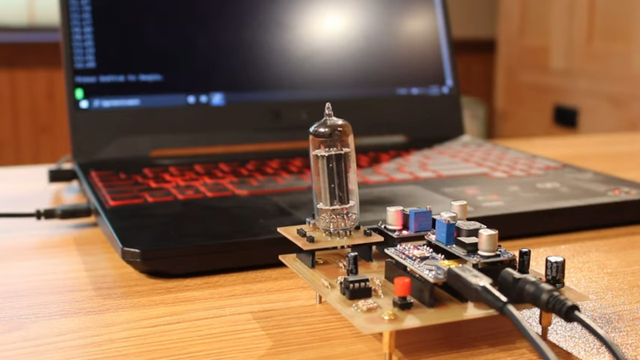
Modern Tube Tester Uses Arduino
There was a time when people like us might own a tube tester and even if you didn't, you probably knew which drug store had a tube testing machine you could use for free. We aren't sure that's a testament to capitalistic ingenuity or an inditement of tube reliability -- maybe both. As [Usagi] has been working on some tube-based projects, he decided he needed a tester so he built one. You can see the results in the video, below.
The tester only uses 24V, but for the projects he's building, that's close to the operation in the real circuits. He does have a traditional tube tester, but it uses 100s of volts which is a different operating regime.
The bulk of the circuit is creating the voltages required, including a 555 charge pump to generate around -10V. The tube is wired up in a particular configuration and the Arduino makes a few measurements while changing the operating bias conditions. The converter goes through a voltage divider so the maximum 24 volts won't overload the Arduino.
Grabbing the data into a spreadsheet allowed some curve tracing which looked useful for matching. However, as [Usagi] points out, the tester is very specific to his application. He has plans to maybe make a more general-purpose tube tester.
One of the problems with a truly general-purpose tube tester is connecting to the different pinouts. Punched cards offered one answer. If you don't remember tube testers in drug stores, you might find that TV repair, at one time, was a big business.
Your 1958 Punch Card Machine Tested Tubes
We think of punched cards as old-fashioned, but still squarely part of the computer age. Turns out, cards were in use way before they got conscripted by computers. Jacquard looms are one famous example. The U.S. Census famously used punched cards for tabulating the census without anything we'd consider a computer. But in the 1950s, you might have had a punched card machine on your electronics workbench. The Hickok Cardmatic was a tube tester with a difference.
About Tube Testers
While you, as a Hackaday reader, might tear into a busted TV at your house and try to fix it, most people today will either scrap a bad set or pay someone to fix it. That's fine today. TVs are cheap and rarely break, anyway. But this hasn't always been the case.
In the "good old days" your expensive TV broke down all the time. Most of the parts were reliable, but the tubes would wear out. If you were the kind of person who would change your own oil, you'd probably look to see if you could spot a burned out tube and try replacing it. If you couldn't spot it, you'd pull all the tubes out. If you were lucky, there was a diagram glued inside the coverof where they all went back. Then you took them to the drugstore.
You might wonder why you'd take them to the drugstore. They were one of the places that would have a tube tester in a large cabinet. You'd look up your tube and it would tell you how to set the various dials on the machine. For example, you might have to plug the tube into socket #5, turn switch 1 to position 4, switch 2 to position B, and then switch C to position 9. You'd push a button and a big meter would show you if the tube was good or bad. If the tube was bad, you'd open the cabinet, pull out a replacement tube, and pay for it at the register. (Imagine having to do this with any given transistor in your cell phone.)
Tube Testing at the Shop
[Joe Haupt] CC-BY-SA 2.0Of course, if you had a TV repair shop or you just had a well-stocked electronics bench, you probably had a tube tester yourself. You might not have had the big cabinet of spares, but then again your tester was probably at least somewhat portable by the standards of the day.
For example, the Knight tube tester was more or less the drugstore model with a smaller meter and a handle. The controls were a little more technically labeled than the consumer models, too. But you still had to look up a table, twist knobs, and throw switches. You really wanted to be sure to read the table correctly, too. Being off one row or getting data from two rows could possibly kill your tube under test.
Enter Punch Cards
My friend [Tom] had a different kind of tube tester for sale at a recent hamfest. Compare this Hickok tube tester to the Knight one up above. There is a conspicuous absence of switches. Of course, there are a number of sockets because you can't force a tube into a different socket. The meter is sort of the same, too. But instead of a table, there's a bin of around 300 punch cards and a card reader you can see near the bottom left corner of the machine.
The card reader doesn't have a computer -- at least, we don't think it did. It was simply a set of contacts you'd normally find behind switches on a conventional tube tester. When you slid the card in, it would move between a set of contacts. When the card hit a stop, the plunger-like switch near the card reader would pop up, engaging the contacts through the card's holes and fixing the card. Pushing down on the plunger released the card.
You can see a better picture of a few of the cards in the other picture. Note that one of the cards was for a 17D4 tube. It tells you to use socket F and since it says, "card 1 of 1" it follows that some of the tubes needed multiple cards and tests.
The Price of Convenience
The Cardmatic shows up in ads in the late 1950s. The "new low price" for the model 121 was $250, so that implies that maybe it cost more at some point. Or perhaps it was relative to the more expenisve model 123. Sure, $250 doesn't sound like much but adjusted that's around $2,300 today. You had to be testing a lot of tubes to justify that kind of expenditure. For the average worker at the time, that was about a month's take-home pay! And the 123A cost $470, even more!
Of course, according to the ad you can see here, it would test the tube in only eight seconds. Well, eight seconds after the tube warmed up. They claim the device was 300% more accurate than an ordinary tube tester, but we have no idea how'd you'd prove or disprove that.
Thanks to [bandersentv], you can actually watch a video (below) of the machine in operation. That particular model is a 121, but they are very similar. There was also a military version, the AN/USM-118B.
The operation wasn't totally automatic. While the tube warms up, you are supposed to observe meter scale 1 which should be near zero. Then you press button 2 and verify the meter is in the green portion of scale 2. Finally -- you probably guessed it -- you press button 3 and make sure the meter's needle is in the green zone on scale 3.
We shouldn't be surprised. Despite common misconception, most processing of punched cards didn't happen with actual computers, even for computer punched cards. Life sure is simpler now. You can get a general-purpose component tester for almost nothing. Of course, it won't test tubes -- we don't think -- but if you build a tube adapter for it, please tell us so we can cover it.
Thanks to [Tom, N3LLL] for the photos of this great old piece of test gear.
#hackadaycolumns #toolhacks #hickok #punchcards #punchedcards #tube #tubetester
Restoring a Vintage Tube Tester to its Former Glory
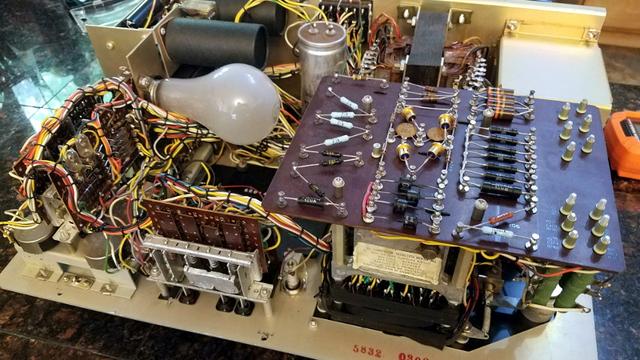
It can be difficult for modern eyes to make much sense of electronics from the 1960s or earlier. Between the point-to-point soldering, oddball components, and the familiar looking passives blown up to comical proportions like rejected props from " Honey, I Shrunk the Kids", even experienced hardware hackers may find themselves struggling to understand what a circuit is doing. But that didn't stop [Cat0Charmer] from taking the time to lovingly restore this Hickok Cardmatic KS-15874-L2 tube tester.
The good news was that the machine had nearly all of its original parts, down to the Hickok branded tubes in the power supply. Unfortunately it looks like a few heavy handed repairs were attempted over the years, with a nest of new wires and components intermixed with what [Cat0Charmer] actually wanted to keep. The before and after shots of individual sections of the machine are particularly enlightening, though again, don't feel to bad if you still can't make heads or tails of the cleaned up version.
Hiding new capacitors inside of the old ones.
As you'd expect for a machine of this age, many of the original components were way out of spec. Naturally the capacitors were shot, but even the carbon composition resistors were worthless after all these years; with some measuring 60% away from their original tolerances.
We particularly liked how [Cat0Charmer] hollowed out the old capacitors and installed the new modern ones inside of them, preserving the tester's vintage look. This trick wasn't always feasible, but where it was applied, it definitely looks better than seeing a modern capacitor adrift in a sea of 60's hardware.
After undoing ham-fisted repairs, replacing the dud components, and installing some new old stock tubes, the tester sprung to life with renewed vigor. The previously inoperable internal neon lamps, used by the tester's voltage regulation system, shone brightly thanks to all the ancillary repairs and changes that went on around them. With a DIY calibration cell built from the schematics in an old Navy manual, [Cat0Charmer] got the tester dialed in and ready for the next phase of its long and storied career.
We love seeing old hardware get restored. It not only keeps useful equipment out of the scrap heap, but because blending new and old technology invariably leads to the kind of innovative problem solving this community is built on.
#classichacks #hardware #recapping #repair #restoration #tubetester #vacuumtube #vintagehardware
 thebigreason
 GentleMan Gef
 hackaday unofficial

