
@capntransit @jerryschippa I was just going to bring that discussion over here.

There's been some research looking at traffic impact studies and trying to make them better. But researchers also warn they might not hold up in court much longer, given their shaky foundation. https://ssti.us/2023/04/03/researchers-warn-traffic-studies-could-face-more-legal-scrutiny/

#TrafficEngineering #TrafficModeling #TrafficForecasting #RoadDesign

Researchers warn traffic studies could face more legal scrutiny

Local governments often rely on traffic impact analyses to review and approve projects, charge impact fees, and ask developers to go above and beyond the basic requirements. These traffic studies, however, are often based on “junk science,” and may not hold up in courts much longer, according to a new Viewpoint article published in the Journal of the American Planning Association. 

State Smart Transportation Initiative

FHWA just published preliminary VMT numbers for 2022. Americans drove slightly more than the previous year, but still less than before the pandemic. Interestingly, traffic delay was still around 50% lower than pre-pandemic, according to INRIX. https://ssti.us/2023/03/06/americans-are-still-driving-less-than-before-the-pandemic/

#TravelDemand #Driving #VMT #UrbanPlanning #TrafficModeling #TrafficEngineering #TrafficForecasting
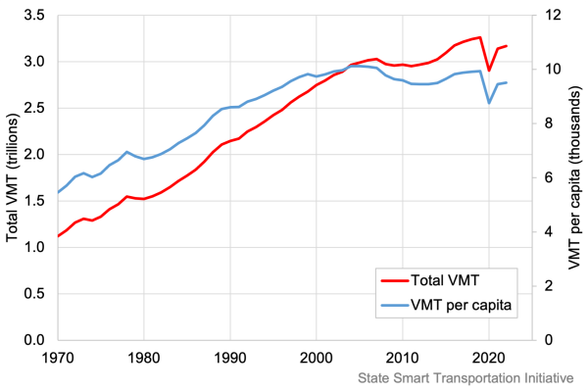
Americans are still driving less than before the pandemic

Vehicle miles traveled (VMT) in the U.S. totaled 3.17 trillion last year, according to preliminary estimates from FHWA. That is a one percent increase from 2021 and a nine percent increase from 2020—the height of the pandemic—but still nearly three percent lower than VMT in 2019. After accounting for population growth, the average American drove four percent less in 2022 than in 2019 and six percent less than the highest point in 2004.

State Smart Transportation Initiative

@LaurentFranckx Thanks for sharing! This is a great study showing that self-driving cars could increase travel by 21 to 26% and fuel use by 5 to 10%, in spite of better fuel efficiency.

https://journals.open.tudelft.nl/ejtir/article/view/5842/5499 #AutonomousVehicles #ReboundEffect #ClimatePolicy #TrafficModeling

View of The impact of self-driving cars on the national transport system: an assessment for Belgium

Here are the potential impacts of autonomous vehicles in #California, from a new UCLA policy brief:
- #VMT will increase 9%.
- #GHG emissions will increase 10%.
- Even with better operations, induced demand will lead to more congestion.

https://escholarship.org/content/qt5nk4n1rc/qt5nk4n1rc.pdf #Climate #ClimatePolicy #AutonomousVehicles #InducedDemand #TrafficModeling #Traffic

My organization has been counting down its most popular blog posts of the year.

#2 The value of travel speed is not often what we think

Investments aimed at moving traffic faster have some benefits, but new research suggests increased speeds don’t offer the same benefits as shorter travel times. As societies become more prosperous, speed becomes less important and bears very little relationship to overall time spent traveling.

https://ssti.us/2022/02/21/the-value-of-travel-speed-is-not-what-we-often-think/

#TrafficEngineering #TrafficModeling

The value of travel speed is not what we often think

People will pay more to reduce the amount of time they spend getting from one place to another, according to a principle known as “value of time.” So naturally, it would make sense that moving people faster would offer the same benefit. However, a new study suggests that increased speeds do not translate to shorter travel times and speed doesn’t have the same value as time.

State Smart Transportation Initiative