 The Mirror: News, Sport, Celebrity & Entertainment
Snoop Dogg sends heartfelt message to Lindsey Vonn after devastating crash

Snoop Dogg sends heartfelt message to Lindsey Vonn after devastating crash
I am still not quite over this ☹️
Five architecture and design controversies that rocked the Tokyo Olympics
The Tokyo 2020 Olympic Games went ahead successfully despite a series of controversies in the run-up, including accusations of plagiarism and greenwashing. Here are five architecture and design scandals that threatened to derail the games.
Zaha Hadid's Olympic Stadium scraped
Perhaps the biggest controversy in the run-up to the games was the hiring and firing of architect Zaha Hadid as the architect of the Olympic stadium.
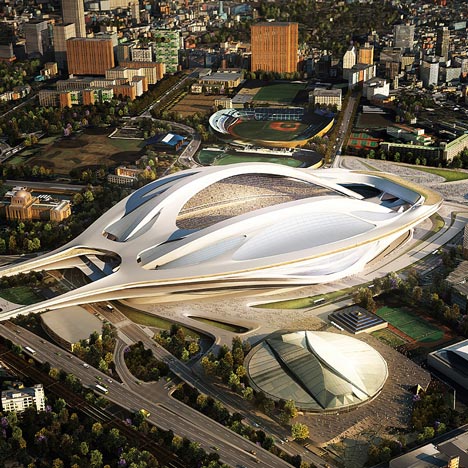
Zaha Hadid Architects won the competition to design the stadium in 2012. However, the proposed design (top and above) was criticised by a group of leading Japanese architects including Fumihiko Maki, Toyo Ito, Sou Fujimoto and Kengo Kuma due to its scale.
Hadid described these architects as "hypocrites". "They don't want a foreigner to build in Tokyo for a national stadium," Hadid told Dezeen at the time. "On the other hand, they all have work abroad."
Following the criticism and a budget cut, Zaha Hadid Architects submitted a proposal for a scaled-back "refined" stadium in 2014.
Despite the redesign, the controversial stadium was scrapped in 2015, with Japanese prime minister Shinzo Abe stating that he had listened "to the voices of the people" and had decided to "start over from zero" with the stadium.
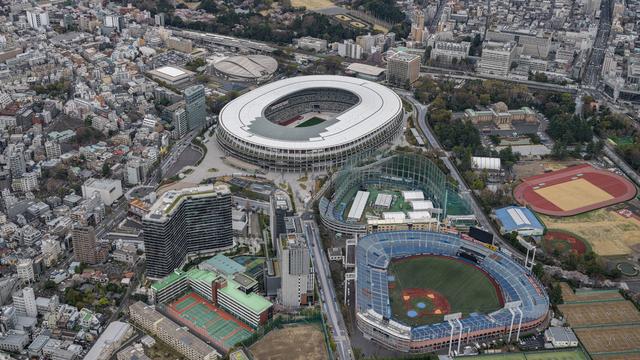
A new competition was launched with designs by Kuma and Ito, who were both critical of Hadid's original stadium chosen as the two finalists. Kuma's design was chosen as the eventual winner.
Olympic logo plagiarism claims
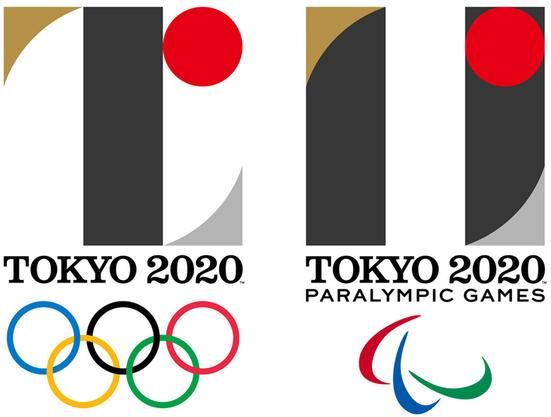
The original logos for the 2020 Olympic and Paralympic Games also proved contentious and, like the stadium, were eventually scrapped.
Designs by Japanese graphic designer Kenjiro Sano (above) were unveiled by the event organisers in 2015 but were quickly embroiled in scandal after Belgian designer Olivier Debie accused Sano of copying his logo for the Théâtre de Liège.
Despite Sano insisting there was "absolutely no truth" in the claims, the plagiarism allegations and a lawsuit led to the organisers withdrawing the design.
A public competition was launched to source a replacement logo, which Japanese artist Asao Tokolo won with a pair of chequerboard designs.
Kengo Kuma accused of plagiarism
Following his victory in the competition to replace Hadid's controversial stadium, Kuma was accused of plagiarising the original design.
According to Hadid, the new stadium had "remarkable similarities" to her own proposal with a similar shape and layout.
"In fact, much of our two years of detailed design work and the cost savings we recommended have been validated by the remarkable similarities of our original detailed stadium layout and our seating bowl configuration with those of the design announced today," she said.
However, Kuma rubbished the claims, telling The Japan Times: "I believe if you take a look at Zaha Hadid's design and mine, you can see very different impressions of the building."
Stadium linked to deforestation
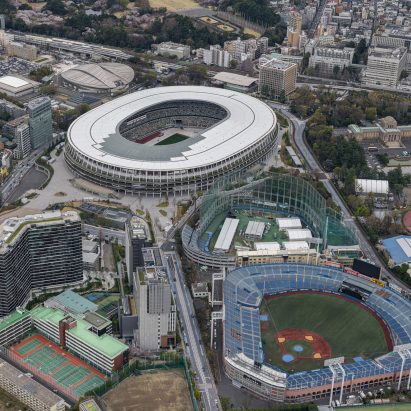
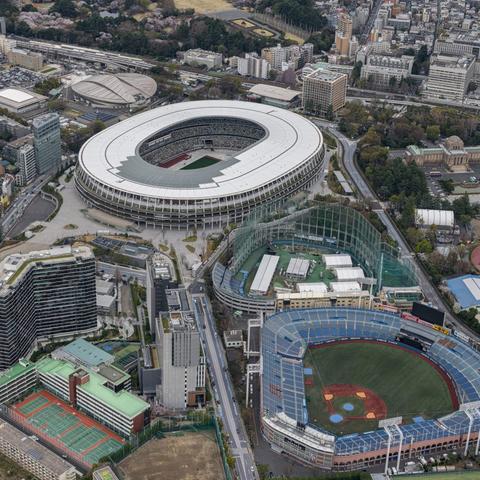
Much has been made of the use of timber in the roof and cladding of Kengo Kuma's 68,000-seat Japan National Stadium, which was built to host the athletic events as well as the opening and closing ceremonies.
However, the Japanese government was criticised for the timber used as a mould for the concrete structure. An investigation by more than 40 charities found that the tropical hardwood being used was linked to deforestation and human rights violations.
A petition signed by over 140,000 people demanded that the government rethink its use of tropical hardwood at the stadium.
"The Olympics is supposed to be all about 'fair play' and 'the youth of the world coming together'. In reality, the human rights of Sarawak's indigenous people and the environment are being threatened by the Olympics," said Mathias Rittgerott of charity Rainforest Rescue, who delivered the petition in Germany.
"The use of tropical timber from Sarawak on Olympic construction sites is nothing to celebrate," she added.
Sustainability efforts branded "greenwashing"
The Tokyo 2020 Olympic Games aimed to be the greenest in recent history, with a host of initiatives from recycled cardboard beds to podiums made of donated plastic designed to help the games move "towards zero-carbon".
According to the organisers, these are the first Olympics to be carbon neutral and run entirely on renewable energy. However, a peer-reviewed study conducted by the University of Lausanne found that the Tokyo event is the third-least sustainable Olympics since 1992.
"The majority of the measures that have been included in this particular Olympics, and the ones that were particularly mediatised, have a more or less superficial effect," said the report's co-author David Gogishvili.
"The efforts the International Olympic Committee is making are important but they are limited and not enough. From my perspective, unless they heavily limit the construction aspect and the overall size of the event, they will always be criticised for greenwashing."
The post Five architecture and design controversies that rocked the Tokyo Olympics appeared first on Dezeen.
#all #architecture #design #roundups #tokyo2020olympics #olympicandparalympicgames


The Tokyo 2020 Olympic Games went ahead successfully despite a series of controversies in the run-up, including accusations of plagiarism and greenwashing. Here are five architecture and design scandals that threatened to derail the games.
The latest edition of our Dezeen Weekly newsletter features our guide to the architecture of the Tokyo 2020 Olympic Games.
As part of our coverage of the coronavirus-delayed Tokyo 2020 Olympic Games, we rounded up the most architecturally significant venues. Buildings by Japanese architects Kengo Kuma, Kenzo Tange and Rafael Viñoly Architects are included.
Readers are impressed. One commenter called the building by Tange: "An icon and masterpiece".
Will Gamble Architects puts modern spin on Victorian details with T-House in London
Other stories in this week's newsletter include a recently renovated Victorian house in south London, a gymnasium at a private school in Bali, and Norway's plan to bury captured carbon under the North Sea.
Subscribe to Dezeen Weekly
Dezeen Weekly is a curated newsletter that is sent every Thursday, containing highlights from Dezeen. Dezeen Weekly subscribers will also receive occasional updates about events, competitions, and breaking news.
Read the latest edition of Dezeen Weekly. You can also subscribe to Dezeen Daily, our daily bulletin that contains every story published in the preceding 24 hours.
The post Our guide to architecture of the Tokyo 2020 Olympic Games features in today's Dezeen Weekly newsletter appeared first on Dezeen.
Kengo Kuma's Japan National Stadium is the centrepiece of the Tokyo 2020 Olympics
Cedar panels clad the eaves of the 68,000-seat Japan National Stadium, which Japanese studio Kengo Kuma and Associates designed for the Tokyo 2020 Olympics.
The structure in Tokyo's Meiji-Jingu Park by Kengo Kuma and Associates with Taisei Corporation and Azusa Sekkei Co hosted the games' opening ceremony last week and is set to host the track and field athletics events at both the Olympics and Paralympics.
Above: Japan National Stadium is located in Tokyo. Top image: it is surrounded by wooden eaves
Completed in 2019, ahead of the coronavirus-postponed games, the stadium takes the form of a large oval.
Its main structure is made from reinforced concrete and steel, sheltered by a roof structure made of steel with laminated larch and cedar trusses.
The eaves nod to traditional Japanese architecture
The roof is punctured with a huge oculus above the track but cantilevered to shelter three tiers of spectators seats.
Behind the seating are the circulation areas, which wrap the edges of each level and contain 47,000 plants. This greenery is visible externally and was designed to help the stadium blend in with the surrounding green environment.
The eaves are positioned below the tree-lined circulation spaces
To reduce the visual impact on the site, the stadium height was minimised by combining a flat roof and a compact arrangement of seats.
Externally, the structure is distinguished by a series of eaves that are clad in cedar collected from each of Japan's 47 prefectures.
Seating is covered by a roof
The eaves were designed by Kengo Kuma and Associates as a contemporary interpretation of the overhanging eaves of traditional wooden Japanese buildings.
They also offer functional benefits, keeping out the sunlight and rain while encouraging air to circulate and prevailing wind to enter. This helps to cool the building in hot weather in tandem with airflow-creating fans and a mist-cooling system.
Wood also features inside the Japan National Stadium, where it lines the interior spaces to help create a warm and tactile environment. It has also been used to furnish the athletes' dressing rooms and to create benches in recreation spaces.
The stadium is complete with more than 450 places for wheelchair users, solar panels on the roof that generate electricity and rainwater collection points in underground cisterns that are used to irrigate the arena's greenery.
The roof structure was built from laminated timber and steel
The Japan National Stadium featured in our roundup of architecturally significant venues hosting the games alongside structures by Japanese architects Kenzo Tange and Fumihiko Maki.
We also featured the stadium during Dezeen's Virtual Design Festival last year, when architecture video blogger Martin van der Linden described it as "quite simple, and definitely not iconic".
Plants line the walkways around the stadium
When Japan National Stadium was first revealed in 2015 it became mired in controversy as it replaced a proposal by UK architect Zaha Hadid that was scrapped over rising costs and opposition.
It came under fire again in 2017 as tropical hardwood linked to deforestation and human rights violations was used as a mould for its concrete elements. This is one of the reasons the Tokyo 2020 Olympics has been accused of greenwashing by promising to be the greenest Olympic event ever.
The photography is courtesy ofJapan Sport Council.
The post Kengo Kuma's Japan National Stadium is the centrepiece of the Tokyo 2020 Olympics appeared first on Dezeen.
#publicandleisure #all #architecture #japan #japanesearchitecture #tokyo #stadiums #kengokuma #tokyo2020olympics #japannationalstadium
Telfar designs unisex uniforms for Liberian Olympic team
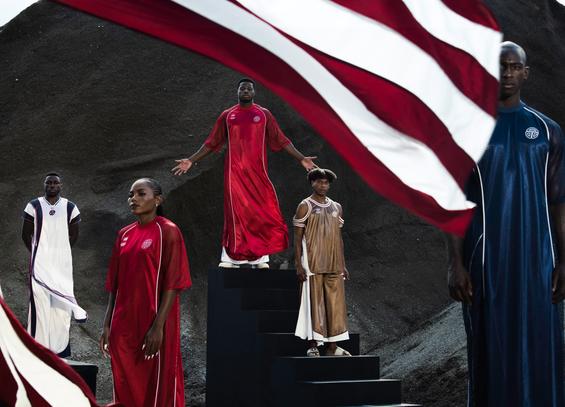
New York-based fashion brand Telfar has designed a collection of unisex uniforms for the Liberian team at the Tokyo 2020 Olympics.
Liberian-American fashion designer Telfar Clemens and his business partner Babak Radboy created unitards, gowns, tank tops and other clothing items for the Liberian Olympic team to wear during the games.
Above: professional Liberian athletes Wellington Zaza, Joseph Fahnbulleh and Akeem Sirleaf model the collection. Top: the uniform is designed to celebrate Liberian culture
Clemens sketched the designs, some of which debuted at the Olympic opening ceremony in the Kengo Kuma-designed Tokyo National Stadium on Friday, while in Africa.
His immediate surroundings were the inspiration for the collection.
"The garments tell the story of a journey of recognition — in which Telfar saw the roots of his design DNA all around him in the streets of a country with a history deeply entwined with America's own," the designers told Dezeen.
"In this sense, the Liberian National Team manifests a profound narrative of repatriation. Telfar, like the athletes who make up the team, is asked to represent something much deeper than a nation."
The designs use red, white, gold and blue colours
The brand, which is best known for its iconic fake leather shopping bags, has printed its own "T" logo on the front of the uniform, giving it a distinctively Telfar aesthetic.
Further notable Telfar styling choices can be seen in the one-shoulder tank tops and the loose-fitting tracksuits.
The uniform incorporates shades of the colours on the Liberian flag – blue, red and white – as well as gold. Large stars have been printed onto the clothes in a nod to the single star on the flag.
African clothing styles also feature in the genderless collection. The African lappa – a traditional colourful skirt or dress that wraps around the wearer – manifests itself as a tie-up garment that can be worn by both male and female athletes.
"The traditional African lappa, which Telfar has produced since 2009 without knowing its origin, is rendered in navy jersey and engineered with graphics and pockets," said the designers.
The word Liberia is printed in capital letters along the side of the clothes.
Liberian sprinter Emmanuel Matadi wears a blue and white unitard which is part of the track uniform
The designers also looked at the global supply chain of clothes to inform the design.
"The collection traces logistics of global distribution networks backwards from their point of termination: in the barrels and containers of used and surplus clothes from which much of Africa — and therefore the world — fashions itself."
Clemens designed the collection while in Africa
Telfar was announced as the official sponsor of the Liberian team at the Tokyo 2020 Olympic Games last month. The brand will launch an Olympics-informed commercial collection after the games.
Nike is another major fashion brand that has designed uniforms for the Tokyo 2020 Olympics. The sportswear company produced basketball and soccer jerseys for the American team. It also created the first-ever Olympic skateboarding uniforms for France, Brasil and the United States.
Photography is byJason Nocito.
The post Telfar designs unisex uniforms for Liberian Olympic team appeared first on Dezeen.
#fashion #all #design #africa #sports #sportswear #tokyo2020olympics #olympicandparalympicgames



Watch Nendo's Toyko 2020 cauldron open to reveal Olympic flame
This video shows the Tokyo 2020 Olympic cauldron designed by Japanese studio Nendo opening up to reveal the hydrogen-powered Olympic flame.
Designed by Nendo founder Oki Sato to evoke a sun, the spherical cauldron was the centrepiece of the games' opening ceremony, which took place last Friday in the Kengo Kuma-designed Tokyo National Stadium.
The video shows the aluminium segments of the spherical cauldron unfurling before the Olympic flame is lit.
The flame is powered by hydrogen, which burns without producing greenhouse gas emissions. This is the first time that this fuel was used for the Olympic flame instead of propane.
Read more about the 2020 Olympic cauldron ›
The post Watch Nendo's Toyko 2020 cauldron open to reveal Olympic flame appeared first on Dezeen.
#all #design #videos #tokyo #nendo #designvideos #tokyo2020olympics #olympicandparalympicgames


Nendo creates spherical Olympic cauldron with hydrogen flame
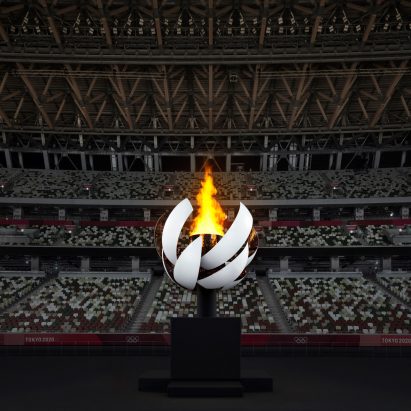
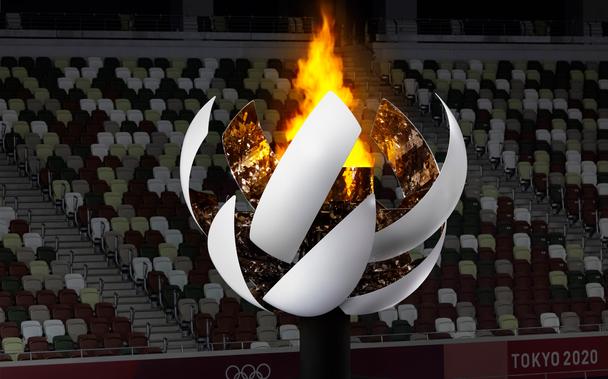
Japanese design studio Nendo's spherical cauldron, which opened to hold the Olympic flame, was the centrepiece of the Tokyo 2020 Olympics opening ceremony.
The dynamic, white structure was designed by Nendo founder Oki Sato to align with the opening ceremony's concept of "All gather under the sun, all are equal, and all receive energy".
Nendo designed the cauldron for the Tokyo 2020 Olympics
Informed by the shape of the sun, the spherical form was made from ten aluminium panels with reflective interiors.
At the finale of the opening ceremony within the Kengo Kuma-designed Tokyo National Stadium these panels opened to reveal the Olympic torch, which was lit by Japanese tennis player Naomi Osaka.
The cauldron has a spherical shape
"At the end of the opening ceremony of the Olympic Games, the cauldron 'blooms' to welcome the final torchbearer," said Nendo.
"This expresses not only the sun itself, but also the energy and vitality that can be obtained from it, such as plants sprouting, flowers blooming, and hands opening wide toward the sky."
The flame is the first at the Olympics to burn hydrogen. The hydrogen was created through the electrolysis of water using solar power at a facility in Japan's Fukushima Prefecture in the west of the country.
Unlike propane, which has been used as the fuel for previous Olympic flames, hydrogen burns with an invisible, colourless flame.
It was lit within the Tokyo National Stadium during the games' opening ceremony
To create the visible, yellow flame sodium carbonate was sprayed into the hydrogen.
"The amount and direction of the aqueous solution sprayed from the vicinity of the burner were repeatedly examined along with the amount of hydrogen and the angle of the valve," said Nendo.
"[We] adjusted the movement and shape of the flame to shimmer like firewood was stoked; such an attempt to 'design flames' was unprecedented."
The flame is powered by hydrogen
The use of hydrogen, which is a zero-carbon fuel, for the Olympic flame was one of several initiatives at this year's games designed to reduce the environmental impact of the event.
The Olympic podiums and medals have been made from recycled materials and the majority of venues that will host events already existed, including several venues built for the previous games in 1964.
Despite these efforts, the co-author of a recent peer-reviewed report told Dezeen that the efforts were "greenwashing".
At the last Olympics in Rio de Janeiro, American artist Anthony Howe created a large kinetic sculpture that complimented the modest-sized cauldron, while the Thomas Heatherwich-designed cauldron for the 2012 games in London was formed of 204 copper petals that combined to create the flame.
The post Nendo creates spherical Olympic cauldron with hydrogen flame appeared first on Dezeen.
#all #design #tokyo #nendo #tokyo2020olympics #olympicandparalympicgames

Tokyo 2020 Olympics accused of "superficial" sustainability efforts
The Tokyo 2020 Olympics opens today amid claims that its promise to be the greenest games ever are "greenwashing".
Instead, it is the third-least sustainable Olympics since 1992, according to a new report.
This year's event marks the first Olympics to be carbon neutral and to run entirely on renewable energy, according to its organisers.
"The majority of the measures that have been included in this particular Olympics, and the ones that were particularly mediatised, have a more or less superficial effect," said David Gogishvili, who is co-author of a peer-reviewed study of the games conducted by the University of Lausanne.
"From my perspective, unless the International Olympic Committee heavily limits the construction aspect and the overall size of the event, they will always be criticised for greenwashing."
Focus on recycling without banning plastic
The games, postponed from last year due to the pandemic, have been billed as the greenest-ever.
At today's opening ceremony, the torchbearer will wear a uniform made from discarded Coca-Cola bottles and hold a hydrogen-fueled torch formed of repurposed aluminium from disaster relief shelters.
Throughout the competition, athletes will sleep on recycled cardboard beds and receive medals made from old smartphones on podiums 3D-printed from household plastic waste.
Yet despite these initiatives, Tokyo 2020 is still the third-least sustainable Olympics to take place in the past 30 years, according to the report.
Above: Nike designed uniforms from recycled materials. Top: Kengo Kuma's Japan National Stadium is built using timber
Masako Konishi, climate and energy project leader at the World Wildlife Fund Japan, agreed with its findings.
"Using recycled plastic for building podiums is good as a showcase but it doesn't leave any legacy to Japanese society as they didn't ban the use of these plastics," she told Dezeen.
However, Konishi, who is a member of the Tokyo Olympics sustainability committee, also argues that the event will set an important precedent by becoming the first games to offset all its emissions through carbon credits.
"The Tokyo Olympics collected more than enough carbon credits, more than 150 per cent of what was needed, meaning that it will be carbon negative," she said.
"These carbon credits follow robust guidelines, which I think could be a role model for future Olympics."
Olympics have become less sustainable over time
Concern around the environmental impact of the Olympic Games first arose in the 1990s, when the International Olympic Committee (IOC) published its own version of the UN's sustainable development plan Agenda 21, sponsored by oil giant Shell.
However, when University of Lausanne researchers analysed all 16 Olympics that have taken place since 1992, they noticed a clear decrease in the sustainability of the games since then, with Tokyo in the bottom three.
This trend can be traced back to the increasing size of the event, Gogishvili says, which causes a chain reaction of environmental, social and economic impacts.
"In 1964, when Tokyo last hosted the Summer Olympics, there were 5,500 athletes participating," he said. "Today, there will be around 12,000."
"More athletes means more events, more participating countries and more media. They need more venues, accommodation and larger capacity, which means more construction and a more negative ecological footprint."
Athletes will be transported by Toyota's electric e-Palette vehicles
The IOC announced last year that all of its upcoming events would be carbon-neutral and, as of 2030, "climate positive".
With this aim, Tokyo 2020 implemented a decarbonisation strategy that helped reduce the event's estimated carbon footprint from 2.9 million tonnes of carbon dioxide equivalent (CO2e) to 2.73 million tonnes.
Beyond the use of renewable energy and electrified transport, this was achieved by cutting down on new construction in favour of retrofitting 25 existing sports venues and making both old and new buildings more energy-efficient.
Among the newly constructed buildings, the Olympic Plaza and Kengo Kuma's Japan National Stadium are built from timber in a bid to limit emissions. However, some of this wood has been linked to deforestation, which effectively negates its positive impacts.
Tokyo 2020 is carbon neutral
To compensate for the emissions that remain, the Japanese Olympics Committee has purchased 4.38 million tonnes worth of carbon credits, generated through local energy-saving and efficiency projects in Tokyo and Saitama prefecture.
"The decarbonisation strategy is the best out of all the past Olympics," Konishi said. "I believe the most important thing that the Tokyo Olympics can show the world is that with current technology, it's possible to get to carbon-zero."
However, unlike offsets that directly remove carbon from the atmosphere via processes such as direct air capture (DAC) or soil carbon sequestration, energy efficiency projects like this only help to reduce future emissions rather than removing existing ones from the atmosphere.
The Tokyo 2020 medals are made from donated e-waste
Even as Tokyo 2020's estimated footprint has been lowered further now that foreign visitors will be barred due to the pandemic, the event will still result in a net addition of 2.4 million tonnes of CO2 to the atmosphere, which is more than the entire city of Copenhagen emitted last year.
"Carbon offsets have been criticised by different scholars, because what they tell us is: we'll keep emitting but we'll just try to offset it," Gogishvili said.
"It is possible to have more sustainable Olympics but there are some radical changes that the IOC needs to take."
Event should be downsized
According to the researcher, this includes establishing an independent body to evaluate the Olympics' sustainability claims, as well as rotating the games among the same cities to mitigate the need for constantly constructing new infrastructure.
But the thing that would have the biggest impact, he argues, would be a focus on degrowth and downsizing the event.
"The first modern Olympics, which were hosted in Athens in the late 19th century, had only 300 athletes," he said.
"Of course, we are not saying that we have to go to that level. But there needs to be a discussion between the IOC, National Olympics Committees and maybe the UN, which takes into consideration the current realities of the world and the climate crisis, to come to a reasonable number."
The Tokyo 2020 Olympics run from 23 July to 8 August 2021 in venues across Tokyo. SeeDezeen Events Guide for an up-to-date list of architecture and design events taking place around the world.
The post Tokyo 2020 Olympics accused of "superficial" sustainability efforts appeared first on Dezeen.
#all #architecture #design #features #tokyo2020olympics #olympicandparalympicgames


Ten Tokyo 2020 Olympics designs that help the games move "towards zero carbon"
From beds made out of recycled cardboard to podiums made of donated plastic, the Tokyo 2020 Olympics are aiming to be the greenest games yet.
The organisers of the Olympics are aiming to create a "minimal impact Games", through a series of steps outlined in the Tokyo 2020 Olympic and Paralympic Games Sustainability Plan.
The majority of venues that will host events already existed with several reused from the Tokyo 1964 Olympics and podiums and medals have been made from recycled materials.
The sustainability plan claims the games are aiming to move "towards zero carbon" by "focusing on maximum energy savings and use of renewable energy".
However, a recent peer-reviewed report has called into question the event's green credentials and ranked it among the least sustainable Olympics of recent times. Co-author David Gogishvili told Dezeen that the efforts were "greenwashing".
Read on for 10 design projects aiming to make the games sustainable.
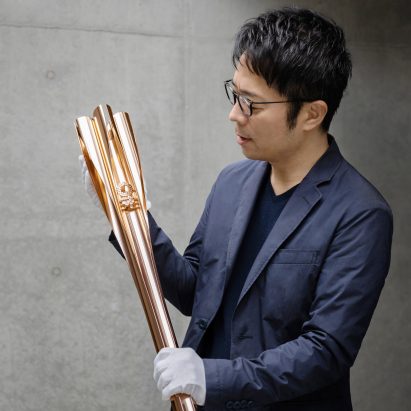
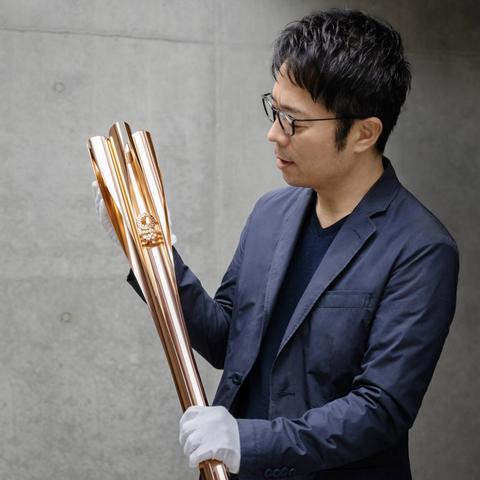
The Olympic torches, designed by Tokujin Yoshioka, were made up of recycled construction waste from temporary housing used in the aftermath of the Great East Japan earthquake and tsunami in 2011.
The designer used an extrusion technique to produce the 71-centimetre rose-gold torches, which resemble the national flower of Japan, the sakura flower. Both the relay torches and cauldron holding the Olympic flame are fueled by hydrogen instead of fossil gas.
Find out more about the Tokyo 2020 Olympics torch ›
Electric e-palette vehicle by Toyota
The autonomous and electric e-Palette vehicle was designed to transport Olympic and Paralympic athletes around the Olympic Village without generating emissions.
Japanese car company Toyota modified its existing fleet of e-Palette vehicles to better suit the needs of athletes who required fuss-free and comfortable transport.
Some of the modifications include widening the doors, lowering the flor and adding electric ramps to enable passengers – particularly wheelchair users – to board easily and quickly.
Find out more about the electric e-Palette vehicle›
Japanese designer Junichi Kawanishi extracted precious metal from old mobile phones and other e-waste donated by the public to create reflective, ribbon-like rings around the edge of the Tokyo 2020 Olympic and Paralympic medals.
Kawanishi's winning medal design was selected from a competition that drew entries from more than 400 professional designers and design students. The medal cases which are manufactured from dyed Japanese ash wood, have been designed by Shinya Yoshida.
Find out more about the Tokyo 2020 Olympic and Paralympic medals ›
Japanese bedding company Airweave produced these lightweight recycled cardboard beds and customisable mattresses for athletes.
Of the 18,000 beds and customisable mattresses created for athletes at this summer's Olympics, 8,000 will be repurposed for use by athletes at the Paralympics.
The brand claims that the mattresses, which are made from polyethylene fibres, can be recycled an unlimited number of times.
Find out more about the cardboard beds›
Japan National Stadium by Kengo Kuma
Japanese architect Kengo Kuma created a wooden lattice design for the Japan National Stadium, which will house the opening and closing ceremonies as well as the athletics events.
Although timber is generally considered a sustainable building material due to its ability to store carbon, the design came under fire for using wood linked to deforestation and human-rights violations.
It was found that the wood used in Kuma's wooden, plant-filled structure could be traced back to Shin Yang, a Malaysian logging giant accused of illegal logging and rainforest destruction.
Find out more about the stadium ›
Torchbearer uniforms by Daisuke Obana
Recycled plastic bottles collected by Coca-Cola have been used in the white T-shirts and trousers worn by torchbearers carrying the Olympic flame at the Tokyo 2020 Olympic torch relay.
The Tokyo Olympic Association designed the unisex Olympic torchbearer uniforms under the theme "hope lights our way".
The designs all feature a sash with a chequered pattern that is known in Japan as ichimatsu moyo. The same pattern can be found in the Tokyo 2020 logos.
Find out more about the Torchbearer uniforms ›
Basketball and soccer uniforms by Nike
Sportswear brand Nike used recycled polyester made from plastic bottles and recycled nylon as well as rubber and yarn waste from the company's factories to create these uniforms.
Among them are soccer jerseys for the American, Korean and Nigerian teams, alongside kits for the USA's men and women basketball teams.
The brand says that the uniforms will be the "most sustainable" and "highest performing" to date.
Find out more about Nike's basketball and soccer uniforms ›
The winners at the Tokyo 2020 Olympics and Paralympics will receive their medals on podiums made from 24.5 tonnes of discarded household plastics.
Japanese artist Asao Tokolo gathered the plastics from the Japanese public before recycling the material and turning it into filaments, which were used to 3D-print the podiums.
The equivalent of 400,000 bottles of laundry detergent was collected to create all 98 podiums that will be used during the Games.
Find out more about the podium ›
Olympic Plaza by Nikken Sekkei
This temporary structure by Tokyo studio Nikken Sekkei was built using 40,000 pieces of Japanese wood. The pieces of cypress, cedar and larch were "borrowed" from local governments across Japan.
The timber space will be used as the central meeting and dining place for athletes, officials, guests and the media within the Olympic Village throughout the games.
Find out more about the village plaza ›
Skateboarding uniforms by Nike
Bright colours and geometric patterns adorn the skateboarding uniforms that Nike has designed for the first skateboarding competitors at the Olympic Games.
According to Nike, all of the skateboarding jerseys are made up of 100 per cent recycled polyester from "water bottles and other things that would go to waste".
The sportswear company has created uniforms for the United States, France and Brazil. They will all be bringing teams to the Tokyo 2020 Olympics to compete in the sport's first street and park competitions at the Olympic level.
Find out more about the skateboarding uniforms ›
The post Ten Tokyo 2020 Olympics designs that help the games move "towards zero carbon" appeared first on Dezeen.
#all #design #roundups #tokyo #tokyo2020olympics #olympicandparalympicgames #sustainability

 Mark Chick
 dezeen (unofficial)


