 In the Dark
Weekly Update from the Open Journal of Astrophysics 27/06/2026
It’s Saturday again so it’s time for another update of activity at the Open Journal of Astrophysics. Since the last update we have published a further three papers, bringing the number in Volume 9 (2026) to 129 and the total so far published by OJAp up to 577.
I will continue to include the posts made on our Mastodon account (on Fediscience); these announcements also show the DOI for each paper.
The first paper to report this week, published on Tuesday 23rd June, is “Interpretable machine learning of halo gas density profiles: a sensitivity analysis of cosmological hydrodynamical simulations” by Daniele Sorini & Sownak Bose (Durham University, UK), Mathilda Denison (U. Penn., USA) and Romeel Davé (University of Edinburgh, UK). This study uses cosmological hydrodynamical simulations and a random forest algorithm to understand how feedback processes affect the gas distribution in galaxies by predicting gas density profiles in various models. It is published in the folder Astrophysics of Galaxies.
The overlay for this paper is here
You can find the officially accepted version on arXiv here and the announcement on Fediverse here:
https://fediscience.org/@OJ_Astro/116798189799110714
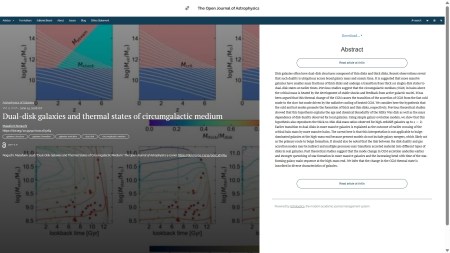
The second paper for this week, published on Wednesday June 24th in the folder Astrophysics of Galaxies is “Dual-disk galaxies and thermal states of circumgalactic medium” by Masafumi Noguchi (Tohoku University, Japan). This paper explores the suggestion that the transition from thick to dual-disk galaxies is influenced by thermal changes in the circumgalactic medium (CGM), which also affects star formation.
The overlay looks like this:
The official version of the paper can be found on arXiv here and the Fediverse announcement here:
https://fediscience.org/@OJ_Astro/116803879351605451
The third and finnal paper of the week, published on Friday 26th June in the folder High-Energy Astrophysical Phenomena, is “Mass Transfer in Tidally Heated Stars Orbiting Massive Black Holes and Implications for Repeating Nuclear Transients” by Philippe Z. Yao and Eliot Quataert (Princeton University, USA). This paper discusses how tidal heating alters the structure of stars near supermassive black holes, affecting mass transfer rates and potentially leading to low-luminosity active galactic nuclei and transient stellar phenomena.
The overlay for this one is here:
The final, accepted version can be found on arXiv here and the Mastodon announcement is here:
https://fediscience.org/@OJ_Astro/116815332283834010
And that concludes this week’s update. It has been another slow week on the publishing front. We have a steadily growing backlog of papers accepted for publication but with final versions yet to appear on arXiv. I suppose it’s the holidays…
P.S. The other day I checked the stats for the Open Journal of Astrophysics and saw that we’ve passed 8,000 citations. The average number of citations per paper is 14.0, which is not bad when you consider that over half the papers were published under a year ago…
#arXiv250510611v2 #arXiv251209021v3 #arXiv260624158v1 #AstrophysicsOfGalaxies #CircumgalacticMedium #DiamondOpenAccess #DiamondOpenAccessPublishing #DualDiskGalaxies #galacticStructure #galaxyFormation #galaxyHaloes #HighEnergyAstrophysicalPhenomena #MachineLearning #massiveBlackHoles #nuclearTransients #OpenAccess #OpenAccessPublishing #TidalHeating

 KillBait
 Nicole Sharp
 Universe Today
 Ansgar Schmidt