Good to see Tiago Forte talking about this. A lot of people read his stuff.

(He's a writer/teacher best known for the "Building a Second Brain" framework.)

"It was that summer when climate change stopped being an abstract concept and became viscerally personal for me. I realized that this wasn’t a one-time freak event—every summer we could expect deteriorating air quality from rampant wildfires. ...

"This convergence of physical heat, failing infrastructure, and human vulnerability isn’t just a temporary inconvenience. It’s a preview of the fundamental challenge that Jeff Goodell explores in The Heat Will Kill You First, a book that forced me to confront an uncomfortable truth: all our routines for productive living and working are built on the assumption of a stable climate. It no longer makes sense for me to teach people how to build productive systems without taking into account the increasing instability of our wider environment."

https://fortelabs.com/blog/life-and-death-on-a-scorched-planet-what-i-learned-from-the-heat-will-kill-you-first/

#TiagoForte #ClimateChange #ClimateDiary #environment #books #heatwave

Life and Death on a Scorched Planet: What I Learned From "The Heat Will Kill You First" - Forte Labs

Tiago's personal climate awakening reveals heat as humanity's biggest threat. Why it's an information crisis + adaptation steps.

Forte Labs

It’s the messiness

It turned out in retrospect that the messy diversity of the forest had been the source of its resilience. When stresses such as storms, disease, drought, fragile soil, or severe cold struck, a diverse forest with its full array of different species of trees, birds, insects, and animals was far better able to survive and recover. A windstorm that toppled large, old trees would typically spare smaller ones. An insect attack that threatened oaks might leave lindens and hornbeams unaffected. The rigidity and uniformity of the system meant that failures were not small and contained but systemic.

~ Tiago Forte, from Productive Disorder: The Hidden Power of Chaos, Noise, and Randomness

slip:4ufobo11.

I’m simply stuck, staring at: “The rigidity […] of the system meant that failures were […] systemic.” I’m filing this under Stuff I Wished I’d Learned 30 Years Ago. I often say that I use systems and structure as a way to multiply my efforts. And that’s true. But I’ve learned that the real reason is that I’m afraid. The big why behind my hyper-organization, maximally-complex systems, and endless aligning of figurative ducks is my desperately trying to control the world around me. With realization comes… the recognition that I have a lot more work to learn to not do.

ɕ

#7ForSunday #AgeOfAir #GettingLessDone #TiagoForte

Craig Constantine

Caution: Blogging. Randomly.

Craig Constantine

Obsidian folder structures, or: how I locate notes

How much structure do you actually need in your Obsidian library? I’ve investigated a number of options and realized that simplicity works best for me.

https://hannahswainlovik.eu/2025/06/02/obsidian-folder-structures-or-how-i-locate-notes/

Ух как я ненавижу читать книги. Нет, не так. Ненавижу расшифровывать умные книжки из разряда "Создай свой второй мозг" Тьяго Форте. Уже 30 из 150 страниц и автор только начинает переходить от вступления к конкретному описанию системы, но оно настолько разбавлено этими историями из жизни, что невозможно понять где же тут суть. Пересказ книги на ютюбе точно будет полезнее.

#secondBrain #tiagoForte
вот такие вот современные #книги

Taking notes on the books I read was a great start, but it wasn’t enough. It did me no good to leave those notes sitting in a software program like a musty filing cabinet in the basement, never to see the light of day again.

I realized if I wanted to benefit from my reading, I needed to engage with the books I read on a much deeper level. I needed to make something out of them. Otherwise, I would continue to passively consume information with no lasting memory of what I learned.

~ Tiago Forte, from The Ultimate Guide to Summarizing Books

Has anyone noticed that’s what I’m attempting to do with all my blogging and writing? Shirley, that’s obvious. (It’s not obvious, and don’t call me Shirley.)

I’ve always deeply loved movies. I was raised (on hose water and neglect) in the era when going to a movie was special. Remember when you had to use the phone (with a rotary dial, mounted on the wall) to call the theatre and listen to a looooong recording detailing what was playing and when? I could tell you so so so many stories about going to the movies. In more recent issues of 7 for Sunday, I’m feeling less inclined to stomp down the inside-joke movie references. If you find them even half as enjoyable to read, as I do to write them, then we’re both better off. I’m pretty sure that my recalling and retelling of all those stories about and around movies makes the entire movie experience more fun; yes the experience during the movie, but also all the stuff around it too.

No, I’ve not lost my own plot. Forte’s point about how to benefit from what one reads is the same thing. If you want to hold on to whatever it was that you’ve gotten from a book… you have to integrate it with the rest of your ongoing, lived experience. You have to go around telling the story of who gave you the book, what the book means to you in the context of your entire life, and what you think your interlocutor might get from it (like this, this, this, this, this, this or… you get my point.)

And as soon as you realize that’s fun for movies, and great for books, you should wonder if it could be a super-power for self-improvement if you could share the contents of your mind, with yourself, in that same fashion. Two suggestions: Start journaling immediately after reading this issue of 7 for Sunday, so you can then begin in a year, to regularly review your journals.

ɕ

https://constantine.name/2024/08/12/filed-and-lost/

#Books #Film #Journaling #KnowledgeSystems #SelfImprovement #TiagoForte

Craig Constantine

Caution: Blogging. Randomly.

Craig Constantine

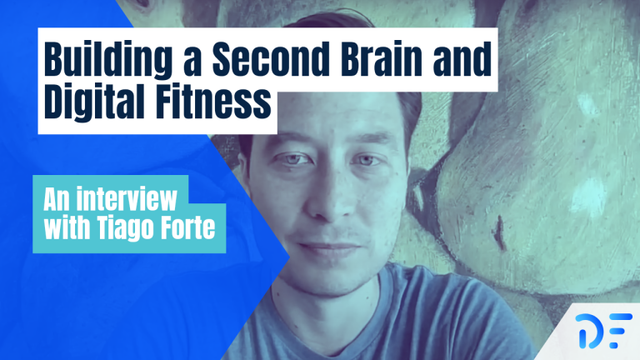
Een gesprek met Tiago Forte over Digitale Fitheid en Persoonlijk Kennis Management

Eind vorig jaar had ik het plezier om te mogen spreken met Tiago Forte over digitale fitheid en Persoonlijk Kennis Management. Daar zaten wel wat eye-openers tussen!

https://www.lykledevries.nl/2024/01/11/een-gesprek-met-tiago-forte-over-digitale-fitheid-en-persoonlijk-kennis-management/

#DigitalFitnessPKM #DigitaleFitheid #PersoonlijkKennisManagementPKM #DigitalFitness #DigitaleFitheid #PKM #TiagoForte

Een gesprek met Tiago Forte over Digitale Fitheid en Persoonlijk Kennis Management – Lykle de Vries

Research with Me – PARA Method by Tiago Forte
In today's research session we looked at The PARA Method by Tiago Forte. When I started reading this book I was thinking of it as a PKM or Zettelkasten book, but it's not. It's a productivity book, a new take on some ideas from GTD and other productivity sources. When I start evaluating the book on those standards, it's a totally different
https://curtismchale.ca/2023/09/11/research-with-me-para-method-by-tiago-forte/
#PKM #PARA #TiagoForte
Research with Me – PARA Method by Tiago Forte – Curtis McHale

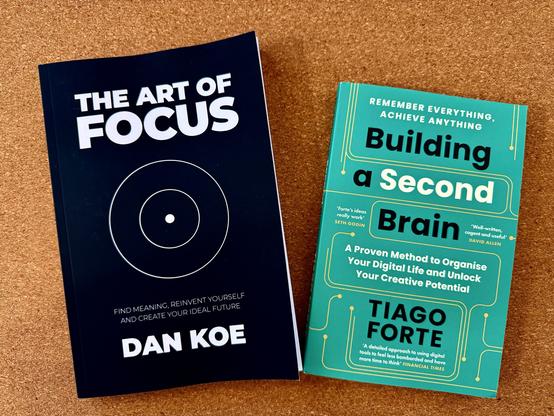
#Lendo #BuildingASecondBrain, de #TiagoForte

Gostando, pois me interesso por construção de uma base de conhecimento
/ #PersonalKnowledgeManagement desde meados de 2013.

Todavia, o Capítulo 2, no título "A Tale of Two Brains", soa bem idealista (no pior sentido), lembrando mais um comercial de margarina do que uma situação real.

Mostra tudo dando certo para uma pessoa que usa o método, mas sem relação de causa com ele, ignorando imprevistos e percalços do dia a dia.

#livros #Mastolivros