"Portrait of a Rabbit," Yabu Chosui, 1867.

I am unable to find any information about Yabu Chosui other than their dates (1814 to c.1870) and several other works, which annoys me.

This is a surimono print, a genre of Japanese printmaking that was generally in small runs and commissioned for a special occasion, like the New Year, which is believed to be the inspiration for this print, assumed to have been made in honor of the Year of the Rabbit.

Surimono prints were commissioned and collected by the educated literati, and as such could be more experimental and extravagant than the usual commercial prints. This is a bit surreal, in giving us a huge rabbit...but the body resembles the bag of Hotei, the god of prosperity, which often figured in New Year's art, and also possibly is meant to resemble the moon, where an immortal rabbit lives, according to Japanese mythology. It's also possibly meant to reflect a common New Year's symbol, the rising sun, as we have the rabbit against a pink field like a morning sky.

Surimono prints were also commissioned by poetry societies to honor a prizewinning poem, and by kabuki actors, to commemorate significant moments in their careers.

Happy Portrait Monday!

From the Art Institute of Chicago.

#Art #YabuChosui #Surimono #JapaneseArt #AsianArt #PortraitMonday

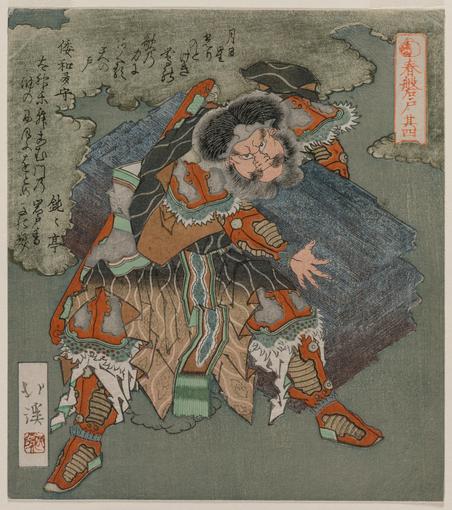
Discover the story of Ama no Tajikara no Mikoto, a captivating surimono print that embodies the vibrant drama of the Amaterasu legend. The intricacies of this 19th-century ukiyo-e piece are mesmerizing—how does it speak to contemporary themes of resilience?

#Surimono #UkiyoE #ArtHistory #
https://clevelandart.org/art/1940.990.4

RT by @digicultEU: #Surimono are a genre of Japanese #WoodblockPrint. Produced in small numbers for a mostly educated audience of literati, surimono were often more experimental and extravagant than commercial prints Explore in our gallery➡️http://bit.ly/3bkMFif

🐦🔗: https://nitter.cz/Europeanaeu/status/1744009494311432265#m

[2024-01-07 14:54 UTC]

Surimono - the finest Japanese prints

Surimono are a genre of Japanese woodblock print. Produced in small numbers for a mostly educated audience of literati, surimono were often more experimental and extravagant than commercial prints.

"Matsukaze (Theater Programme)"
Medium: Ukiyo-e woodblock printed "naga-surimono"; ink, color and metallic pigment on paper
Classification: Prints
Date: Late Edo period, dated 1830
Culture: Japanese
Division: Asian and Mediterranean Art
Creditline: Harvard Art Museums/Arthur M. Sackler Museum, Gift of the Friends of Arthur B. Duel
Katsushika Hokusai 葛飾北斎 (1760 - 1849)
https://www.harvardartmuseums.org/collections/object/207485
#harvardartmuseum #print #surimono
Matsukaze (Theater Programme) | Harvard Art Museums

Prints

"OHARAME AND OX"
Medium: Ukiyo-e woodblock-printed "surimono"; ink and color on paper
Classification: Prints
Culture: Japanese
Division: Asian and Mediterranean Art
Creditline: Harvard Art Museums/Arthur M. Sackler Museum, Gift of the Friends of Arthur B. Duel
Keisai Eisen 渓斎英泉 (1790 - 1848)
https://www.harvardartmuseums.org/collections/object/208385
#harvardartmuseum #print #surimono
OHARAME AND OX | Harvard Art Museums

Prints

"Girl Reaching for Shuttlecock"
Medium: Ukiyo-e woodblock-printed "surimono"; ink and color on paper
Classification: Prints
Culture: Japanese
Division: Asian and Mediterranean Art
Creditline: Harvard Art Museums/Arthur M. Sackler Museum, Gift of the Friends of Arthur B. Duel
Utagawa Kunihiro (1815 - 1843)
https://www.harvardartmuseums.org/collections/object/208174
#harvardartmuseum #surimono #print
Girl Reaching for Shuttlecock | Harvard Art Museums

Prints