He was a sweet, witty, creative guy, and I still miss him like crazy. I'm not seeking pity here; I just think sometimes we don't value the love of stepparents enough. #stepmom #stepmothers

Somehow missed that #MaaikeHornstra's final dissertation chapter is out in
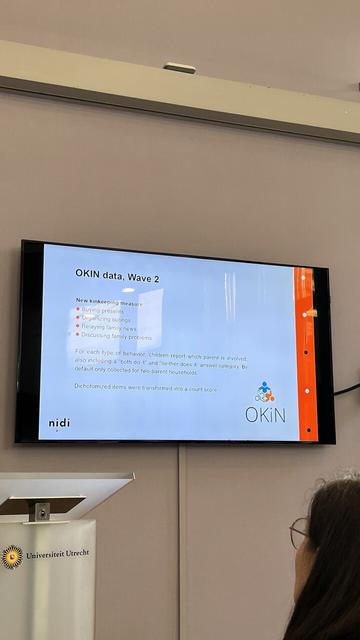
#SexRoles. We use the #OKiN survey to examine #kinkeeping involvement across parents & how these practices are related to parent-child closeness.
https://link.springer.com/article/10.1007/s11199-023-01352-2
A few key findings:
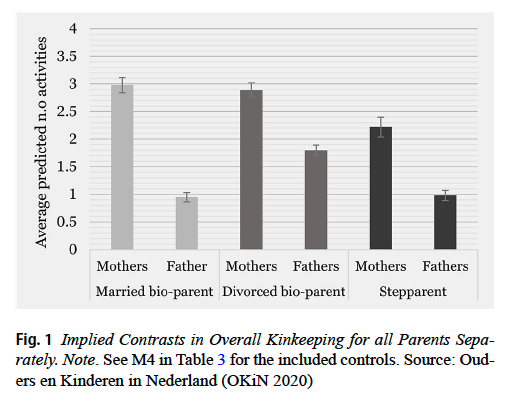
1) #kinkeeping - the work needed to build & maintain family ties - is primarily done by women, irrespective of their biological tie to the child. In fact, when involved, #stepmothers are engaged in more kinkeeping activities than any type of father (as shown in attached figure).
2) we found that when a spouse takes an active role in #kinkeeping, it can foster ties between parents & children. For example, a #stepmother who helps with kin-work may facilitate closer ties between separated biological fathers and their children.
3) #2 echoes - for example - the qualitative work of #MariaSchmeeckle published in #JMF which highlights the active role which a #stepmother plays in facilitating contact & inclusion between herself, her husband, & the involved children (his & hers).
And yes, I might have spent some of the time editing the article proofs humming #Labour of #parispaloma...
A kinkeeper is the person within the household that is involved in the management of family relationships, a position traditionally fulfilled by women. Due to the increased complexity of family life, which resulted from the rise in divorce and remarriage, the kinkeeper role might nowadays be particularly important but also more ambiguous. First, we examined differences in parental involvement in kinkeeping (buying presents, organizing outings, relaying family news, and discussing problems) along the lines of gender, family structure, and biological relatedness. Second, we explored whether the kinkeeping of parents and their partners is effective in the facilitation of intergenerational closeness with adult children. We used the OKiN survey, which includes information on kinkeeping in Nā=ā746 intact, Nā=ā982 mother-stepfather, and Nā=ā1,010 father-stepmother families. Findings indicated a central facilitative role for mothers and stepmothers. Substantial gaps were found between mothers and fathers, married and divorced parents, and biological and stepparents with respect to the (variety of) kinkeeping in which these parents were involved. Yet, the contrasts of biological relatedness and family structure were also found to be gendered, as these gaps were smaller for mothers than fathers. Finally, an association was found between adult closeness with biological parents and the kinkeeping of the spouse, regardless of the nature of the relationship between the spouse and adult child. This implies that a stepmother can be just as effective as a married biological mother in facilitating the ties between a father and his biological children.