Quote of the day, 8 January: Peter-Thomas Rohrbach, OCD

Peter Thomas was born in a small town in the province of Périgord in Aquitaine about the year 1305. His father was a farm laborer, and the family was wretchedly poor.

Assigned to the monastery in Paris for the purpose of acquiring a higher degree in theology, he encountered a vexing and shameful problem—a growing abuse in the Order, which we will discuss in the following chapter, required that the university student obtain for himself the money to finance his education, either from his preaching, or his tutoring, or, most often, from his own relatives.

Therefore, Carmelites who came from affluent families were easily able to get the required money, while students from poorer backgrounds had to struggle. Peter’s family was impecunious, and with the pressure of his religious duties and his studies, he felt for a time that he would have to discontinue his studies.

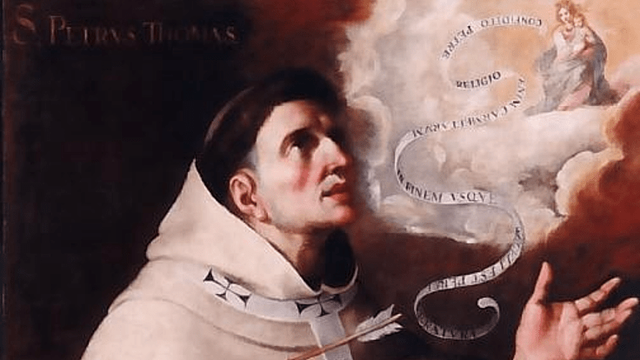
He later recounted to Mezières an episode which happened as he paced the cloister corridor late one night, worrying about his problem. The Blessed Virgin appeared to him, saying:

“My son, do not worry about your lack of money, for I will not forsake you. Work hard at your studies and so you will serve my son and me.”

The next morning, he received a large and unexpected donation with which he was able to continue his studies. He obtained his doctorate in theology and was assigned to the important monastery at Avignon, where the papal court was located.

At Avignon, there also occurred the celebrated vision of the Blessed Virgin’s promise concerning the Carmelite Order. Peter had apparently been praying to her—late at night again—in behalf of the Order when he heard these words from her:

“Have confidence, Peter, for the Carmelite Order will last until the end of the world. Elijah, its founder, obtained it a long time ago from my Son.”

Peter-Thomas Rohrbach, O.C.D.

Journey to Carith, Chapter II

Note: Philip de Mezières, a layman and aide to Peter of Lusignan, king of Cyprus, became a close personal friend of Peter Thomas and wrote his biography based on firsthand experience and the saint’s own recollections. Unusual for its time, the work is candid and restrained, largely free of the embellishments typical of medieval hagiography, and is regarded as a notable achievement of medieval literature.

Rohrbach, P 1966, 2015, Journey to Carith: The Sources and Story of the Discalced Carmelites, ICS Publications, Washington DC.

Featured image: Saint Peter Thomas, by Fray Juan del Santísimo Sacramento, 1666 oil on canvas. Image credit: Museo de Bellas Artes de Córdoba (Public Domain).

#anxiety #apparition #BlessedVirginMary #StPeterThomas #study

8 January: St. Peter Thomas

January 8
SAINT PETER THOMAS
Bishop

Optional Memorial

Born about 1305 in southern Perigord in France, Peter Thomas entered the Carmelites when he was twenty-one. He was chosen by the Order as its procurator general to the Papal Court at Avignon in 1345. After being made bishop of Patti and Lipari in 1354, he was entrusted with many papal missions to promote peace and unity with the Eastern Churches. He was translated to the see of Corone in the Peloponnesus in 1359 and made Papal Legate for the East. In 1363, he was appointed Archbishop of Crete and in 1364 Latin Patriarch of Constantinople. He won a reputation as an apostle of church unity before he died at Famagosta on Cyprus in 1366.

From the Common of Pastors

Office of Readings

The First Reading
1 Timothy 1:1-7, 15-19, 2:1-8

A reading from the First Letter of St. Paul to Timothy

The calling of a pastor

From Paul, apostle of Christ Jesus appointed by the command of God our savior and of Christ Jesus our hope, to Timothy, true child of mine in the faith; wishing you grace, mercy and peace from God the Father and from Christ Jesus our Lord.

As I asked you when I was leaving for Macedonia, please stay at Ephesus, to insist that certain people stop teaching strange doctrines and taking notice of myths and endless genealogies; these things are only likely to raise irrelevant doubts instead of furthering the design of God which are revealed in faith. The only purpose of this instruction is that there should be love, coming out of a pure heart, a clear conscience and a sincere faith. There are some people who have gone off the straight course and taken a road that leads to empty speculation; they claim to be doctors of the Law, but they understand neither the arguments they are using nor the opinions they are upholding.

Here is a saying that you can rely on and nobody should doubt: that Christ Jesus came into the world to save sinners. I myself am the greatest of them; and if mercy has been shown to me, it is because Jesus Christ meant to make me the greatest evidence of his inexhaustible patience for all the other people who would later have to trust in him to come to eternal life. To the eternal King, the undying, invisible and only God, be honor and glory for ever and ever. Amen.

Timothy, my son, these are the instructions that I am giving you: I ask you to remember the words once spoken over you by the prophets, and taking them to heart to fight like a good soldier with faith and a good conscience for your weapons. Some people have put conscience aside and wrecked their faith in consequence.

My advice is that, first of all, there should be prayers offered for everyone — petitions, intercessions and thanksgiving — and especially for kings and others in authority, so that we may be able to live religious and reverent lives in peace and quiet. To do this is right, and will please God our Savior: he wants everyone to be saved and reach full knowledge of the truth. For there is only one God, and there is only one mediator between God and mankind, himself a man, Christ Jesus, who sacrificed himself as a ransom for them all. He is the evidence of this, sent at the appointed time, and I have been named a herald and apostle of it and — I am telling the truth and no lie — a teacher of the faith and the truth to the pagans.

In every place, then, I want the men to lift their hands up reverently in prayer, with no anger or argument.

Responsory

R/. Bear with one another in love; do all that you can to preserve the unity of the Spirit by the peace that binds you together; there is one body and one Spirit, * just as you were all called into one and the same hope when you were called.
V/. A servant of the Lord is to aim for holiness and faith, love, and peace, in union with all those who call on the Lord with pure minds; * just as you were all called into one and the same hope when you were called.

The Second Reading
Bk I, Ch 6

A reading from The Book of the Institution of the First Monks

Love your neighbor as yourself

The Lord says, “The man who hears My commandments and keeps them, he it is who loves Me.” And the first of all commandments is: “Hear, O Israel: The Lord our God is one Lord; and you shall love the Lord your God with all your heart, and with all your soul, and with all your might. This is the greatest and first commandment.” This cannot be observed without love of neighbor, because “he who does not love his brother whom he has seen, cannot love God whom he has not seen;” “and the second commandment is like it. You shall love your neighbor as yourself,” namely, in the things and for the reason that you love yourself. “His soul hates him who loves violence,” says the Psalmist. Therefore, love your neighbor as yourself in good and not in evil, and “whatever you wish that men would do to you, do so to them” and “what you hate, do not do to anyone.” Thus, you must love your neighbor, and so act that he becomes just if he is wicked, or remains just if he is good.

Again you must love yourself, not because of yourself, but because of God. Whatever is loved because of itself is thus made a source of joy and a happy life, the hope of attaining which is comforting even on earth. But you must not place the hope of a blessed life in yourself or another man. “Cursed is the man who trusts in man and makes flesh his arm, whose heart turns away from the Lord.” Therefore, you must make the Lord the source of your joy and the happy life, as the apostle says: “But now that you have been set free from sin and have become slaves of God, the return you get is sanctification and its end, eternal life in Christ Jesus our Lord.”

If you understand this clearly, you must love God because of Himself, and yourself, not because of yourself, but because of God; and, since you must love your neighbor as yourself, you must love him, not because of himself, nor because of yourself, but because of God, and what else is this but to love God in your neighbor? “By this we know that we love the children of God, when we love God and obey His commandment.” In the preparation of your soul you do all of this if you love God because of Himself and your neighbor as yourself because of God. “On these two commandments depend all the law and the prophets.”

Responsory

R/. With all our hearts we desired nothing better than to share with you our own lives, as well as God’s gospel, * so greatly had we learned to love you.
V/. My little children, I am in travail over you afresh, until I can see Christ’s image formed in you, * so greatly had we learned to love you.

Canticle of Zechariah

Ant. I am the good shepherd; I lay down my life for my sheep; and there shall be one flock and one shepherd.

Prayer

Lord,
You inspired in Your bishop St. Peter Thomas
an intense desire to promote peace and Christian unity.
Following His example
may we live steadfast in the faith
and work perseveringly for peace.

We ask this through Our Lord Jesus Christ, Your Son,
who lives and reigns with You and the Holy Spirit,
God, for ever and ever.

Canticle of Mary

Ant. May the peace of Christ fill your hearts with joy, that peace to which all of you are called as one body.

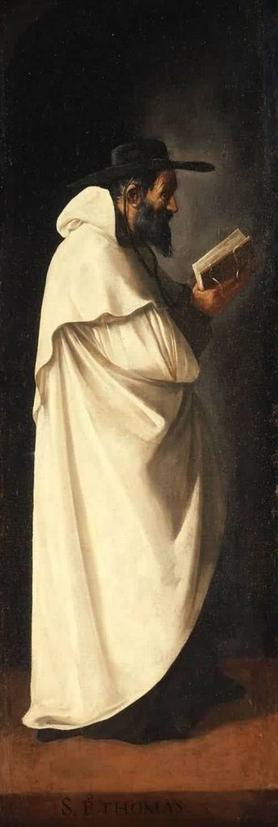
Saint Peter Thomas
Francisco de Zurbarán (Spanish, 1598–1664)
Oil on canvas, after 1634
Museum of Fine Arts, Boston

Catholic Church 1993, Proper of the Liturgy of the Hours of the Order of the Brothers of the Blessed Virgin Mary of Mount Carmel and the Order of Discalced Carmelites (Rev. and augm.), Institutum Carmelitanum, Rome.

#bishop #Carmelites #LiturgyOfTheHours #optionalMemorial #StPeterThomas

Sts. Peter Thomas & Andrew Corsini: Peacemakers & Pastors

Saints Peter Thomas and Andrew Corsini are celebrated for their lives of extraordinary service to the Church and their unwavering dedication to peace. As Carmelites, they embodied the Order’s mission through their work as pastors and mediators in some of history’s most challenging times.

In this episode of the Carmelite Quotes podcast, we explore their inspiring stories, highlighting their impact as peacemakers and shepherds of souls. We also take a closer look at the beautiful artistic depictions that preserve their legacies: Francisco de Zurbarán’s portrait of St. Peter Thomas and Guido Reni’s painting of St. Andrew Corsini.

Listen and discover how these saints’ lives and the art that honors them continue to inspire us to seek holiness.

https://open.spotify.com/episode/69gje4AaEAGnMH2mtV2Pvu?si=0VQYGxsqSdKMwBLV-d1SoQ

Featured image: DALL-E imagines a 14th-century inspired design with Gothic elements: soft arches, faint stained glass patterns, and warm earthy tones, evoking illuminated manuscripts. Image credit: DALL-E / OpenAI (Some rights reserved), with customizations by Carmelite Quotes

#art #pastor #peacemaker #Podcast #StAndrewCorsini #StPeterThomas

Saint Peter Thomas

Quote of the day, 8 January: St. Peter Thomas

As the feast of Christmas drew near, my father presided in person at the divine services. In the middle of the night which ushered in the feast he made his way from the Car­melite monastery where he was staying to the cathedral of Famagosta for the solemn celebration of Matins. He cele­brated with full solemnity the three Masses of Christmas, but was affected by the cold and caught an infection in the throat, for he was weakened by fasting and vigils and wore only light clothing, following the example of the holy fathers of the desert.

During the following days he offered Mass daily but was evidently trying to conceal his illness. On the Tuesday the fever became critical. He made a general and particular con­fession, and spoke affectionately with his household. Then turning to the cross he adored and kissed it, and with joined hands fervently asked forgiveness of all his confreres, a ges­ture which moved them to tears.

“My brothers and friends,” he said, “what toils and dangers you have met with in my service—hunger and thirst, cold and unexpected trials. I have never given you the recognition or the recompense you deserve, and yet you were kind enough to bear with me and my shortcomings. How often for me you faced real risk of your lives! How can I repay you? Forgive me; I beg you to forgive me.”

Then he asked that the sacred Body of the Lord be brought to him, and he received communion with reverence and un­feigned faith. At the end of that day, at the sixth hour of the night, he asked that the bishop of Laodicea, who was vicar of the diocese of Famagosta, should come in his pontifical vest­ments accompanied by the clergy of the cathedral to anoint him with the oil of the sick.

Meanwhile, he summoned his own household and put on the symbols of his episcopal of­fice. Despite his weakness, he sought out the office of anoint­ing with his own hand and, having found the right place, followed attentively the preliminary prayers. After this, he lay down on some sackcloth spread on the ground and wait­ed calmly for the arrival of the bishop.

When they heard the bishop coming with all his clergy he began to recite the penitential psalms in a loud clear voice suggestive of a man in full health: “Lord, rebuke me not in your anger.” With those around him making the responses he continued till about halfway through the seven psalms. At last, however, his strength gave out, though his mind re­mained clear, and he signalled to his vicar-bishop to join in and support him, and thus the whole seven psalms were completed.

As the vicar anointed him with the holy oil he managed to make all the responses of the ritual, striving to keep from the eyes of others the threadbare tunic and scap­ular he always wore. When the anointing was finished, my father devoutly recit­ed the Confiteor and received absolution from the bishop. He humbly asked forgiveness of him, his household and all the assisting clergy if he had in any way offended them in the exercise of his office; and at the same time he requested them to ask on his behalf the same pardon of all the inhab­itants of Cyprus and elsewhere.

Finally, he gave up his soul to the God who made him. It was the sixth day of January in the year of our salvation thirteen hundred and sixty-six.

Philip of Mézières, O.Carm.

A reading from the Life of St. Peter Thomas by his secretary, ch. 6

Catholic Church 1993, Proper of the Liturgy of the Hours of the Order of the Brothers of the Blessed Virgin Mary of Mount Carmel and the Order of Discalced Carmelites (Rev. and augm.), Institutum Carmelitanum, Rome.

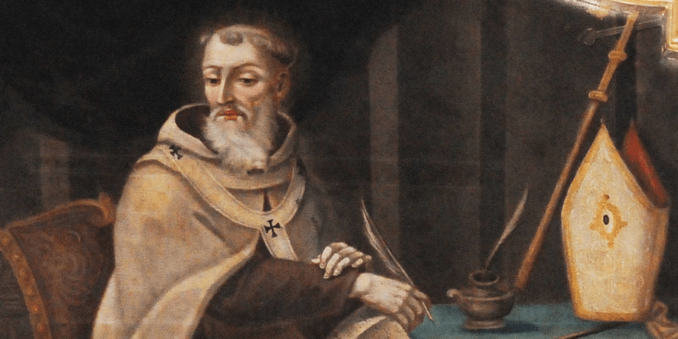
Featured image: Detail from the portrait of St. Peter Thomas in the Carmelite Church of Braga, Portugal. Image credit: José Goncalves / Wikimedia Commons (Some rights reserved)

#deathAndDying #forgiveness #lastWords #pardon #sacraments #StPeterThomas

On January 6, 1366, St. Peter Thomas received the sacraments with devotion and humbly asked forgiveness before surrendering his soul to God. #StPeterThomas

http://carmelitequotes.blog/2025/01/07/piertommaso25/

Quote of the day, 8 January: St. Peter Thomas

St. Peter Thomas, exemplified humility and holiness in his final days. On January 6, 1366, he sought forgiveness from his confreres, received the sacraments with devotion, and surrendered his soul …

Carmelite Quotes

8 January: St. Peter Thomas

January 8
SAINT PETER THOMAS
Bishop

Optional Memorial

Born about 1305 in southern Perigord in France, Peter Thomas entered the Carmelites when he was twenty-one. He was chosen by the Order as its procurator general to the Papal Court at Avignon in 1345. After being made bishop of Patti and Lipari in 1354, he was entrusted with many papal missions to promote peace and unity with the Eastern Churches. He was translated to the see of Corone in the Peloponnesus in 1359 and made Papal Legate for the East. In 1363, he was appointed Archbishop of Crete and in 1364 Latin Patriarch of Constantinople. He won a reputation as an apostle of church unity before he died at Famagosta on Cyprus in 1366.

From the Common of Pastors

Office of Readings

The First Reading
1 Timothy 1:1-7, 15-19, 2:1-8

A reading from the First Letter of St. Paul to Timothy

The calling of a pastor

From Paul, apostle of Christ Jesus appointed by the command of God our savior and of Christ Jesus our hope, to Timothy, true child of mine in the faith; wishing you grace, mercy and peace from God the Father and from Christ Jesus our Lord.

As I asked you when I was leaving for Macedonia, please stay at Ephesus, to insist that certain people stop teaching strange doctrines and taking notice of myths and endless genealogies; these things are only likely to raise irrelevant doubts instead of furthering the design of God which are revealed in faith. The only purpose of this instruction is that there should be love, coming out of a pure heart, a clear conscience and a sincere faith. There are some people who have gone off the straight course and taken a road that leads to empty speculation; they claim to be doctors of the Law, but they understand neither the arguments they are using nor the opinions they are upholding.

Here is a saying that you can rely on and nobody should doubt: that Christ Jesus came into the world to save sinners. I myself am the greatest of them; and if mercy has been shown to me, it is because Jesus Christ meant to make me the greatest evidence of his inexhaustible patience for all the other people who would later have to trust in him to come to eternal life. To the eternal King, the undying, invisible and only God, be honor and glory for ever and ever. Amen.

Timothy, my son, these are the instructions that I am giving you: I ask you to remember the words once spoken over you by the prophets, and taking them to heart to fight like a good soldier with faith and a good conscience for your weapons. Some people have put conscience aside and wrecked their faith in consequence.

My advice is that, first of all, there should be prayers offered for everyone — petitions, intercessions and thanksgiving — and especially for kings and others in authority, so that we may be able to live religious and reverent lives in peace and quiet. To do this is right, and will please God our Savior: he wants everyone to be saved and reach full knowledge of the truth. For there is only one God, and there is only one mediator between God and mankind, himself a man, Christ Jesus, who sacrificed himself as a ransom for them all. He is the evidence of this, sent at the appointed time, and I have been named a herald and apostle of it and — I am telling the truth and no lie — a teacher of the faith and the truth to the pagans.

In every place, then, I want the men to lift their hands up reverently in prayer, with no anger or argument.

Responsory

R/. Bear with one another in love; do all that you can to preserve the unity of the Spirit by the peace that binds you together; there is one body and one Spirit, * just as you were all called into one and the same hope when you were called.
V/. A servant of the Lord is to aim for holiness and faith, love, and peace, in union with all those who call on the Lord with pure minds; * just as you were all called into one and the same hope when you were called.

The Second Reading
Bk I, Ch 6

A reading from The Book of the Institution of the First Monks

Love your neighbor as yourself

The Lord says, “The man who hears My commandments and keeps them, he it is who loves Me.” And the first of all commandments is: “Hear, O Israel: The Lord our God is one Lord; and you shall love the Lord your God with all your heart, and with all your soul, and with all your might. This is the greatest and first commandment.” This cannot be observed without love of neighbor, because “he who does not love his brother whom he has seen, cannot love God whom he has not seen;” “and the second commandment is like it. You shall love your neighbor as yourself,” namely, in the things and for the reason that you love yourself. “His soul hates him who loves violence,” says the Psalmist. Therefore, love your neighbor as yourself in good and not in evil, and “whatever you wish that men would do to you, do so to them” and “what you hate, do not do to anyone.” Thus, you must love your neighbor, and so act that he becomes just if he is wicked, or remains just if he is good.

Again you must love yourself, not because of yourself, but because of God. Whatever is loved because of itself is thus made a source of joy and a happy life, the hope of attaining which is comforting even on earth. But you must not place the hope of a blessed life in yourself or another man. “Cursed is the man who trusts in man and makes flesh his arm, whose heart turns away from the Lord.” Therefore, you must make the Lord the source of your joy and the happy life, as the apostle says: “But now that you have been set free from sin and have become slaves of God, the return you get is sanctification and its end, eternal life in Christ Jesus our Lord.”

If you understand this clearly, you must love God because of Himself, and yourself, not because of yourself, but because of God; and, since you must love your neighbor as yourself, you must love him, not because of himself, nor because of yourself, but because of God, and what else is this but to love God in your neighbor? “By this we know that we love the children of God, when we love God and obey His commandment.” In the preparation of your soul you do all of this if you love God because of Himself and your neighbor as yourself because of God. “On these two commandments depend all the law and the prophets.”

Responsory

R/. With all our hearts we desired nothing better than to share with you our own lives, as well as God’s gospel, * so greatly had we learned to love you.
V/. My little children, I am in travail over you afresh, until I can see Christ’s image formed in you, * so greatly had we learned to love you.

Canticle of Zechariah

Ant. I am the good shepherd; I lay down my life for my sheep; and there shall be one flock and one shepherd.

Prayer

Lord,
You inspired in Your bishop St. Peter Thomas
an intense desire to promote peace and Christian unity.
Following His example
may we live steadfast in the faith
and work perseveringly for peace.

We ask this through Our Lord Jesus Christ, Your Son,
who lives and reigns with You and the Holy Spirit,
God, for ever and ever.

Canticle of Mary

Ant. May the peace of Christ fill your hearts with joy, that peace to which all of you are called as one body.

Saint Peter Thomas
Francisco de Zurbarán (Spanish, 1598–1664)
Oil on canvas, after 1634
Museum of Fine Arts, Boston

Catholic Church 1993, Proper of the Liturgy of the Hours of the Order of the Brothers of the Blessed Virgin Mary of Mount Carmel and the Order of Discalced Carmelites (Rev. and augm.), Institutum Carmelitanum, Rome.

#bishop #Carmelites #LiturgyOfTheHours #optionalMemorial #StPeterThomas

Saint Peter Thomas