
The 2-Degree Shift: How Small Choices Build Unshakable Strength

896 words, 5 minutes read time.

“Rather train yourself for godliness; for while bodily training is of some value, godliness is of value in every way, as it holds promise for the present life and also for the life to come.” — 1 Timothy 4:7b-8 (ESV)

The Illustration of the Navigator

In navigation, there is a concept known as the “1-in-60 rule.” It states that if a pilot or a captain is off course by just one degree, after sixty miles, they will be exactly one mile away from their target. On a short trip, a one-degree error is a minor nuisance. On a journey across the Atlantic or into deep space, that tiny, microscopic shift determines whether you reach your destination or vanish into the void.

For a man following Christ, spiritual life rarely fails because of one massive, intentional leap into a chasm. Instead, it fails through a series of “1-degree” compromises—small choices made in the dark or in the mundane moments of a Tuesday afternoon. Conversely, spiritual strength is not built by waiting for a “Goliath” to slay; it is built by the discipline of the small shift toward the Father, day after day, until the trajectory of the soul is unshakeable.

The Spiritual Lesson: Training vs. Trying

In 1 Timothy, the Apostle Paul uses the Greek word gymnazō—the root of our word “gymnasium”—to describe the pursuit of godliness. He isn’t telling Timothy to “try harder” to be a good person. He is telling him to train.

There is a profound difference between trying and training. “Trying” is what we do when the crisis hits—it is a frantic, white-knuckled attempt to use willpower to overcome a temptation or a trial. “Training” is the intentional arrangement of our daily rhythms so that we have the strength to do what we cannot do by willpower alone.

When a man chooses to open the Word for ten minutes instead of scrolling through his phone, or when he chooses to offer a word of grace to a colleague instead of a sharp critique, he is performing a spiritual “rep.” These micro-obediences are the mortar between the bricks of a man’s character. We often overestimate the importance of one “big” spiritual experience and underestimate the power of ten thousand small, faithful choices. If you haven’t built the muscle of obedience in the small things, you will find your spiritual frame buckling under the pressure of the big things.

The “easy yoke” of Jesus is not a result of a lack of effort; it is the result of a life lived in a specific direction. Discipline is not about earning God’s favor—we already have that through Christ. Discipline is about capacity. It is about keeping the channels of our hearts clear so that the Holy Spirit can move through us without being blocked by the debris of a thousand small, selfish compromises.

Conclusion and Call to Action

The man you will be ten years from now is being formed by the 2-degree shifts you make today. You do not need a mountain-top experience to grow; you need a consistent “yes” to the Holy Spirit in the ordinary.

Your Challenge: Identify one “small” area of your life—your first five minutes of the day, your evening routine, or your speech with your family—where you have drifted a few degrees off course. Commit today to a “micro-obedience”: one specific, disciplined action you will take this week to point your ship back toward the True North of Christ.

A Closing Prayer

Heavenly Father, I thank You that You meet me in the mundane moments of my life. I confess that I often wait for a “big” moment to prove my faith while neglecting the small opportunities You give me to grow. Grant me the discipline to train for godliness. Strengthen my will in the quiet choices that no one sees, so that my life might be a firm foundation for Your glory. Amen.

Reflection & Discussion Questions

  • Where in your life are you currently “trying” (using willpower) instead of “training” (building habits)?
  • What is one “1-degree” compromise that has slowly crept into your daily routine?
  • Why is it harder for men to value “quiet discipline” than “heroic action”?
  • How does the truth that we are already “favored in Christ” change your motivation for being disciplined?
  • What is one “micro-obedience” you can commit to starting tomorrow morning?
  • Call to Action

    If this devotional encouraged you, don’t just scroll on. Subscribe for more devotionals, share a comment about what God is teaching you, or reach out and tell me what you’re reflecting on today. Let’s grow in faith together.

    D. Bryan King

    Sources

    Disclaimer:

    The views and opinions expressed in this post are solely those of the author. The information provided is based on personal research, experience, and understanding of the subject matter at the time of writing. Readers should consult relevant experts or authorities for specific guidance related to their unique situations.

    #1Timothy478 #bibleStudyHabits #biblicalDiscipline #biblicalManhood #biblicalWisdom #buildingALegacy #buildingSpiritualStrength #characterDevelopment #christianCharacter #ChristianDevotion #ChristianDiscipleship #ChristianEthics #ChristianGrowth #ChristianHabits #ChristianIntegrity #ChristianLeadership #ChristianLiving #consistencyInFaith #dailyDevotionsForMen #dailySanctification #discipleshipTools #disciplineOfTheHeart #faithDevelopment #faithHabits #godliness #godlyHabits #holiness #intentionalChristianity #intentionalLiving #lordshipOfChrist #maleSpirituality #maturingInFaith #menOfFaith #microObedience #morningRoutineForMen #narrowPath #ObedienceToGod #overcomingTemptation #pastoralAdvice #practicalFaith #prayerLife #smallChoices #SpiritualDepth #spiritualDisciplineForMen #spiritualEndurance #spiritualFocus #spiritualFormation #spiritualGrit #spiritualGrowthForMen #spiritualHealth #spiritualMuscle #spiritualPersistence #spiritualTraining #spiritualVitality #spiritualWarfare #strengthInChrist #trainingForGodliness #unshakableFaith #walkingWithGod
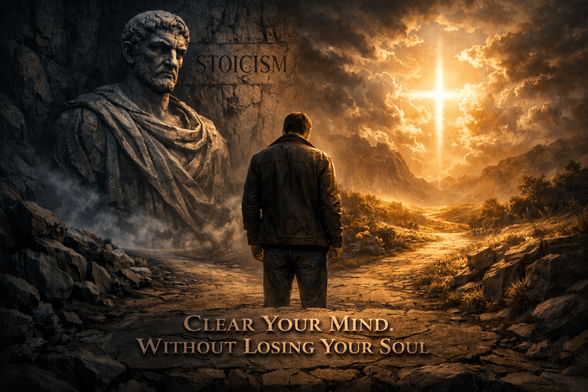
    Clear Your Mind Without Losing Your Soul: Why Jesus Succeeds Where Stoicism Stops

    1,230 words, 7 minutes read time.

    Why Modern Men Feel Mentally Under Siege

    There’s a reason so many men today feel like their minds are under constant attack. We wake up already behind, already reacting, already measuring ourselves against lives we don’t live and standards we didn’t choose. Notifications hit before our feet touch the floor. Old regrets resurface at night like ghosts with unfinished business, replaying conversations, decisions, and failures on a loop. Anxiety no longer feels like a medical condition reserved for the fragile; it feels like the default operating system for modern life. In that relentless mental noise, it’s not surprising that men go looking for anything that promises order, clarity, and strength—something that can quiet the chaos without requiring vulnerability.

    Why Stoicism Appeals to the Modern Mind

    Into that chaos, Stoicism makes a compelling pitch. And to be clear from the outset, there is much within Stoic thought that can be learned from. Stoicism takes the inner life seriously. It emphasizes discipline, attention, responsibility, and the refusal to be ruled by impulse. Those are not small virtues, and dismissing them outright would be intellectually lazy. But where Stoicism ultimately points inward for the solution, I believe the answer lies elsewhere. Stoicism promises calm without faith, discipline without dependence, and control without vulnerability. For men tired of emotional fragility and spiritual ambiguity, it sounds strong, clean, and rational. It tells you the problem isn’t the world. The problem is your reaction to it. Christianity agrees that the mind matters—but it insists that lasting peace does not come from mastering the self. It comes from surrendering the self to God.

    Stoicism Was Forged in Hard Times—And That Matters

    To be fair, Stoicism is not naïve or shallow. It was forged in a brutal world of war, exile, disease, and political instability. Marcus Aurelius ruled an empire during plagues and invasions. Epictetus lived as a slave before becoming a teacher of philosophy. These were not men lounging in ivory towers offering abstract self-help advice. They were men under pressure, searching for a kind of peace that could not be stripped away by external circumstances. That historical context explains why Stoicism still resonates today. We recognize ourselves in their instability, and we admire their refusal to collapse under it.

    Where Stoicism Gets the Diagnosis Right—but the Cure Wrong

    Here is the uncomfortable truth. Stoicism correctly identifies the battlefield of the mind, but it misidentifies the source of power. It diagnoses the disease accurately while prescribing a treatment that ultimately collapses under the weight of human limitation. Stoicism believes the mind can be trained into sovereignty through awareness, discipline, and detachment. Christianity does not deny the need for discipline, but it denies the myth of self-sufficiency. The human will, no matter how refined, is not strong enough to save itself from itself.

    Self-Mastery Versus Surrender to God

    Stoicism teaches you to stand unmoved at the center of the storm. Jesus teaches you to kneel—and in kneeling, to find a kind of rest Stoicism can never produce. That difference is not semantic; it is foundational. Stoicism aims for independence from circumstance. Christianity aims for dependence on God. The Stoics were right about one thing: the mind matters. Where they went wrong is believing the mind could redeem itself through effort alone.

    Attention, Rumination, and the Power of Thought

    Stoicism’s central insight is that attention feeds suffering. Obsess over what you cannot control, and anxiety multiplies. Rehearse the past, and bitterness deepens. Fixate on imagined futures, and fear becomes prophetic. Modern neuroscience confirms this pattern. Rumination amplifies stress responses. Attention strengthens neural pathways. What you rehearse, you reinforce. On this point, Stoicism and modern psychology shake hands. But agreement on mechanism does not equal agreement on meaning.

    Mental Discipline Without a Throne for the Self

    The Stoic solution is mental discipline. Observe thoughts without attachment. Redirect attention toward what is within your control. Detach emotion from identity. In short, become sovereign over your internal world. Christianity does not reject discipline, but it refuses to crown the self as king. Scripture presents the mind not as an autonomous observer but as contested territory. The apostle Paul describes thoughts as something that must be actively captured and submitted, not merely watched as they drift by. The mind is not neutral. It is bent. It wanders. Left to itself, it does not become calm; it becomes clever in self-deception.

    “You Are Not Your Thoughts” — A Half-Truth

    Stoicism says you are not your thoughts; therefore, do not be disturbed by them. Christianity responds that your thoughts reveal what you love, fear, and trust; therefore, they must be confronted and transformed. That difference matters more than it appears. Passive detachment can produce numbness, but it cannot produce repentance, wisdom, or holiness. Christianity does not merely ask you to observe your thoughts. It asks you to judge them in the light of truth.

    Anger, Fear, and Suffering: Two Very Different Roads

    The Stoic approach to anger is detachment. The Christian approach is discernment followed by repentance or righteous action. The Stoic approach to fear is acceptance. The Christian approach is trust anchored in the character of God. The Stoic approach to suffering is endurance. The Christian approach is endurance infused with hope rooted in resurrection. Stoicism seeks order. Christianity seeks obedience. One wants equilibrium; the other wants alignment with reality as God defines it.

    The Quiet Overreach of Stoic Self-Confidence

    This is where Stoicism quietly overreaches. It assumes that with enough awareness and training, the human will can govern itself. History, Scripture, and lived experience all disagree. If self-control were sufficient, humanity would have solved itself long ago. The Bible does not flatter our mental strength. It assumes weakness and builds grace into the system. Transformation is not self-authored; it is received, practiced, and sustained by the Spirit of God.

    Why Stoic Calm Cracks Under Real Weight

    This is why Stoic calm often fractures under real trauma, grief, or moral failure. When control is the foundation, collapse becomes catastrophic. Christianity offers something sturdier. It offers rest that exists even when control is lost. Jesus does not say, “Master your thoughts and you will find peace.” He says, “Come to me, all who are weary, and I will give you rest.” That is not an invitation to passivity. It is an invitation to reorder authority.

    Christian Mental Discipline Starts With Surrender

    Christian mental discipline begins with surrender, not assertion. The mind is renewed not by isolation but by exposure to truth. Scripture does not merely replace bad thoughts with neutral ones; it replaces lies with reality. That is why biblical renewal is not visualization or redirection. It is confrontation. Truth crowds out distortion. Worship displaces anxiety. Prayer redirects attention not inward but upward.

    Suffering, Preparation, and the Larger Story

    There is also a crucial difference in how each system handles suffering. Stoicism prepares for loss by imagining it until its sting fades. Christianity prepares for suffering by placing it inside a larger story. One reduces pain through mental rehearsal. The other redeems pain through meaning. Stoicism can make you resilient. Christianity makes you anchored.

    Focus, Distraction, and Modern Overstimulation

    The modern man doesn’t need more detachment. He needs clarity rooted in something bigger than his own mental stamina. Attention discipline matters, but attention must be ordered under truth, not autonomy. Focus without purpose becomes obsession. Calm without hope becomes numbness. Jesus does not promise the absence of storms. He promises presence within them. That distinction changes everything.

    Grace Does Not Replace Discipline—It Redirects It

    When you submit your mind to Christ, you are not abandoning discipline. You are relocating it. Thoughts are still examined. Distractions are still resisted. Focus is still cultivated. But the source of strength is no longer internal grit. It is grace. That grace does not make men weak. It makes them honest.

    The Goal Is Not an Empty Mind, but a Faithful One

    The goal is not an empty mind. It is a faithful one. A mind aligned with reality. A mind that knows when to fight, when to rest, and when to trust. Stoicism offers silence. Jesus offers peace. One teaches you to stand alone. The other invites you to walk with God. And that is why, for all its insights, Stoicism will always stop short of what the human soul actually needs.

    Call to Action

    If this article challenged you, sharpened you, or unsettled you in a good way, don’t let the thought drift away unused. Subscribe for more, share a comment about what God is teaching you, or reach out and tell me what you’re reflecting on today. The mind matters—but only when it’s anchored to something strong enough to hold it.

    D. Bryan King

    Sources

    Disclaimer:

    The views and opinions expressed in this post are solely those of the author. The information provided is based on personal research, experience, and understanding of the subject matter at the time of writing. Readers should consult relevant experts or authorities for specific guidance related to their unique situations.

    #anxietyAndFaith #attentionDiscipline #biblicalCounselingConcepts #biblicalFocus #biblicalMindfulness #biblicalWorldview #ChristianApologetics #christianContentMarketing #ChristianEthics #ChristianGrowth #ChristianMasculinity #ChristianMeditation #christianMentalDiscipline #christianPhilosophy #christianPhilosophyBlog #ChristianReflection #christianSelfDiscipline #ChristianSpirituality #ChristianTruth #ChristianWisdom #ChristianWorldview #christianWorldviewBlog #clearYourMind #controllingThoughts #disciplineAndGrace #faithAndReason #faithBasedMindset #faithFocusedMindset #faithOverSelfControl #gospelCenteredLiving #gospelTruth #jesusAndMentalHealth #jesusOverStoicism #maleChristianAudience #menAndSpirituality #mentalClarityFaith #mentalPeaceJesus #mindRenewalScripture #overcomingAnxietyBiblically #peaceThroughChrist #philosophyAndFaith #philosophyForMen #practicalChristianLiving #renewingTheMind #scriptureBasedLiving #spiritualFocus #spiritualFormation #spiritualResilience #spiritualWarfareMind #stoicPhilosophyAnalysis #stoicismAlternatives #stoicismCritique #stoicismExplained #stoicismVsChristianity #surrenderToGod #theologyOfTheMind #thoughtDiscipline #thoughtLife #toxicThoughts

    PRAYER FOR MIDWEEK STRENGTH

    🔥 Midweek strength determines weekly victory. This Morning Fire prayer renews energy, restores focus, and enforces consistency for the rest of the week. #PastorWoleAdenubi, #DPFireStreams, #DangerousPrayer, #MorningFire, #MidweekStrength, #WednesdayPrayer, #RenewedStrength, #PrayerWarriors, #FaithConsistency, #SpiritualFocus,

    https://dangerousprayer.wordpress.com/2026/01/07/prayer-for-midweek-strength/?utm_source=mastodon&utm_medium=jetpack_social

    PRAYER FOR MIDWEEK STRENGTH

    🔥 Midweek strength determines weekly victory. This Morning Fire prayer renews energy, restores focus, and enforces consistency for the rest of the week. #PastorWoleAdenubi, #DPFireStreams, #Dangero…

    Dangerous Prayers

    The Plow Hand

    As the Day Ends

    Scripture: “No one who puts a hand to the plow and looks back is fit for service in the kingdom of God.”Luke 9:62

    As the evening quiets the noise of the day, this verse invites us into reflection. The words of Jesus in Luke 9:62 are both challenging and comforting. They remind us that discipleship requires direction. It’s not about perfection, but focus—keeping our eyes on the Lord even when our hearts are tempted to look behind us. “No one who puts a hand to the plow and looks back,” He said, “is fit for service in the kingdom of God.” The image is vivid. A plowman who glances backward veers off course; his furrows wander, and the field becomes uneven. Likewise, a believer distracted by the past—by regret, nostalgia, or fear—risks losing sight of God’s present calling.

    As this day closes, take a moment to examine where your gaze has been. Have your thoughts lingered on what could have been? Have you found yourself glancing over your shoulder at old wounds or former comforts? The Lord doesn’t condemn us for our human tendency to look back, but He does invite us to lift our eyes to what lies ahead. When Jesus spoke these words, He was on His way to Jerusalem—to the cross. His face, as Luke later writes, was “set toward” the path of obedience. He calls us to that same steadfastness. Our plow is whatever work He has entrusted to us today—our families, our service, our prayers, our faithfulness.

    At day’s end, the fields of our life often show uneven lines—moments of distraction, seasons of fatigue. Yet God is merciful. He doesn’t discard the imperfect plowman; He strengthens his grip and redirects his gaze. The work of the Kingdom is not about flawless lines—it’s about faithful direction. When we trust the One guiding our steps, we find rest, even in the furrows. As you close your eyes tonight, remember: you are not called to fix the past, only to be faithful in the present. Keep your hand on the plow, and let the Lord steer your path toward peace.


    Triune Prayer

    To the Heavenly Father:
    Father, thank You for the gift of this day and for the work You placed in my hands. I confess that at times my eyes have wandered—toward worry, toward regret, toward things beyond my control. But tonight, I choose to rest in Your faithfulness. You are the God who steadies my hand and straightens my path. I thank You for Your patience when I falter, and for Your grace that never runs dry. Teach me, even in the quiet of this evening, to trust the direction of Your will. I release the burdens I tried to carry alone and place them back into Your strong and gentle hands.

    To the Son:
    Lord Jesus, You set Your face toward the cross without turning back. You showed me what single-hearted obedience looks like, even when the road is hard. Forgive me for the times I’ve hesitated in following You—when comfort seemed easier than commitment, or fear whispered louder than faith. You never looked back, even when the path led through suffering. Help me walk that same way, eyes fixed on You. Thank You for walking beside me today, for forgiving my missteps, and for reminding me that Your yoke is easy and Your burden light. May I sleep tonight with gratitude for Your finished work, confident that tomorrow begins again in grace.

    To the Holy Spirit:
    Holy Spirit, gentle Guide and constant Companion, quiet my restless mind as the day ends. Teach me to listen more than I speak, to surrender more than I strive. I need Your wisdom to discern where my heart still looks backward—to old fears, unhealed memories, or misplaced affections. Fill me with renewed courage to keep moving forward in faith. Whisper truth where doubt has lingered. Replace anxiety with peace, distraction with devotion, and fatigue with rest. Overshadow my night with Your comfort and fill my dreams with reminders of Your presence. Let Your light lead me into the dawn of a new day lived with purpose and joy. Amen.


    Thought for the Day

    Faithfulness is not about how straight our lines appear—it’s about keeping our hands on the plow and our eyes on Christ. Don’t let yesterday’s regrets or tomorrow’s worries steal tonight’s peace. The God who called you this morning will keep you through the night and guide you again tomorrow.

    Thank you for your service to the Lord’s work today and every day. May your rest be deep, your peace unshaken, and your heart renewed for the journey ahead.


    For further reflection on following Jesus with focus and faith, read What Does It Mean to Put Your Hand to the Plow? on Crosswalk.com .


    FEEL FREE TO COMMENT SHARE SUBSCRIBE


    #christianPerseverance #dailyReflection #discipleship #eveningDevotion #faithJourney #followingJesus #luke962 #restingInGod #spiritualFocus #spiritualRenewal