Bryan King
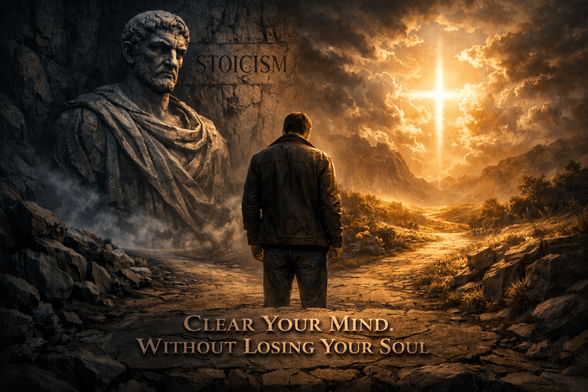
Clear Your Mind Without Losing Your Soul: Why Jesus Succeeds Where Stoicism Stops
1,230 words, 7 minutes read time.
Why Modern Men Feel Mentally Under Siege
There’s a reason so many men today feel like their minds are under constant attack. We wake up already behind, already reacting, already measuring ourselves against lives we don’t live and standards we didn’t choose. Notifications hit before our feet touch the floor. Old regrets resurface at night like ghosts with unfinished business, replaying conversations, decisions, and failures on a loop. Anxiety no longer feels like a medical condition reserved for the fragile; it feels like the default operating system for modern life. In that relentless mental noise, it’s not surprising that men go looking for anything that promises order, clarity, and strength—something that can quiet the chaos without requiring vulnerability.
Why Stoicism Appeals to the Modern Mind
Into that chaos, Stoicism makes a compelling pitch. And to be clear from the outset, there is much within Stoic thought that can be learned from. Stoicism takes the inner life seriously. It emphasizes discipline, attention, responsibility, and the refusal to be ruled by impulse. Those are not small virtues, and dismissing them outright would be intellectually lazy. But where Stoicism ultimately points inward for the solution, I believe the answer lies elsewhere. Stoicism promises calm without faith, discipline without dependence, and control without vulnerability. For men tired of emotional fragility and spiritual ambiguity, it sounds strong, clean, and rational. It tells you the problem isn’t the world. The problem is your reaction to it. Christianity agrees that the mind matters—but it insists that lasting peace does not come from mastering the self. It comes from surrendering the self to God.
Stoicism Was Forged in Hard Times—And That Matters
To be fair, Stoicism is not naïve or shallow. It was forged in a brutal world of war, exile, disease, and political instability. Marcus Aurelius ruled an empire during plagues and invasions. Epictetus lived as a slave before becoming a teacher of philosophy. These were not men lounging in ivory towers offering abstract self-help advice. They were men under pressure, searching for a kind of peace that could not be stripped away by external circumstances. That historical context explains why Stoicism still resonates today. We recognize ourselves in their instability, and we admire their refusal to collapse under it.
Where Stoicism Gets the Diagnosis Right—but the Cure Wrong
Here is the uncomfortable truth. Stoicism correctly identifies the battlefield of the mind, but it misidentifies the source of power. It diagnoses the disease accurately while prescribing a treatment that ultimately collapses under the weight of human limitation. Stoicism believes the mind can be trained into sovereignty through awareness, discipline, and detachment. Christianity does not deny the need for discipline, but it denies the myth of self-sufficiency. The human will, no matter how refined, is not strong enough to save itself from itself.
Self-Mastery Versus Surrender to God
Stoicism teaches you to stand unmoved at the center of the storm. Jesus teaches you to kneel—and in kneeling, to find a kind of rest Stoicism can never produce. That difference is not semantic; it is foundational. Stoicism aims for independence from circumstance. Christianity aims for dependence on God. The Stoics were right about one thing: the mind matters. Where they went wrong is believing the mind could redeem itself through effort alone.
Attention, Rumination, and the Power of Thought
Stoicism’s central insight is that attention feeds suffering. Obsess over what you cannot control, and anxiety multiplies. Rehearse the past, and bitterness deepens. Fixate on imagined futures, and fear becomes prophetic. Modern neuroscience confirms this pattern. Rumination amplifies stress responses. Attention strengthens neural pathways. What you rehearse, you reinforce. On this point, Stoicism and modern psychology shake hands. But agreement on mechanism does not equal agreement on meaning.
Mental Discipline Without a Throne for the Self
The Stoic solution is mental discipline. Observe thoughts without attachment. Redirect attention toward what is within your control. Detach emotion from identity. In short, become sovereign over your internal world. Christianity does not reject discipline, but it refuses to crown the self as king. Scripture presents the mind not as an autonomous observer but as contested territory. The apostle Paul describes thoughts as something that must be actively captured and submitted, not merely watched as they drift by. The mind is not neutral. It is bent. It wanders. Left to itself, it does not become calm; it becomes clever in self-deception.
“You Are Not Your Thoughts” — A Half-Truth
Stoicism says you are not your thoughts; therefore, do not be disturbed by them. Christianity responds that your thoughts reveal what you love, fear, and trust; therefore, they must be confronted and transformed. That difference matters more than it appears. Passive detachment can produce numbness, but it cannot produce repentance, wisdom, or holiness. Christianity does not merely ask you to observe your thoughts. It asks you to judge them in the light of truth.
Anger, Fear, and Suffering: Two Very Different Roads
The Stoic approach to anger is detachment. The Christian approach is discernment followed by repentance or righteous action. The Stoic approach to fear is acceptance. The Christian approach is trust anchored in the character of God. The Stoic approach to suffering is endurance. The Christian approach is endurance infused with hope rooted in resurrection. Stoicism seeks order. Christianity seeks obedience. One wants equilibrium; the other wants alignment with reality as God defines it.
The Quiet Overreach of Stoic Self-Confidence
This is where Stoicism quietly overreaches. It assumes that with enough awareness and training, the human will can govern itself. History, Scripture, and lived experience all disagree. If self-control were sufficient, humanity would have solved itself long ago. The Bible does not flatter our mental strength. It assumes weakness and builds grace into the system. Transformation is not self-authored; it is received, practiced, and sustained by the Spirit of God.
Why Stoic Calm Cracks Under Real Weight
This is why Stoic calm often fractures under real trauma, grief, or moral failure. When control is the foundation, collapse becomes catastrophic. Christianity offers something sturdier. It offers rest that exists even when control is lost. Jesus does not say, “Master your thoughts and you will find peace.” He says, “Come to me, all who are weary, and I will give you rest.” That is not an invitation to passivity. It is an invitation to reorder authority.
Christian Mental Discipline Starts With Surrender
Christian mental discipline begins with surrender, not assertion. The mind is renewed not by isolation but by exposure to truth. Scripture does not merely replace bad thoughts with neutral ones; it replaces lies with reality. That is why biblical renewal is not visualization or redirection. It is confrontation. Truth crowds out distortion. Worship displaces anxiety. Prayer redirects attention not inward but upward.
Suffering, Preparation, and the Larger Story
There is also a crucial difference in how each system handles suffering. Stoicism prepares for loss by imagining it until its sting fades. Christianity prepares for suffering by placing it inside a larger story. One reduces pain through mental rehearsal. The other redeems pain through meaning. Stoicism can make you resilient. Christianity makes you anchored.
Focus, Distraction, and Modern Overstimulation
The modern man doesn’t need more detachment. He needs clarity rooted in something bigger than his own mental stamina. Attention discipline matters, but attention must be ordered under truth, not autonomy. Focus without purpose becomes obsession. Calm without hope becomes numbness. Jesus does not promise the absence of storms. He promises presence within them. That distinction changes everything.
Grace Does Not Replace Discipline—It Redirects It
When you submit your mind to Christ, you are not abandoning discipline. You are relocating it. Thoughts are still examined. Distractions are still resisted. Focus is still cultivated. But the source of strength is no longer internal grit. It is grace. That grace does not make men weak. It makes them honest.
The Goal Is Not an Empty Mind, but a Faithful One
The goal is not an empty mind. It is a faithful one. A mind aligned with reality. A mind that knows when to fight, when to rest, and when to trust. Stoicism offers silence. Jesus offers peace. One teaches you to stand alone. The other invites you to walk with God. And that is why, for all its insights, Stoicism will always stop short of what the human soul actually needs.
Call to Action
If this article challenged you, sharpened you, or unsettled you in a good way, don’t let the thought drift away unused. Subscribe for more, share a comment about what God is teaching you, or reach out and tell me what you’re reflecting on today. The mind matters—but only when it’s anchored to something strong enough to hold it.
D. Bryan King
Sources
- The Holy Bible – Romans 12:1–2 (Renewal of the Mind)
- The Holy Bible – 2 Corinthians 10:3–5 (Taking Thoughts Captive)
- The Holy Bible – Matthew 11:28–30 (Rest for the Weary)
- Encyclopaedia Britannica – Stoicism
- Marcus Aurelius – Meditations (Public Domain)
- Epictetus – Discourses and Enchiridion (Public Domain)
- Stanford Encyclopedia of Philosophy – Stoicism
- John Piper – Battling Unbelief
- Crossway – Taking Every Thought Captive
- Ancient Faith – Christian Asceticism and the Mind
- Monergism – Sanctification and Spiritual Growth
- Psychology Today – Cognitive Discipline and Thought Awareness
Disclaimer:
The views and opinions expressed in this post are solely those of the author. The information provided is based on personal research, experience, and understanding of the subject matter at the time of writing. Readers should consult relevant experts or authorities for specific guidance related to their unique situations.
#anxietyAndFaith #attentionDiscipline #biblicalCounselingConcepts #biblicalFocus #biblicalMindfulness #biblicalWorldview #ChristianApologetics #christianContentMarketing #ChristianEthics #ChristianGrowth #ChristianMasculinity #ChristianMeditation #christianMentalDiscipline #christianPhilosophy #christianPhilosophyBlog #ChristianReflection #christianSelfDiscipline #ChristianSpirituality #ChristianTruth #ChristianWisdom #ChristianWorldview #christianWorldviewBlog #clearYourMind #controllingThoughts #disciplineAndGrace #faithAndReason #faithBasedMindset #faithFocusedMindset #faithOverSelfControl #gospelCenteredLiving #gospelTruth #jesusAndMentalHealth #jesusOverStoicism #maleChristianAudience #menAndSpirituality #mentalClarityFaith #mentalPeaceJesus #mindRenewalScripture #overcomingAnxietyBiblically #peaceThroughChrist #philosophyAndFaith #philosophyForMen #practicalChristianLiving #renewingTheMind #scriptureBasedLiving #spiritualFocus #spiritualFormation #spiritualResilience #spiritualWarfareMind #stoicPhilosophyAnalysis #stoicismAlternatives #stoicismCritique #stoicismExplained #stoicismVsChristianity #surrenderToGod #theologyOfTheMind #thoughtDiscipline #thoughtLife #toxicThoughts
 Dr. Neo