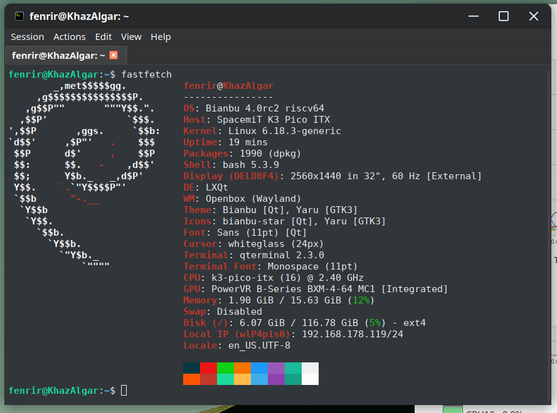
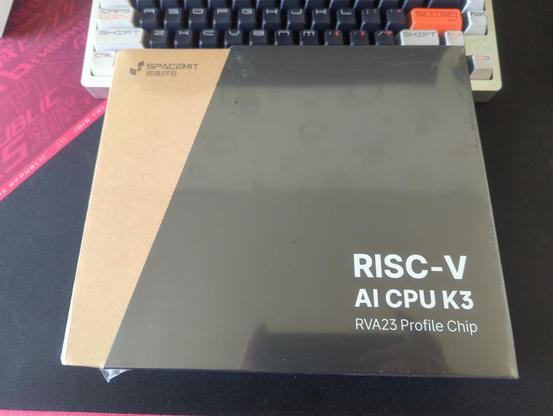
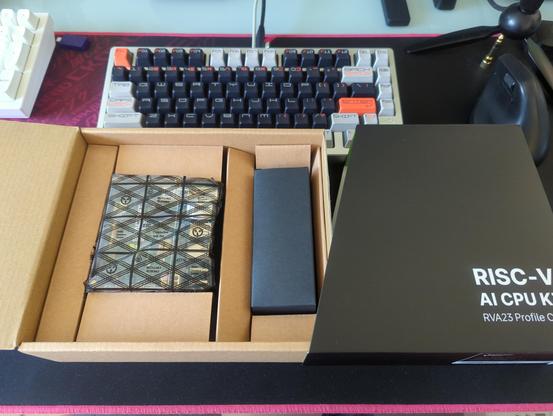
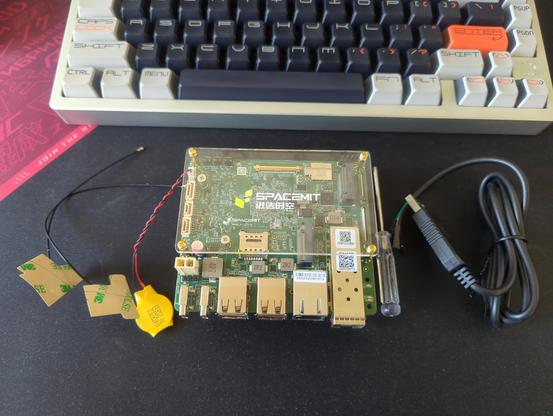
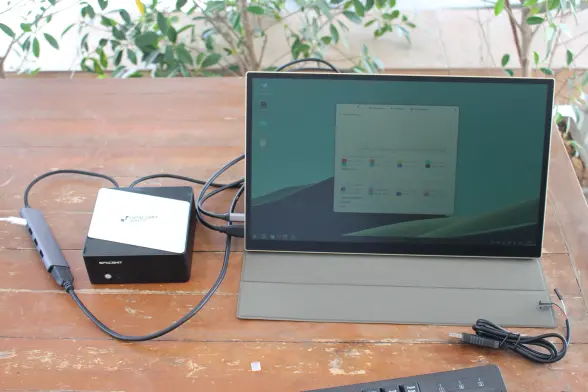
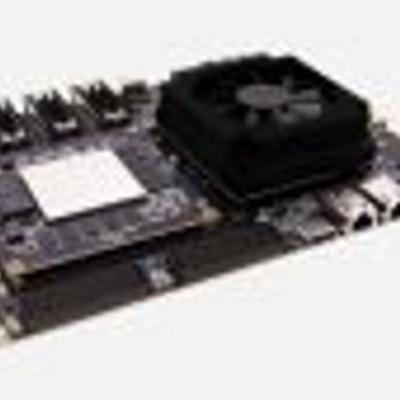
And here it is, my own #SpacemIT K3... so hyped, made sure I have a proper beefy USB charger to run it, but missed the point you need a splitter to get a video signal out of it... FFFFFF lol so proper test sadly has to wait.
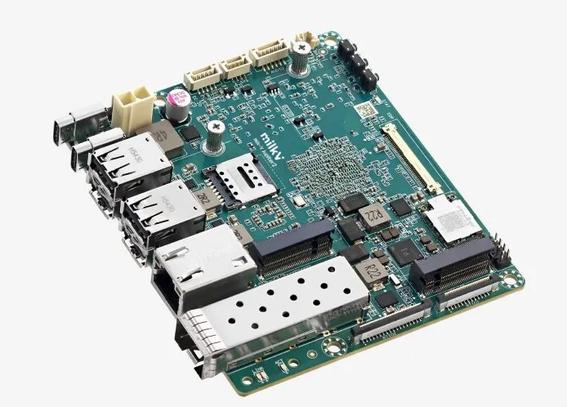
SpacemiT K3 Pico-ITX Chassis Kit Review – Part 1: Unboxing, teardown, and first boot

SpacemiT has sent me a K3 Pico-ITX Chassis Kit for review. It's based on the K3 Pico-ITX motherboard with the SpacemiT K3 16-core RISC-V Edge AI processor housed in a compatible chassis. I'll start the review with an unboxing, a teardown, and a first boot to the pre-installed Bianbu OS. In the second part of the review, I'll perform feature testing and run several benchmarks (see early K3 benchmarks for reference) to evaluate the status of the software and performance of the system. SpacemiT K3 Pico-ITX Chassis Kit unboxing I received a kit in a retail package reading "RISC-V AI CPI K3 RVA23 Profile Chip" and a UGREEN USB-C dock with a few USB-A ports, HDMI output, and 100W USB PD support. The dock will make perfect sense once we connect the system for our first boot. I was initially expecting a Pico-ITX SBC, so I was a little surprised
Firefly CSC2-N48SPK3 – A 2880 TOPS RISC-V AI server with 48 SpacemiT K3 Nodes, 48 NVMe SSDs

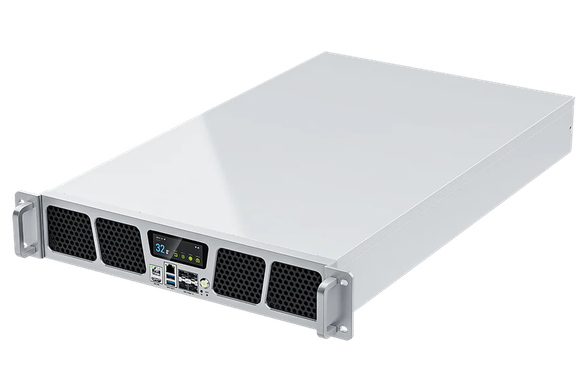
After SpacemiT officially launched the K3 Pico-ITX SBC, and the K3 chip entered volume production, an Edge AI mini PC, and a laptop motherboard (for Framework 13) have been released. To add to the list, Firefly has recently launched the CSC2-N48SPK3, a massive 2U rack-mounted server based on multiple SpacemiT K3 SoCs designed to bring RISC-V computing power to enterprise racks. While consumer devices and modular laptops are great for developers, large-scale server-side AI workloads require more powerful hardware. The CSC2-N48SPK3 addresses this with up to 48 SpacemiT K3 RISC-V compute nodes, each with an octa-core X100 SoC delivering up to 60 TOPS (Sparse) AI performance, up to 32GB LPDDR5 RAM, 128 GB UFS storage, and an optional NVMe SSD. To manage all of these nodes, Firefly relies on a Rockchip RK3588 octa-core Arm processor as the central control node. Firefly CSC2-N48SPK3 specifications: Server Form Factor – 2U rack-mounted 48 Node high-density
Start9 RISC-V Router features SpacemiT K1 SoC, runs StartWRT OpenWrt fork (Crowdfunding)

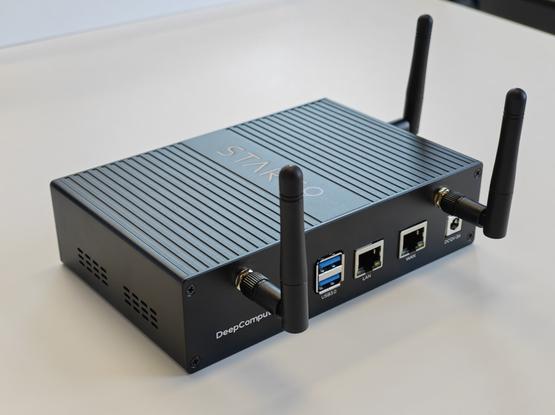
Start9's "RISC-V Router" is powered by a SpacemiT K1 octa-core RISC-V processor paired with 4GB RAM and 16GB eMMC flash, and offers dual GbE networking, as well as an AsiaRF AW7915-NP1 WiFi 6 4T4R module enabling up to 2401 Mbps combined data link. It's not exactly a high-end router, but Start9 claims it is the "most open router on the market" thanks to its RISC-V processor, OpenSBI open-source boot stack, and StartWrt operating system, a fork of OpenWrt. Start9 router specifications: SoC – SpacemiT K1 CPU – 8-core X60 RISC-V processor with single-core performance equivalent to about 1.3x the performance of an Arm Cortex-A55 GPU – Imagination IMG BXE-2-32 with support for OpenCL 3.0, OpenGL ES3.2, Vulkan 1.2 VPU – H.265, H.264, VP9, VP8 4K encoding/encoding NPU – 2.0 TOPS AI accelerator System Memory – 4GB LPDDR4 Storage 16GB eMMC flash MicroSD card slot Networking 2x Gigabit Ethernet RJ45 ports
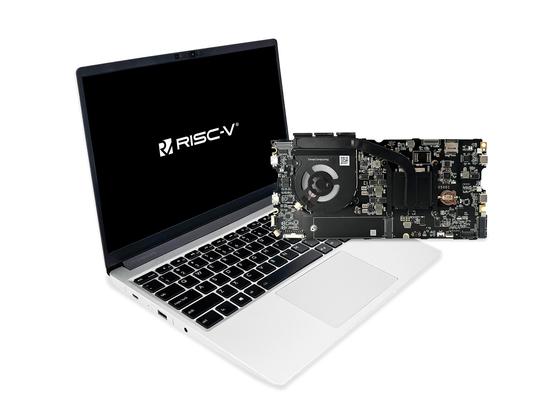
SpacemiT K3-powered DC-ROMA RISC-V motherboard III is made for the Framework Laptop 13

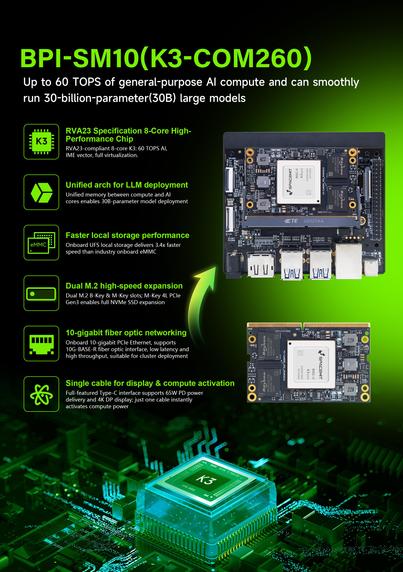
Another day, another SpacemiT K3 device is released, namely Deep Computing DC-ROMA RISC-V Mainboard III for Framework Laptop 13, following the K3 Pico-ITX SBC and K3-CoM260 (and related Jupiter 2 and Banana Pi BPI-SM10) on Monday, and the Firefly AIBOX-K3 on Tuesday. Initially launched with Intel processors, the Framework Laptop 13 repairable and modular laptop had already got a RISC-V motherboard with the StarFive JH7110-based “DC-ROMA RISC-V Mainboard” in 2024, followed by an ESWIN EIC7702X variant the next year. The third RISC-V mainboard features the octa-core K3 64-bit RISC-V SoC with up to 60 TOPS (Sparse) of AI performance, up to 32GB RAM, and an optional 1TB NVMe SSD. Specifications of the Framework Laptop 13 with DC-ROMA RISC-V Mainboard III: SoC – SpacemiT K3 CPU 8x 64-bit RISC-V X100 “big” cores clocked up to 2.4 GHz, RVA23 compliance; 130 KDMIPS performance (similar to RK3588) 8x RISC-V A100 AI Cores with
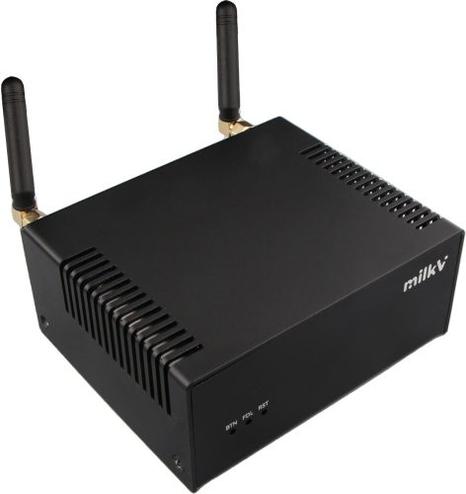
Milk-V Jupiter2 is mini PC with a SpacemiT K3 RISC-V processor
The Milk-V Jupiter2 is a compact computer powered by a SpacemiT K3 processor with an eight-core RVA23 compliant RISC-V processor, Imagination BXM-4-64-MC1 graphics, and support for up to 60 TOPS of AI performance.
Compared with the original Milk-V Jupiter, the new model should bring big CPU, GPU, and AI performance boosts. It also supports faster wired networking. But it also features a […]
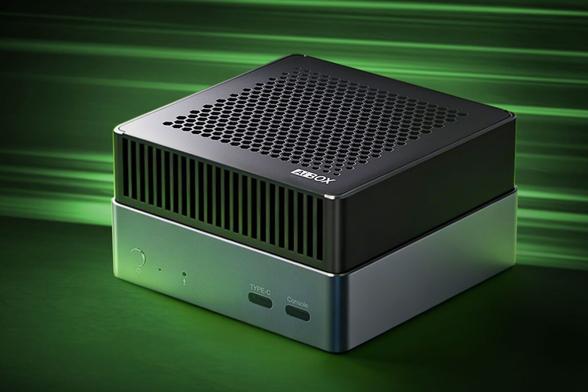
#milkV #milkVJupiter2 #riscV #spacemit #spacemitK3 Read more: https://liliputing.com/milk-v-jupiter2-is-mini-pc-with-a-spacemit-k3-risc-v-processor/Firefly AIBOX-K3 – An Edge AI mini PC powered by SpacemiT K3 RISC-V SoC

Back in July last year, SpacemiT unveiled the SpacemiT K3 SoC. After that, we saw some system information and early benchmarks come out around January this year. The company has just officially launched the K3 Pico-ITX SBC, which is now available through various distributors. Firefly has launched its own K3 hardware with the AIBOX-K3, a complete industrial-grade RISC-V edge computing box. The AIBOX-K3 Edge AI mini PC is built around the SpacemIT Key Stone K3 octa-core processor and features an integrated AI engine that delivers up to 60 TOPS of compute performance, making it suitable for local LLM inference and edge AI applications. Firefly AIBOX-K3 specifications: SoC – SpacemiT K3 CPU 8x 64-bit RISC-V X100 “big” cores clocked up to 2.4 GHz, RVA23 compliance; 130 KDMIPS performance (similar to RK3588) 8x RISC-V A100 AI Cores with support for up to 1024-bit RVV1.0 parallel computing, optimized for matrix operations. GPU – Imagination
SpacemiT K3 integrates 8-core RISC-V CPU cluster and 60 TOPS AI engine