Thank you @LIBEReurope for mentioning @tibhannover Climate Knowledge Graph (CKG) - by @mrchristian, Markus Stocker and Laura Oldenbourg - in the recent issue of LIBER INSIDER! https://mailchi.mp/libereurope/liber-insider-november-2025?e=885146fe97
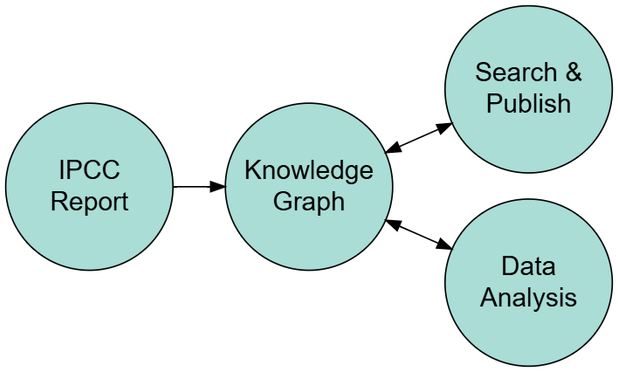
CKG is an R&D project to make a knowledge graph of the open access parts of the 10,000 page #IPCC Sixth Assessment Report (AR6) corpus. It's hosted and funded by TIB, and organised in partnership with #semanticClimate and the National Institute of Plant Genome Research (NIPGR) – India.

500: We've Run Into An Issue | Mailchimp

#blogpost 'Climate Knowledge Graph: Project Kickoff' - an R&D project for making climate change knowledge held in the IPCC Sixth Assessment Report more accessible using open science methods and FAIR data principles - AKA a knowledge graph https://blog.tib.eu/2025/10/02/climate-knowledge-graph-project-kickoff/ - big thank you for getting us here #semanticClimate @tibhannover
Journal article from myself and colleagues from #semanticClimate 'Climate Justice in Electronic Publishing: A New Approach Supporting Global South Participation' - doi: https://doi.org/10.3998/jep.7206 in @JEPub in the special issue on Publishing and Climate Justice - TL;DR using ML tools from #semanticClimate to see what EPMC 7mil OA articles and IPCC AR6 know about climate justice; contextualising bias against global south by academic publishing practices. Notebooks & data https://github.com/semanticClimate/climate-justice-lit-review
Climate Justice in Electronic Publishing: A New Approach Supporting Global South Participation

This article argues that the ways in which scholarly electronic publishing is currently carried out is inherently a climate injustice as it unnecessarily hinders participation by people from the Global South in the climate science discourse, which is further exacerbated by the reliance of publishers on PDF-oriented system architectures. We argue that mega-publishers and societies are responsible for the state of electronic publishing and hence for the resulting climate injustice. A new publishing model for electronic publishing is proposed, informed by the semantic web, hypermedia, and the software system designs of earlier technological visionaries who built and promoted global access to knowledge through granular indexing and linking. This new type of publishing remains unsupported in mainstream scholarly publishing, which renders the knowledge it contains almost unnavigable, especially in complex, fast-moving research domains such as climate science. We are members of the #semanticClimate open research group, led by young Indian scientists, and together we are working to implement this new model for the Intergovernmental Panel on Climate Change (IPCC) climate reports. The IPCC Sixth Assessment Report (AR6) is the most authoritative summation of climate change scientific knowledge and influences the acknowledgment of climate justice globally in policy for addressing climate change. As do other research bodies, the IPCC uses conventional electronic publishing workflows (centered on the PDF), but this holds back its potential wider reach. Our research intends to demonstrate how such reports could be made more accessible. The research we present in this article includes a semi-automated literature search on the topic of “climate justice” and asks the following questions: What does the open access scholarly corpus know about this topic, and what is the shape of the discourse as it exists in this literature? In which papers and journals has the topic appeared, and reaching back several decades, how often have the term and related terms been mentioned? We will also demonstrate the open-source tools that we will use for future work to create the Climate Knowledge Graph (ClimateKG), which aims to make the IPCC report globally accessible. The research presented in this article covers an experiment carried out by the #semanticClimate team, which focused on searching and computationally retrieving the open access scholarly research corpus from Europe PubMed Central (6.9 million open access papers) as well as all 70 chapters of the AR6 held on GitHub as HTML with IDs. The outcome of this experiment is a first-round scoping exercise to create the Climate Justice Dictionary, which represents terms associated with climate justice collected from this open scholarly corpus over 20 years as well as from the IPCC report.

The Journal of Electronic Publishing
@tibosl @tibhannover these are the hackathon topics today on #climatechange - AI accuracy, interfaces, llm, data sharing, bots, synthetic abstracts, crowd sourcing, llm systematic reviews, causality. And here's a pic of Einsteinturm with team #semanticClimate https://airtable.com/appgWqrMCT253D82m/shr1sGwiYU0QZlBMe/tbluSWG7x0aTjk3eM
with Indian NIPGR #semanticClimate colleagues today - attending the #DESTINY - climate change hackathon in Potsdam's #PIK climate institute. We're playing with #ML #LLM #LOD for adaptation health #potsdam #berlin - with support of @tibosl @tibhannover were building a knowledge graph for #IPCC reports https://github.com/TIBHannover/climate-knowledge-graph we just got started 1st July, so good timing
The Research AI Summit | Bridging Innovation & Open Science | #semanticClimate https://semanticclimate.github.io/p/en/events/ALR_June25/
The Research AI Summit | Bridging Innovation & Open Science | #semanticClimate

Two Days research summit including Hands-On DIY Sessions at NIPGR, New Delhi

Workshop #semanticClimate : AI-Assisted Literature Review at WII, Dehradun, North India - @ Wildlife Institute of India (WII) https://semanticclimate.github.io/p/en/events/ALR_bio/ Session 1 : Fundamentals of AI and Natural Language Processing (NLP)
Session 2 : Workspace Demo: AI over NLP using our Semantic Toolkit
Session 3 : DIY! AI over Your Own Literature Metadata #ClimateKG
AI-Assisted Literature Review at WII, Dehradun | #semanticClimate

One Day Hands-on Workshop on AI over NLP using semantic toolkits

🧵 5/8 - #semanticClimate - https://semanticclimate.github.io/ events, software, tutorials. |
Journal Article: Worthington, Simon, Gitanjali Yadav, Shweata Hegde, Renu Kumari, Neeraj Kumari, and Peter Murray-Rust. 2024. ‘The #SemanticClimate Community: Making Open-Source Software for Knowledge Liberation’. Annals of Library and Information Studies https://doi.org/10.56042/alis.v71i4.14285 | Pic: AI for Climate | A Data Mining Workshop. Center for Applied Geomatics, CRDF, Ahmedabad, Gujarat, India - https://semanticclimate.github.io/p/en/past-events/datathon_CRDF/
#semanticClimate

🧵 4/8 - #semanticClimate is active on a daily basis as a community and NIPGR supports an India wide internship programme, hackathon series, and youth outreach programme. Additionally #sC presents globally from Beijing, Montevideo, to Berlin. E.g., Hands-on workshop on BioAI for Research, 21-23 January 2025 at #NIPGR https://semanticclimate.github.io/p/en/posts/bioai_research/ with a number of interns and volunteers contributing to the programme | Full events list https://semanticclimate.github.io/p/en/events/
Hands-on Workshop on BioAI for Research | NIPGR, New Delhi | #semanticClimate

Exploring Open Source tools and leveraging various aspects of AI in science.

🧵 3/8 - ClimateKG comes directly out of the five year old #semanticClimate open research group founded by Dr. Gitanjali Yadav of the National Institute of Plant Genome Research #NIPGR Delhi, Dr Peter Murray-Rust of Cambridge University, and Simon Worthington (TIB) which works on software tool development for semantic enrichment. #ClimateKG. Photo: National Conclave on AI and Ethics - https://semanticclimate.github.io/p/en/past-events/AI_Ethics/
National Conclave on AI and Ethics | #semanticClimate

AI and ETHICS | Perspectives from Industry and Academia