Film en français - 52' - dès 6 ans, suggéré 6 ans
Prix du meilleur film wildlife européen 2026

Le long des côtes bretonnes, Sepia, une jeune seiche, explore un monde sous-marin à la fois riche et fragile. Dotée de talents étonnants, elle apprend à chasser, à échapper aux marées et à survivre face à la pollution et au changement climatique. Son voyage, jalonné de défis, la mènera vers sa mission ultime : perpétuer son espèce.

Les projections dans le canton voir en commentaire
#seiche

"Winds as high as 80 miles per hour created a giant storm surge that pushed water ashore on the eastern end of the lake, including near downtown Buffalo, flooding roads and houses and coating the shoreline and everything on it with a thick layer of ice.

In a matter of hours, water levels rose eight feet in Buffalo, while in Ohio, they dropped eight feet, a likely record."

https://www.nytimes.com/2026/02/17/science/lake-erie-storm-surges.html

#LakeErie #GreatLakes #Ohio #seiche #Buffalo

Lake Erie’s Storm Surges Become More Extreme

Officials are designing new ways to protect the shorelines from sudden flooding and longer storm seasons.

The New York Times
#LakeErie #seiche
Lake Erie seiche after bomb cyclone.
Beach combing in winter
https://www.youtube.com/watch?v=8-IK5rnEn4o
Lake Erie seiche exposes hidden treasures and decades-old stories

Strong winds from a winter storm created a somewhat rare weather phenomenon on Lake Erie this week, pushing water eastward and exposing miles of lake bed alo...

YouTube

What happens to Lake Erie when high wind storms come through... like the recent "bomb cyclone".

#Seiche
#SortOfTsunami --- the water moves away from shore and up opposite side. Then wind goes away and it sloshes back.

https://www.youtube.com/watch?v=8-IK5rnEn4o

Lake Erie seiche exposes hidden treasures and decades-old stories

Strong winds from a winter storm created a somewhat rare weather phenomenon on Lake Erie this week, pushing water eastward and exposing miles of lake bed alo...

YouTube

Searching for the Seiche

On 16 September 2023, seismometers around the world began ringing, registering a signal that — for 9 days — wobbled back and forth every 92 seconds. A second, similar signal appeared a month later, lasting about a week. Researchers tracked the signal’s origin to a remote fjord in East Greenland, where it appeared a glacier front had collapsed. The falling rocks and ice triggered a long-lasting wave — a seiche — that rang back and forth through the fjord for days.

Simulations showed that a seiche was plausible from a rockfall like the two that caused the seismic signal, but, without first-hand observations, no one could be certain. Now a new study has looked at satellite data to confirm the seiche. Researchers found that the then-new Surface Water and Ocean Topography (SWOT) satellite and its high-resolution altimeters had passed over the fjord multiple during the two landslide events. And, sure enough, the satellite captured data showing the water surface in the fjord rising and falling as the seiche ricocheted back and forth.

It’s a great reminder that having multiple instrument types monitoring the Earth gives us far better data than any singular one. Without both seismometers and the satellite, it’s unlikely that scientists could have truly confirmed a seiche that no one saw firsthand. (Image credit: S. Rysgaard; research credit: T. Monahan et al.; via Eos)

#fluidDynamics #geophysics #physics #planetaryScience #science #seiche

"On September 16th, 2023, an anomalous 10.88 mHz seismic signal was observed globally, persisting for 9 days. One month later an identical signal appeared, lasting for another week. Several studies have theorized that these signals were produced by seiches which formed after two landslide-generated mega-tsunamis in an East Greenland fjord. This theory is supported by seismic inversions, and analytical and numerical modeling, but no direct observations have been made. Here, we present primary observations of this phenomenon using data from the Surface Water Ocean Topography mission. By ruling out other oceanographic processes, we validate the seiche theory of previous authors and independently estimate its initial amplitude at 7.9 m using Bayesian machine learning and seismic data."

#seiche
#swot

https://www.nature.com/articles/s41467-025-59851-7

Observations of the seiche that shook the world - Nature Communications

The Surface Water Ocean Topography mission observed week-long earth-shaking waves formed by landslide-induced tsunamis in an East Greenland fjord. Connecting these observations with seismic data confirms their existence and initial characteristics.

Nature

#Tsunamis #science #seiche #climatechange

For 9 days in 2023 scientists picked up a pulse every 90 seconds. This remained a mystery. It happened again just a month later. Using technology and satellites they were able to establish that the pulse came from massive waves created by landslides. The landslides created waves that bounced back and forth causing the pulse every 90 seconds. So they are seiche events rather than Tsunamis and are a result of climate change. https://www.discovermagazine.com/planet-earth/the-earth-mysteriously-pulsed-every-90-seconds-for-nine-days-in-2023-we-now

The Earth Mysteriously Pulsed Every 90 Seconds for Nine Days in 2023 — We Now Know Why

Using next-generation technology could offer fresh insight into unprecedented ocean extremes driven by climate change or other factors.

Discover Magazine

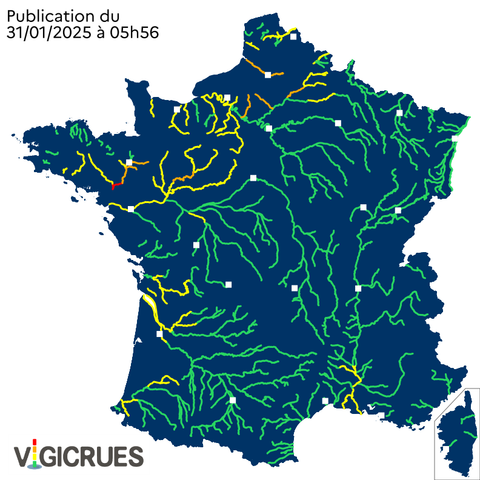
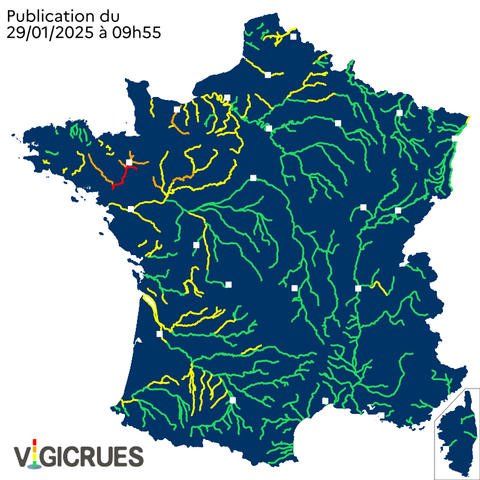
🔁 Vigicrues (@Vigicrues)

Maintien en #vigilanceRouge de #Vilaine aval, descente en #VigilanceOrange de #Vilaine médiane, et maintien de #Oise moyenne, #Thérain, #Somme, #Epte, #Vilaine amont, #Seiche, #Sarthe aval.
Restez informé sur http://www.vigicrues.gouv.fr et l'appli #Vigicrues.

🐦🔗 https://twitter.com/Vigicrues/status/1885192040301973585
🕐 31/01 06:03

Accueil - Carte de vigilance crues nationale : Vigicrues.gouv.fr

Carte de vigilance crues (prévision des inondations) : v1.9.0