Original study:
T. Fernández-Crespo et al., Large-scale #violence in Late #Neolithic Western #Europe based on expanded skeletal evidence from San Juan ante Portam Latinam, #SciReports 13, 2023. 🔓
https://www.nature.com/articles/s41598-023-43026-9

Large-scale violence in Late Neolithic Western Europe based on expanded skeletal evidence from San Juan ante Portam Latinam - Scientific Reports
This paper explores the nature and extent of conflict in Late Neolithic Europe based on expanded skeletal evidence for violence from the San Juan ante Portam Latinam rockshelter in present-day Spain (ca. 3380–3000 cal. BC). The systematic osteological re-examination has identified 65 unhealed and 89 healed traumas—of which 77 were previously undocumented—consistent with aggression. They affect 23.1% of the 338 individuals represented. Adolescent and adult males are particularly affected (44.9% of the 107 identified), comprising 97.6% of unhealed trauma and 81.7% of healed trauma recorded in individuals whose sex could be estimated and showing higher frequencies of injuries per individual than other demographic subgroups. Results suggest that many individuals, essentially men, were exposed to violence and eventually killed in battle and raids, since warriorship is mainly restricted to this demographic in many societies. The proportion of casualties is likely to have been far greater than indicated by the 10.1% individuals exhibiting unhealed trauma, given the presence of isolated cases of unhealed postcranial trauma and of arrowheads potentially having impacted into soft tissues. This, together with skeletal indicators of poor health and the possible socioeconomic outcomes evidenced in the region, suggest wider social impacts, which may relate to a more sophisticated and formalized way of warfare than previously appreciated in the European Neolithic record.
Original study:
J. Coppe et al., Terminal ballistic analysis of impact fractures reveals the use of #spearthrower 31 ky ago at Maisières-Canal, Belgium, #SciReports 13, 2023. 🔓
https://www.nature.com/articles/s41598-023-45554-w

Terminal ballistic analysis of impact fractures reveals the use of spearthrower 31 ky ago at Maisières-Canal, Belgium - Scientific Reports
The emergence of hunting technology in the deep past fundamentally shaped the subsistence strategies of early human populations. Hence knowing when different weapons were first introduced is important for understanding our evolutionary trajectory. The timing of the adoption of long-range weaponry remains heavily debated because preserved organic weapon components are extremely rare in the Paleolithic record and stone points are difficult to attribute reliably to weapon delivery methods without supporting organic evidence. Here, we use a refined use-wear approach to demonstrate that spearthrower was used for launching projectiles armed with tanged flint points at Maisières-Canal (Belgium) 31,000 years ago. The novelty of our approach lies in the combination of impact fracture data with terminal ballistic analysis of the mechanical stress suffered by a stone armature on impact. This stress is distinct for each weapon and visible archaeologically as fracture proportions on assemblage scale. Our reference dataset derives from a sequential experimental program that addressed individually each key parameter affecting fracture formation and successfully reproduced the archaeological fracture signal. The close match between the archaeological sample and the experimental spearthrower set extends the timeline of spearthrower use by over 10,000 years and represents the earliest reliable trace-based evidence for the utilization of long-distance weaponry in prehistoric hunting.
The first tool of all might've been a sling for the baby to keep their hands free - but then they reached for the #atlatl. 🙋♀️
M. Bebber et al., Atlatl use equalizes #female and male #projectile weapon #velocity, #SciReports 13, 2023. 🔓
https://www.nature.com/articles/s41598-023-40451-8
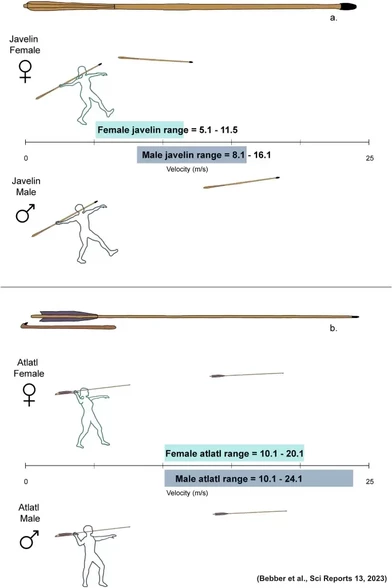

Atlatl use equalizes female and male projectile weapon velocity - Scientific Reports
The atlatl is a handheld, rod-shaped device that employs leverage to launch a dart, and represents a major human technological innovation. One hypothesis for forager atlatl adoption over its presumed predecessor, the thrown javelin, is that a diverse array of people could achieve equal performance results, thereby facilitating inclusive participation of more people in hunting activities. We tested this hypothesis via a systematic assessment of 2160 weapon launch events by 108 people who used both technologies. Our results show that, unlike the javelin, the atlatl equalizes the velocity of female- and male-launched projectiles. This result indicates that a javelin to atlatl transition would have promoted a unification, rather than division, of labor. Moreover, our results suggest that female and male interments with atlatl weaponry should be interpreted similarly.
Und die vollständige, in #SciReports 13, 2023 veröffentlichte Studie über "First osteological evidence of severed #hands in Ancient #Egypt" von Julia Gresky et al. kann online im open access hier gelesen werden:
https://www.nature.com/articles/s41598-023-32165-8

First osteological evidence of severed hands in Ancient Egypt - Scientific Reports
For the first time, the severed right hands of 12 individuals have been analysed osteologically. The hands were deposited in three pits within a courtyard in front of the throne room of a 15th Dynasty (c.1640–1530 BC) Hyksos palace at Avaris/Tell el-Dab‘a in north-eastern Egypt. Although this kind of practice is known from tomb or temple inscriptions and reliefs from the New Kingdom onwards, this is the first time that physical evidence has been used to learn more about the procedure and the individuals whose hands were taken. Here, we show that the right hands belonged to at least 12 adults, 11 males, and possibly one female. It is unclear if the hands were taken from dead or living individuals. After removing any attached parts of the forearm, the hands were placed in the ground with wide-splayed fingers, mainly on their palmar sides. The osteological analysis not only supports the archaeological interpretation of this evidence but also adds more detail regarding trophy-taking practices in Ancient Egypt.
 Jens Notroff
 DAI
DAI